Chemical Plant Lighting: Gas Groups, Corrosion and a Reactor Floor Layout
How to choose explosion-proof lighting for chemical plants: gas groups and temperature classes by chemical, corrosion, multi-floor reactor buildings and a 24 × 12 m example.
Key points
- A chemical plant often handles gases from all three groups, so one IIC fitting family simplifies spares, but IIB fittings are fine where the area drawing allows.
- Temperature class must cover the lowest auto-ignition temperature on site: diethyl ether needs T4, carbon disulphide T6.
- For a 24 × 12 m reactor floor with 6 m storey height and dark steelwork, 12 BED fittings of 100 W give about 196 lux by our lighting calculator.
- Corrosion, not ignition, is what usually ends a fitting's life in a chemical plant: specify the housing coating and stainless fasteners as carefully as the Ex marking.
Chemical plants are harder to light than refineries in one respect: they rarely handle just one substance. A single site can have hydrogen in one unit, ethylene in another and solvents in the tank farm, each with its own gas group and ignition temperature, all in an atmosphere that eats ordinary paint. This guide walks through how to choose fittings for that mix and works through a layout for a typical reactor floor.
Start with the substances, not the fitting
The area classification drawing tells you the zone. The process data sheets tell you the gas group and temperature class. Collect both before choosing anything. These examples, from the classification data in IEC 60079-20-1, show how wide the range can be in one plant:
| Substance | Gas group | Temperature class needed |
|---|---|---|
| Methanol, acetone, toluene | IIA | T1–T2 |
| Ethylene, ethylene oxide | IIB | T2 |
| Diethyl ether | IIB | T4 |
| Hydrogen | IIC | T1 |
| Acetylene | IIC | T2 |
| Carbon disulphide | IIC | T6 |
Two rules follow from the table. The gas group of the fitting must be equal to or higher than every gas in the area (IIC covers IIB and IIA). The temperature class must be at least as strict as the lowest-rated substance (T6 covers T1–T5). Our guides to IIB vs IIC gas groups and to T6 temperature class lighting explain both in more depth.
Zone 1 or Zone 2
Most of a chemical plant’s classified area is Zone 2: places where a release happens only in abnormal conditions, such as a flange leak. Zone 1 is found around sample points, open charging hatches, vents and pump seals that release in normal operation. A fitting marked Gb works in both, which is why many plants standardise on Gb everywhere instead of tracking two fitting types. The Zone 1 vs Zone 2 article explains the difference in protection level.
Matching our fittings to the plant
| Fitting | Marking | Where it fits |
|---|---|---|
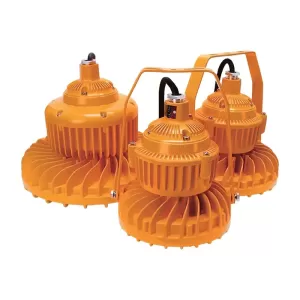
| BED series, 30–600 W | Ex db eb mb IIC T4 Gb; Ex tb IIIC T130 °C Db; IP65 | Indoor reactor floors and compressor houses with any gas group up to T4, also dust zones |
| BDE507, 20–70 W | Ex d IIC T6 Gb; IP66, WF2 | Small rooms, sample stations, and areas with T5/T6 substances such as carbon disulphide |
| ExF series, 50–150 W | Ex d IIB T6 Gb; IP67, WF2 | Outdoor pipe racks and tank areas where no IIC gas is present |
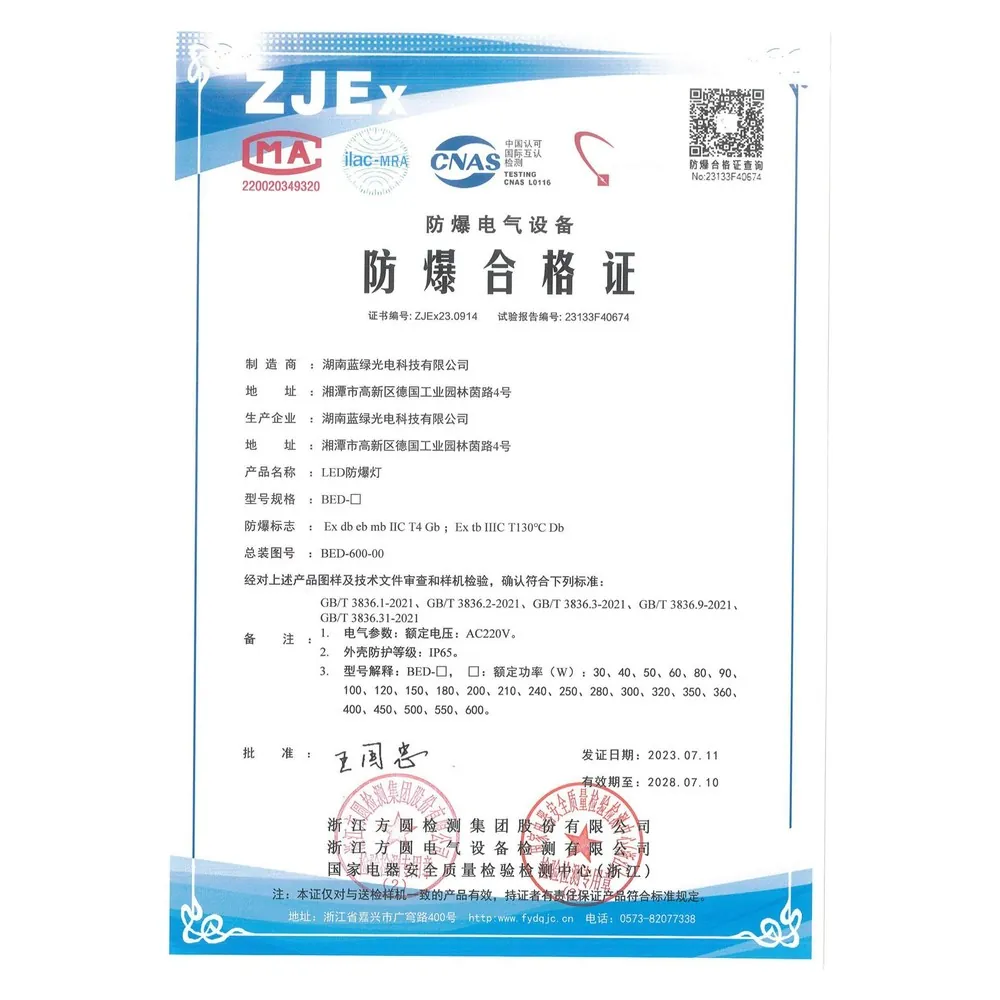
The BED is the one series covered by our own certificate (ZJEx23.0914, under GB 3836). Note its T4 limit: in a unit handling carbon disulphide, use the T6-rated BDE507 instead. For other models we supply the certificate that applies to each one with the quotation.
Worked example: a 24 × 12 m reactor floor
Reactor buildings are usually open-sided steel structures with grating floors, several storeys high. Take one floor: 24 × 12 m, 6 m from floor to the steel above, dark painted steelwork and vessels (low reflectance), target 150 lux at 0.8 m. The floor handles hydrogen, so the fitting must be IIC; the classification is Zone 2 with Zone 1 around the charging hatches.
Using the BED at 100 W and a conservative 110 lm/W, our lighting calculator gives:
| Result | Value |
|---|---|
| Room index | 1.54 |
| Utilisation factor | 0.53 (dark surfaces) |
| Fittings | 12 (4 × 3) |
| Spacing | 6.0 m × 4.0 m |
| Average illuminance | about 196 lux |
| Power density | 4.2 W/m² |
| Wattage that would just reach 150 lux | about 77 W |
Running the calculator again at 80 W shows why we did not go lower: the grid jumps to 15 fittings (5 × 3) to stay above 150 lux, which costs more in fittings, glands and cable than the 12 × 100 W layout saves in power.
In practice the grid moves to fit the steel. Fittings go on beams over walkways and at the operating faces of vessels, not over the vessels themselves, where light is blocked and maintenance access is poor. Add local fittings at instruments, sight glasses and manual valves that are shadowed by pipework; the average figure says nothing about the back of a heat exchanger.
Outdoor pipe racks and tank areas
Pipe racks need light for walking and for reading gauges, typically around 50–100 lux at ground level. Fittings mounted on the rack steel at 4–6 m, aimed along the walkway, work better than floodlights from far away, which leave the space under the rack in shadow. Where the rack carries no IIC gas, the ExF with its IP67 housing and WF2 corrosion rating is a good match. For larger tank areas see our tank farm lighting guide, and for comparable refinery practice the oil and gas plant lighting article.
Corrosion: the real life limit
The Ex marking gets most of the attention in a specification, yet in a chemical atmosphere corrosion is what usually forces replacement. Points to specify:
- Housing finish. Die-cast aluminium with a thick polyester or epoxy powder coat; ask for the salt spray hours or a corrosion grade such as WF2.
- Fasteners. Stainless steel for all exposed screws, including the bracket.
- Gaskets. Silicone resists most conditions; confirm compatibility where strong solvents or oxidisers are present.
- Glands and conduit. Nickel-plated brass or stainless glands, not plain brass, in acid atmospheres. Our guide to explosion-proof cable glands covers selection.
- Glass. Tempered glass resists most chemicals; polycarbonate covers can craze when exposed to solvents.
Emergency and escape lighting
Every escape route through a classified area needs emergency lighting that is itself rated for the zone. Self-contained explosion-proof emergency fittings at stair heads and exits are the simplest option; our explosion-proof emergency light guide covers duration and placement.
Reading the marking on site
Inspectors check that each installed fitting’s marking matches the drawing. Teach maintenance staff to read it: a fitting marked IIB T6 in a IIC area is wrong even though T6 is the strictest class. Our Ex marking guide decodes each part.
What to send us
- Area classification drawings with zones, gas groups and temperature classes
- Floor plans and heights for each building or structure
- The chemicals handled, if the drawing does not list them
- Supply voltage and any requirement for emergency lighting
We return a fitting schedule by area, calculated lux levels and the certificate for each model.
Sources
Frequently asked questions
What lighting is required in a chemical plant?
Fittings certified for the zone, gas group and temperature class shown on the area classification drawing, plus emergency lighting on escape routes. Outside the classified areas, ordinary industrial fittings can be used if they resist the plant's corrosive atmosphere.
Is IIB enough for a chemical plant?
Only where the drawing shows no IIC gases. Hydrogen, acetylene and carbon disulphide are IIC; many plants have hydrogen somewhere, for example in hydrogenation units or electrolysers. If in doubt, a IIC fitting covers all gas groups.
What lux level does a reactor floor need?
Plants commonly use about 100 lux on walkways and 150–200 lux on operating floors and at control points; EN 12464-2 lists values for outdoor process areas. Local readings at gauges and valves matter more than the average.
Why do fittings corrode so quickly in chemical plants?
Acid vapours, chlorides and solvent residues attack powder coatings, gaskets and plain steel screws. Look for marine-grade coatings, a corrosion rating such as WF2, stainless fasteners and gaskets compatible with the chemicals present.