Tank Farm Lighting: Explosion-Proof Tank Lights, Bund Floodlighting and Pump Shelters
How to light a fuel tank farm: zones around vents and inside the bund, floodlights from outside the dike, tank-top gauging lights, and a pump-shelter layout from our lighting calculator.
Key points
- Around a fixed-roof tank, API RP 500 typically shows Division 1 within 5 ft (1.5 m) of the vent and Division 2 out to 10 ft (3 m), with the bund up to the top of the dike also Division 2.
- The cheapest safe layout puts floodlights on masts outside the bund, aimed in, so most fittings are outside the classified area.
- Tank-top platforms, gauging hatches and stair landings still need small Ex fittings, because floodlights cannot light them from below.
- A 15 × 8 m pump shelter at 100 lux needs 6 explosion-proof fittings of 50 W by our lighting calculator.
A tank farm is mostly empty ground with tall steel cylinders on it. Lighting it looks simple, but the zones around vents, the bund walls and the height of the tanks make the layout easy to get wrong. This guide explains where the zones sit, where the lights should go, and how many fittings a typical pump shelter needs.
Where the zones are
The area classification drawing decides everything, but a typical pattern from API RP 500 for a fixed-roof tank holding a flammable liquid looks like this:
| Location | Typical classification |
|---|---|
| Within 5 ft (1.5 m) of a vent or open hatch | Division 1 (Zone 1) |
| From 5 to 10 ft (1.5–3 m) around the vent | Division 2 (Zone 2) |
| Inside the bund, from ground up to the top of the dike wall | Division 2 (Zone 2) |
| Pump stations and manifolds | Division 2 (Zone 2), Division 1 in pits and sumps |
| Open ground beyond the bund and zones | Unclassified |
Floating-roof tanks have their own pattern, with the space above the floating roof inside the shell usually the most hazardous. Our guide to the Class/Division and Zone systems explains how the two naming systems match, and Zone 1 vs Zone 2 lighting compares the fittings each zone accepts.
The layout rule: light from outside, aim in
The most economical tank farm layouts follow one rule: keep as many fittings as possible outside the zones.
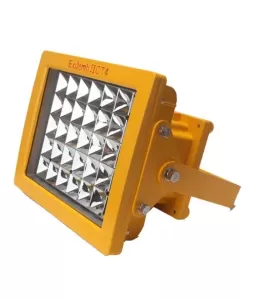
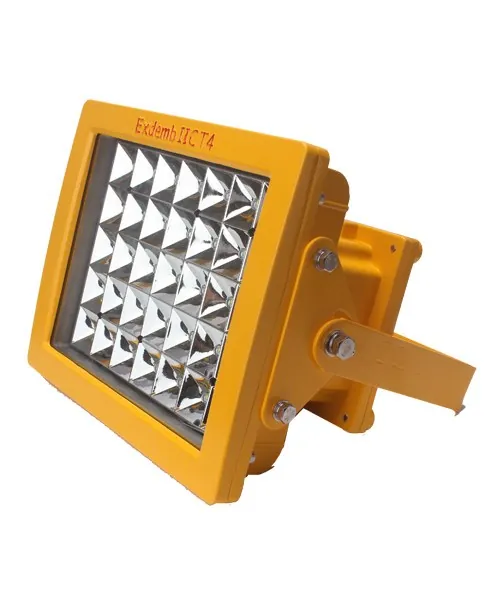
- Floodlights on masts outside the bund. Put masts beyond the dike wall and outside any zone, and aim floodlights across the bund. Standard floodlights can then be used, which costs less and is easier to maintain.
- Ex floodlights only where a mast must stand inside. Large bunds sometimes need a mast inside to avoid long throws and shadows behind tanks. Fittings there need an Ex rating for the zone at their height.
- Small Ex fittings at tank tops and stairs. No floodlight from the ground lights a gauging hatch or a stair landing 15 m up. These need local fittings, and because they sit close to vents they usually need a Zone 1 rating.
Because the bund zone stops at the top of the dike, a floodlight mounted well above the dike and away from vents is often outside the zone even on a mast inside the bund. Check the drawing; do not assume it.
Bund floodlighting: a quick estimate
Take a bund 60 × 40 m with a target of 20 lux on the ground. Using the lumen method by hand:
- Area: 60 × 40 = 2,400 m²
- Lumens needed on the ground: 2,400 × 20 = 48,000 lm
- A 200 W BAD8599 at 120 lm/W gives 24,000 lm
- Assume 40 % of each floodlight’s output lands on the bund floor (floods aimed across from the edge lose light over the walls and on tank shells) and a maintenance factor of 0.8: 24,000 × 0.4 × 0.8 = 7,680 lm per fitting
- 48,000 ÷ 7,680 = 6.25, so 7 fittings, rounded up to 8 for four masts of two
The 40 % figure is our planning assumption, not a measurement. Tanks cast long shadows, so the final layout must be checked with a point-by-point calculation using the floodlight’s photometric file. Our explosion-proof flood lights guide covers beam choice for long throws.
Tank tops and gauging points
Operators climb tanks to dip, sample and inspect. The light they need is local:
- Stair landings and the top of the stair: one small fitting per landing, on the stair side away from the vent.
- Gauging hatch and sampling point: one fitting aimed at the hatch, mounted so the operator does not stand in its glare.
- Roof walkway on large tanks: fittings every 6 to 8 m along the handrail.
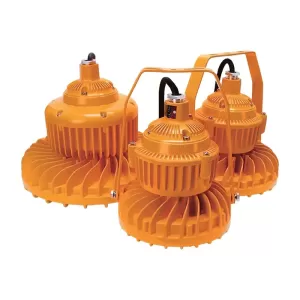
For these points our BDE507 (20–70 W, Ex d IIC T6 Gb, IP66, WF2) is the usual choice; 30 W is enough for a landing. Mount it on the handrail with a stainless bracket and route the cable through a sealed gland. Our installation guide covers glands and stopping boxes.
Worked example: a 15 × 8 m pump shelter
Pump stations need more light than open bund areas, because operators read gauges, open valves and check seals. Take an open-sided shelter 15 × 8 m with lights at 5 m, a target of 100 lux on the ground, and dark surroundings. With a 50 W BAD8599 at 120 lm/W, our lighting calculator gives:
| Result | Value |
|---|---|
| Room index | 1.04 |
| Utilisation factor | 0.45 |
| Fittings | 6 (3 × 2) |
| Spacing | 5.0 m × 4.0 m |
| Average illuminance | about 108 lux |
| Power density | 2.5 W/m² |
The calculator also shows that about 46 W per fitting would reach 100 lux on the same grid, so the 50 W version has a small margin for lumen depreciation. Pumps in pits or below grade sit in Division 1, so check the rating at the height of every fitting.
Corrosion and weather
Tank farms are often near the sea or rivers, and the air carries salt and hydrocarbon vapour.
- Specify a corrosion grade of WF2 for outdoor fittings near the coast. The BAD8599 and BDE507 both list WF2 options.
- Use stainless brackets and fixings; galvanised steel rusts at cut edges.
- Seal unused cable entries with certified stopping plugs.
Our article on explosion-proof IP ratings explains why IP66 matters for spray and washdown.
Controls
Tank farms are usually unmanned at night. Common controls:
- photocell or astronomical timer for mast floodlights;
- local switches at pump shelters, with the switch itself Ex rated if it sits in a zone;
- emergency lighting on stairways and escape routes, rated for the zone.
Fuel stations and loading racks
Smaller sites follow the same logic. We supplied forecourt lighting for a Sinopec petrol station in Xiangtan, where fittings close to dispensers and vents must suit their zone while those further away can be standard. Our oil and gas plant lighting guide has a loading-rack example.
What to send us
- Plot plan with tanks, bunds and mast positions
- Area classification drawing
- Target lux levels per area
- Supply voltage and whether low-voltage fittings are required
- Distance to the coast or corrosive sources
With these we will return a fitting list, a mast layout and a check of which fittings need an Ex rating and which do not.
Sources
Frequently asked questions
Do all lights in a tank farm need to be explosion-proof?
No. Only fittings inside a classified zone must be Ex rated. Floodlights on masts outside the bund and beyond the zones can be standard IP66 floodlights, as long as the area drawing confirms it.
What are explosion-proof tank lights?
The term covers small Ex fittings on tank-top platforms and gauging points, and floodlights aimed at tank shells. Fittings near vents and hatches sit in the most hazardous zone and need a rating for it, typically Zone 1 or Division 1.
How much light does a tank farm need?
Many company specifications use about 20 lux for general bund areas, 50 to 100 lux at pump stations and manifolds, and higher local levels at gauging and sampling points. Your client's standard decides the values.
Which of your lights suit a tank farm?
The BAD8599 floodlight (50–600 W, Ex d IIC T6 Gb, IP66, WF1/WF2) for aimed lighting inside zones, the BDE507 (20–70 W, Ex d IIC T6 Gb) for tank tops and stairs, and standard LED floodlights for masts outside the zones.