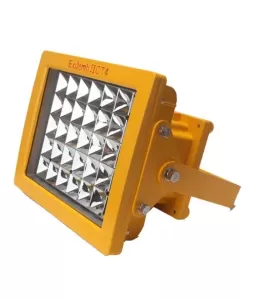
Explosion-Proof Flood Lights: Sizing a Tank Farm or Loading Area, Marking and Mounting
Choosing explosion-proof LED flood lights: a 60 × 30 m loading area at 20, 50 and 100 lux, what the Ex marking must match, and mounting and cable glands.
Key points
- Hazardous outdoor areas are lit with flameproof floodlights on masts, structures or pipe racks; the marking must match the zone, the gas group and the temperature class.
- With 120 lm/W fittings, a utilisation factor of 0.45 and a maintenance factor of 0.7, a 60 × 30 m loading area needs about 5 × 200 W at 20 lux, 12 × 200 W at 50 lux or 16 × 300 W at 100 lux.
- Replacing twelve 400 W metal halide floodlights with 200 W LED, lit 12 hours a night, saves about 13,700 kWh a year.
- Use certified cable glands, keep the bracket and aiming within the certificate, and choose WF2 corrosion protection near the sea or chemical vapour.
Most of a refinery, tank farm or chemical plant is lit from above: floodlights on masts, on the tops of tank walls, on pipe racks and on the canopies of loading bays. Where those positions are inside a classified hazardous area, the floodlight must be certified for it. That makes the choice a little different from an ordinary floodlight: the marking comes first, and the light level is planned around fewer, well-placed positions where cabling and maintenance are possible. This guide covers both, with a worked example.
Start with the marking
A floodlight in a hazardous area must match three things on the area classification drawing:
- The zone, which sets the equipment protection level: Gb or better for Zone 1, Gc or better for Zone 2; Db for Zone 21 dust.
- The gas group: IIA, IIB or IIC. IIC, which includes hydrogen and acetylene, covers the other two. See our guide to gas groups IIB and IIC.
- The temperature class: T1 to T6. The floodlight’s maximum surface temperature must stay below the ignition temperature of every gas present. See T3 vs T4.
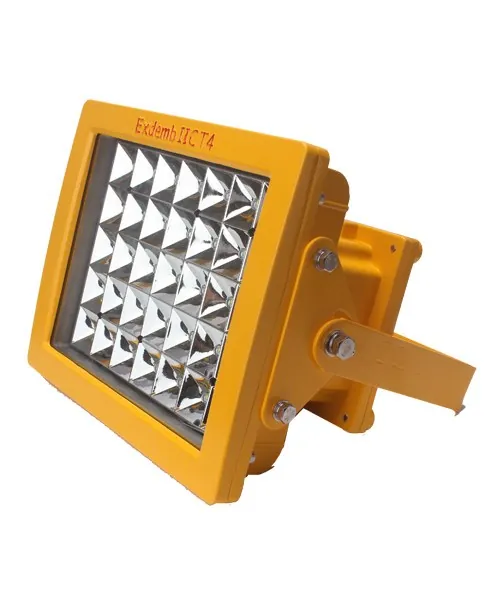
A floodlight marked Ex d IIC T6 Gb, such as our BAD8599 explosion-proof LED floodlight, covers Zone 1 and 2, every gas group and every temperature class. Its certificate is supplied with the quotation. Our own certified series, the BED explosion-proof LED light, is marked Ex db eb mb IIC T4 Gb under certificate ZJEx23.0914 and covers 30–600 W. The difference between these protection types is explained in our article on explosion-proof vs flameproof.
Worked example: a 60 × 30 m loading area
Take a road tanker loading area of 60 × 30 m, lit from the canopy edges and two masts. The light level depends on the operator’s standard and the task; we show three common targets. We used the lumen method with:
- floodlights of 120 lm/W, the minimum rated efficacy of the BAD8599;
- a utilisation factor of 0.45, typical for floodlights aimed from the edges of an area;
- a maintenance factor of 0.7, lower than in a clean building, because lenses on process plants collect dust, oil mist and salt.
Lights = target lux × area ÷ (watts × 120 × 0.45 × 0.7)
| Floodlight | 20 lux (general area, walkways) | 50 lux (loading, connection points) | 100 lux (detailed work) |
|---|---|---|---|
| 150 W | 7 | 16 | 32 |
| 200 W | 5 | 12 | 24 |
| 300 W | 4 | 8 | 16 |
| 400 W | 3 | 6 | 12 |
The table gives the order of magnitude. The real count depends on how many mounting positions the structure offers. Fewer, larger floodlights mean fewer certified junction boxes and glands, but deeper shadows behind tanks and vehicles. Around loading arms, valves and ladders, light from two directions is worth more than extra watts from one. EN 12464-2 lists light levels for outdoor workplaces, including petrochemical areas, and many oil companies have their own standards.
For a full loading-rack design with canopy fittings, see our explosion-proof high bay guide for the indoor equivalent and Class 1 Division 1 lighting for NEC sites.
Replacing metal halide floodlights
Older plants often use 400 W metal halide floodlights in flameproof housings. Twelve of them, drawing about 460 W each with the ballast and lit 12 hours a night, replaced by 200 W LED floodlights in our LED retrofit savings calculator:
| Item | Metal halide | LED |
|---|---|---|
| Energy per year | 24,178 kWh | 10,512 kWh |
| Saving | 13,666 kWh (57%) |
The cost inputs in the calculator are placeholders; enter your own quotation. In hazardous areas the bigger gain is often maintenance: every lamp change on a flameproof floodlight needs a work permit, gas testing, scaffolding or a lift, and a check of the flame paths before closing the housing. An LED floodlight rated for 100,000 hours removes most of those visits.
Mounting and aiming
- Use the certified bracket. The BAD8599 has a thick aluminium U-bracket with stainless steel screws, and its certificate covers the fitting as supplied. Drilling the housing or adding unapproved brackets voids the certification.
- Aim downwards. Keep the beam below about 60–70° from vertical to limit glare for drivers and operators climbing tanker ladders.
- Mounting height. The BAD8599 is specified for 2.5–15 m depending on power. Higher positions give more even light but harder maintenance; plan access with the maintenance team.
- Vibration. On pipe racks and near pumps, secure the bracket with locking washers and check it at each inspection.
Cables and glands
The cable entry is where many hazardous-area installations fail inspection. Use cable glands certified for the same protection type and gas group as the floodlight, sized for the cable (the BAD8599 takes G3/4″ entries for 10–14 mm cable), and seal unused entries with certified stopping plugs. Junction boxes in the zone need their own certification. Our explosion-proof light installation guide covers glands, earthing and inspection in more detail.
Corrosion
Tank farms and terminals near the coast, and plants with chlorine, ammonia or acid vapour, attack aluminium and steel quickly. Specify WF2 corrosion protection for these sites, stainless fixings and a coating suited to the chemicals present. Our guide to WF1 vs WF2 corrosion ratings explains the difference.
Supply voltage and emergency lighting
Most explosion-proof floodlights run on AC 220–240 V. The BAD8599 also accepts AC/DC 90–265 V, with 24 V and 36 V versions for mines and special supplies. Escape routes on process plants need emergency lighting; certified explosion-proof emergency fittings or floodlights with backup are used where the escape route crosses a zone.
What to send for a design
Send the area classification drawing, the gas group and temperature class, the dimensions of the area, the mounting positions available and the light level your standard requires. We will return the floodlight count and wattage, a photometric calculation and a quotation with the certificate for each fitting.
Sources
Frequently asked questions
What is an explosion-proof flood light?
A floodlight whose housing is certified for use in a flammable gas or dust atmosphere, usually as flameproof (Ex d), so that a fault inside cannot ignite the atmosphere outside. It is used in refineries, tank farms, loading racks, chemical plants and mines.
How many explosion-proof flood lights do I need for a loading area?
Use the lumen method: lights = lux × area ÷ (lumens per light × utilisation factor × maintenance factor). For a 60 × 30 m area at 50 lux with 200 W, 120 lm/W fittings, a utilisation factor of 0.45 and a maintenance factor of 0.7, the answer is about 12.
What temperature class do explosion-proof flood lights need?
The class of the area, set by the gases present. T4 (135 °C) covers most hydrocarbons including petrol vapour, propane and hydrogen; carbon disulphide needs T6. The floodlight's marking must be equal to or better than the area's class.
Can I use explosion-proof flood lights in Zone 2?
Yes. A floodlight certified for Zone 1 (equipment protection level Gb) is also accepted in Zone 2. The reverse is not allowed.