
ATEX T3 vs T4: Temperature Classes for Explosion-Proof Lights Explained
ATEX temperature classes T1 to T6 in one table: T3 is 200 °C, T4 is 135 °C. Which gases need which class, the effect of ambient heat, and a real T4 marking.
Key points
- The T class is the highest surface temperature the light can reach: T3 is 200 °C, T4 is 135 °C, T6 is 85 °C.
- A lower limit is the stricter one, so a T4 light may be used wherever T3, T2 or T1 is required, but not the other way round.
- The class must sit below the ignition temperature of the gas: petrol and diesel vapours need T3 or better, diethyl ether and acetaldehyde need T4.
- The class is only valid inside the ambient range on the nameplate, normally −20 °C to +40 °C unless a wider range is marked.
- Dust markings use a temperature in degrees instead of a class, for example T130 °C on our BED series.
Every explosion-proof light carries a temperature class, written T1 to T6 near the end of the marking. It answers one question: how hot can any surface of the light get? If that temperature is higher than the temperature at which the surrounding gas ignites by itself, the light can start a fire without any spark at all. This guide explains the six classes, compares T3 and T4, and shows how to match the class to the gas on your site.
The six classes
| Class | Maximum surface temperature | Meaning in practice |
|---|---|---|
| T1 | 450 °C | Least strict |
| T2 | 300 °C | |
| T3 | 200 °C | Common requirement in fuel handling |
| T4 | 135 °C | Common rating of LED explosion-proof lights |
| T5 | 100 °C | |
| T6 | 85 °C | Strictest |
The numbering runs the opposite way to what many people expect. A higher T number means a cooler light. A T4 light is therefore suitable for any place that asks for T1, T2, T3 or T4. A T3 light is not suitable where T4 is required.
North American T-codes use the same six main values and add intermediate steps such as T2A or T3C. A light marked T3C, for example, is limited to 160 °C.
T3 vs T4 side by side
| T3 | T4 | |
|---|---|---|
| Surface limit | 200 °C | 135 °C |
| Covers gases that ignite above | 200 °C | 135 °C |
| Typical substances | Petrol, diesel, kerosene, most solvents | The same, plus diethyl ether and acetaldehyde |
| Effect on the light | Higher wattage possible in a given housing | Cooler running; larger housing for the same wattage |
| Can replace the other? | No, not in a T4 area | Yes, in a T3 area |
For most oil, gas and chemical sites the area classification asks for T3. T4 gives a margin and covers a few more substances, which is why many LED lights are certified T4: LEDs waste less energy as heat than the old discharge lamps, so 135 °C is achievable at useful wattages.
Which gases need which class
The rule is simple: the class limit must be below the auto-ignition temperature of every gas or vapour that may be present.
| Substance | Approximate auto-ignition temperature | Minimum class |
|---|---|---|
| Hydrogen | about 560 °C | T1 |
| Methane (natural gas) | about 540–600 °C | T1 |
| Ethylene | about 425–450 °C | T2 |
| Acetylene | about 305 °C | T2 |
| Petrol, diesel, kerosene | about 210–280 °C, depending on grade | T3 |
| Diethyl ether | about 160–175 °C | T4 |
| Acetaldehyde | about 155–175 °C | T4 |
| Carbon disulphide | about 90–100 °C | T6 |
These figures vary with the source and the test method, so always use the value in the safety data sheet and the site’s area classification, not a general table. Note that the temperature class has nothing to do with how easily a gas is lit by a spark. Hydrogen needs only T1, yet it is in the most demanding gas group, IIC. The two ratings are separate and both must be satisfied. Our guide to explosion-proof light ratings shows the whole marking.
Ambient temperature
The surface temperature is measured with the light running at its rated power in the highest ambient temperature it is certified for. Unless the nameplate says otherwise, that range is −20 °C to +40 °C.
If the air around the light is hotter than the certified ambient, every surface is hotter too, and the class no longer holds. This matters:
- under roofs and in pipe racks in hot climates;
- near furnaces, dryers and boilers;
- inside enclosures or canopies with poor air movement.
For those places, look for a marking such as “−40 °C ≤ Ta ≤ +55 °C”. The same light often has a lower wattage limit, or a less strict class, at the higher ambient. Ask for the table that shows class against ambient and wattage.
Dust: degrees instead of a class
For dust areas the marking gives the maximum surface temperature directly, for example T130 °C. Dust is different from gas because it settles on the light, acts as a blanket and can smoulder.
The usual selection rules in IEC 60079-14 are:
- the surface temperature must not exceed two-thirds of the ignition temperature of the dust cloud;
- it must be at least 75 K below the smouldering temperature of a 5 mm dust layer.
For a light marked T130 °C, the dust cloud must therefore ignite above 195 °C, and a 5 mm layer must smoulder above 205 °C. Thicker layers need a larger margin, which is one reason housekeeping matters in grain, flour, sugar and coal plants.
A real marking
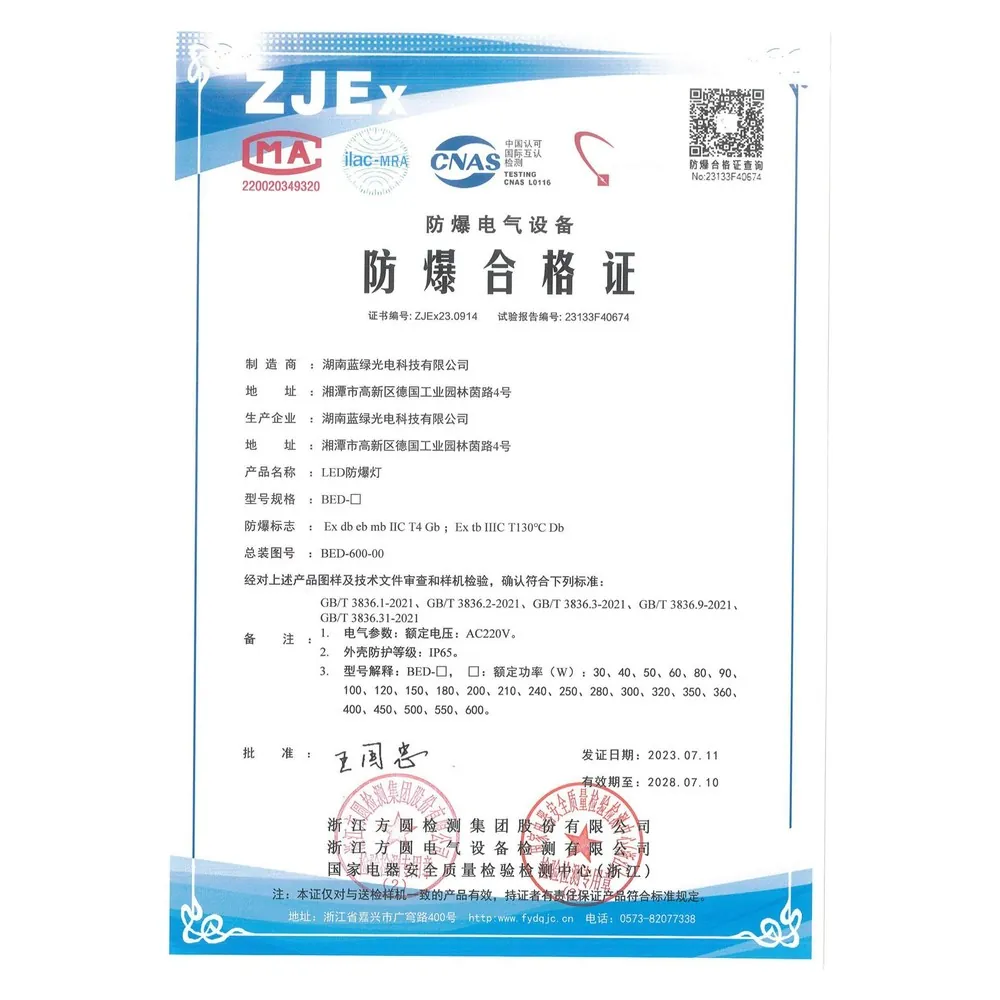
Our BED explosion-proof LED light is certified, under certificate ZJEx23.0914:
- gas: Ex db eb mb IIC T4 Gb
- dust: Ex tb IIIC T130 °C Db
Reading only the temperature parts: T4 means no surface above 135 °C, so the series can be used with gases that need T1 to T4, in Zone 1 and Zone 2. T130 °C is the dust limit used in the two rules above. The series runs from 30 W to 600 W, on AC 220 V, with IP65 protection. The certificate is valid from 11 July 2023 to 10 July 2028.
This is the certificate for the BED series only. For our other explosion-proof series, we confirm the marking and the certificate with the quotation.
How to choose
- Take the temperature class from the hazardous area classification of the site. If there are several gases, the lowest ignition temperature decides.
- Check the ambient temperature where the light will hang, not the weather forecast.
- Choose a light whose class is equal to or stricter than the requirement, at that ambient.
- Check the gas group and the zone separately. See ATEX explosion-proof lights for the other parts of the marking.
- For dust, apply the two-thirds and 75 K rules to the dust on your site.
Common mistakes
| Mistake | Result |
|---|---|
| Reading T6 as “hotter” than T3 | Wrong light ordered |
| Asking for T6 everywhere “to be safe” | Few suitable lights, higher cost, no extra safety |
| Ignoring a hot ambient | The certified class does not apply |
| Using the gas class for a dusty area | Dust layers can smoulder below the gas limit |
| Changing the lamp or driver wattage on site | The certified surface temperature is no longer valid |
Maintenance and the T class
The class is tested on a clean light. A thick layer of dust or paint on the housing holds heat in. Keep the fins clean, do not paint the housing, and replace drivers and LED modules only with the parts named by the maker. For the selection steps as a whole, see our explosion-proof LED lights buying guide.
Ordering
Tell us the zone, the gas group, the temperature class, the highest ambient temperature and the mounting height. We will confirm which series covers the requirement and send the certificate with the quotation.
Sources
Frequently asked questions
What is the difference between ATEX T3 and T4?
T3 allows a maximum surface temperature of 200 °C, T4 allows 135 °C. A T4 light runs cooler, so it can be used with more substances. Any T4 light is also acceptable where the area only needs T3.
Is T4 better than T3?
It is stricter, not better in every way. T4 covers more gases, but a T4 design of the same size usually has a lower wattage limit, because the housing must stay cooler. Choose the class the area classification asks for.
What does T6 mean on an explosion-proof light?
The surface never exceeds 85 °C under the test conditions. T6 is needed for only a few substances, such as carbon disulphide. Asking for T6 when the site needs T3 limits your choice of lights without adding safety.
Does a hot site change the temperature class?
Yes. The class is tested at the maximum ambient on the nameplate, normally 40 °C. In a hotter place, such as above a furnace or in a desert plant, the light needs a marking with a higher ambient, for example Ta up to 55 °C.
