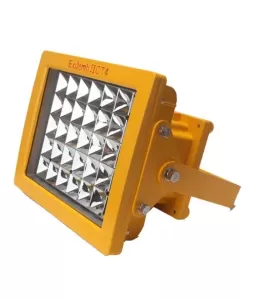
Group I vs Group II Explosion-Proof Equipment: Mining Lights vs Surface Industry
What Group I, II and III mean on explosion-proof lights, why a Group II light is not for underground coal mines, and how mine surface plants are lit.
Key points
- Group I is for mines susceptible to firedamp (methane and coal dust underground); Group II is for explosive gas atmospheres elsewhere; Group III is for combustible dust.
- A light marked IIA, IIB or IIC is Group II and must not be used underground in a gassy coal mine; that needs Group I equipment with EPL Ma or Mb.
- IEC 60079-0 limits light metals such as aluminium in Group I enclosures, so most die-cast aluminium LED fittings, including ours, are Group II only.
- Mine surface plants, such as methane drainage stations, coal preparation and conveyors, are classified under Group II and III and can use Group II and III fittings.
Explosion-proof markings start with a symbol and a group. Most buyers focus on the gas group letter, IIA, IIB or IIC, but the Roman numeral in front of it matters just as much. It tells you whether the equipment is meant for mines or for the rest of industry. Mixing the two is one of the more serious specification errors in hazardous-area lighting.
The three equipment groups
IEC 60079-0 divides equipment for explosive atmospheres into three groups:
| Group | For | Subgroups | Equipment protection levels |
|---|---|---|---|
| I | Mines susceptible to firedamp (methane, coal dust underground) | None | Ma, Mb |
| II | Explosive gas atmospheres other than mines | IIA, IIB, IIC | Ga, Gb, Gc |
| III | Combustible dust atmospheres | IIIA, IIIB, IIIC | Da, Db, Dc |
ATEX follows the same logic with Group I (mining) and Group II (surface industries), using categories M1 and M2 for mining equipment. Our guide on how to read an Ex marking shows where the group sits in a full marking.
Why mining has its own group
Underground coal mines combine hazards that surface industry rarely sees together:
- Firedamp: methane released from coal seams, which can reach explosive concentrations suddenly.
- Coal dust: deposited on every surface and easily raised into a cloud by a methane explosion, turning a small ignition into a major one.
- Mechanical abuse: falling rock, impact from machinery, water and confined spaces.
- Rescue limits: escape is slow, so preventing ignition has to be very reliable.
Group I requirements reflect this. Two examples from IEC 60079-0:
- Surface temperature: limited to 150 °C where coal dust can form a layer, and 450 °C where it cannot. There is no temperature class; the limit is fixed for the group.
- Materials: Group I enclosures have limits on aluminium, magnesium, titanium and zirconium content, because a blow against a light-alloy surface can produce incendive sparks.
Mechanical tests for Group I are also stricter than for Group II.
Why our fittings are Group II
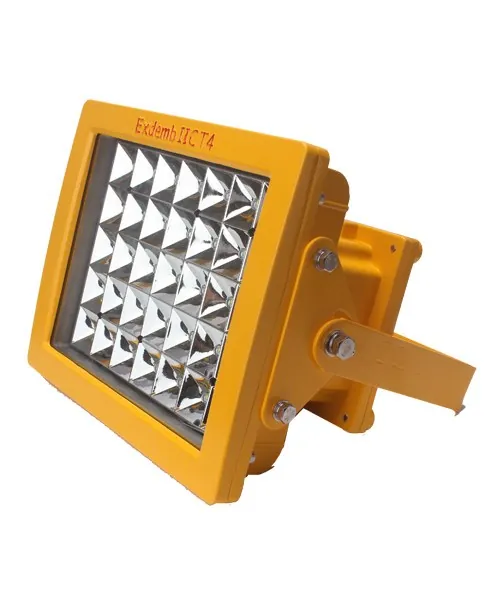
Our explosion-proof lights are die-cast aluminium. That gives good heat dissipation and light weight, but it puts them in Group II and III. Their markings show it:
| Model | Marking | Groups |
|---|---|---|
| BED series | Ex db eb mb IIC T4 Gb; Ex tb IIIC T130 °C Db | II and III |
| BAD8599 floodlight | Ex d IIC T6 Gb; Ex tD A21 IP66 T80 °C | II and III |
| BDE507 | Ex d IIC T6 Gb | II |
| ExF series | Ex d IIB T6 Gb | II |
None of these is Group I equipment, so none should be installed underground in a mine where firedamp can occur. The BAD8599 is offered with DC 24 V and AC/DC 36 V supplies, which some mine sites require for safety reasons on the surface; the low voltage does not change the group. Our guide to 24 V explosion-proof lights explains where low-voltage fittings are used.
In China, equipment for underground coal mines also needs a coal mine safety mark in addition to the explosion-proof certificate. Other mining countries have similar additional approvals.
Where Group II fittings do belong at a mine
A mine is much more than its underground workings. The surface plant is classified under the normal Group II and III rules:
- Methane drainage and utilisation stations: gas pumped from the seams is methane, group IIA, handled at the surface in Zone 1 or Zone 2.
- Coal preparation plants, crushers and conveyors: combustible dust, Zone 21 or Zone 22, group IIIB or IIIC depending on the dust. Our guide to coal handling plant lighting covers these areas.
- Fuel stores and workshops: diesel and lubricant stores, battery charging rooms.
- Non-coal mines: metal and mineral mines without firedamp are often classified under Group II where there is any gas hazard, or are not hazardous at all. The site’s area study decides.
Worked example: a methane drainage pump house
A surface pump house for a methane drainage system is 20 × 12 m with fittings at 5 m. The area study classifies it Zone 2, group IIA, T1. Target: 100 lux on the floor, with dark surroundings (equipment and pipework absorb light). Using the BAD8599 at 50 W and 120 lm/W, our lighting calculator gives:
| Result | Value |
|---|---|
| Room index | 1.5 |
| Utilisation factor | 0.53 |
| Fittings | 12 (4 × 3) |
| Spacing | 5.0 m × 4.0 m |
| Average illuminance | about 127 lux |
| Power density | 2.5 W/m² |
| Wattage that would just reach 100 lux | about 39 W |
The BAD8599’s IIC T6 marking is far more than IIA T1 requires, which is fine: a higher group and temperature class can always be used in a lower one. The opposite is never allowed. Place fittings to light pump seals, valves and gauges, and add an explosion-proof emergency light near each exit.
Common mistakes
- Reading “mining” in an application list as Group I. Some product sheets list “mines” as an application for Group II fittings, meaning surface plant or non-gassy mines. The marking is what counts.
- Assuming IIC is the highest rating. IIC is the highest Group II subgroup. It says nothing about Group I suitability.
- Forgetting dust. A methane-only rating is not enough in a coal preparation plant; check the Group III marking as well.
- Ignoring local mining approvals. Group I equipment usually needs a national mining approval in addition to its Ex certificate.
How the groups fit with zones
| Location | Group | Typical EPL |
|---|---|---|
| Underground coal face, gassy | I | Ma or Mb |
| Underground roadways in a gassy coal mine | I | Mb |
| Surface methane drainage station | II (IIA) | Gb or Gc |
| Coal preparation plant | III (IIIB/IIIC) | Db or Dc |
| Refinery, chemical plant | II | Ga, Gb or Gc |
Our article on explosion-proof light ratings covers zones and EPLs in more detail.
What to send us
- Whether the installation is underground or on the surface
- The area classification, group and zone
- Supply voltage required on site
- Any national mining approvals required
For surface plant we can propose fittings and layouts; for underground coal mines we will tell you plainly that our range is not Group I equipment.
Sources
Frequently asked questions
What is the difference between Group I and Group II explosion-proof?
Group I equipment is for underground parts of mines and their surface installations endangered by firedamp. Group II is for explosive gas atmospheres in all other places, subdivided into IIA, IIB and IIC. Group III covers combustible dust.
Can I use a IIC light in a coal mine?
Not underground where firedamp can occur. IIC is a Group II marking. Underground coal mines need Group I equipment (marked I, with EPL Ma or Mb), and in some countries an additional mining approval.
Are your explosion-proof lights suitable for mines?
Our fittings carry Group II and, for some models, Group III dust markings. They suit mine surface plants and non-coal sites classified under those groups. They are not Group I equipment for underground coal mines.
Why can't aluminium be used in mining equipment?
IEC 60079-0 limits aluminium, magnesium, titanium and zirconium in Group I enclosures, because a struck light-alloy surface can produce hot sparks, especially with rusty steel. Mining fittings therefore usually use steel, stainless steel or approved low-alloy materials.