24V Explosion-Proof Lights: When to Use Low Voltage and How Far the Cable Can Run
When a 24 V or 36 V explosion-proof light makes sense (tanks, wet areas, mines, battery systems), and why voltage drop limits cable runs to tens of metres. Worked voltage-drop tables included.
Key points
- Low-voltage explosion-proof lights are chosen for electric-shock safety in wet or conductive spaces such as tanks and vessels, for battery or solar systems, and where site rules require extra-low voltage.
- Low voltage does not make a light intrinsically safe: a 24 V fitting in a hazardous area still needs an Ex rating for the zone.
- At 24 V a 50 W fitting draws about 2.1 A, so a 2.5 mm² cable loses 5 % of the voltage in about 42 m; at 220 V the same cable could run over 3 km.
- Four 30 W fittings on one 24 V circuit lose 10 % on 2.5 mm² cable but 4.2 % on 6 mm², by our calculation.
Most explosion-proof lights run on 110–240 V AC. A few jobs call for 24 V or 36 V instead, and buyers are often surprised by what changes when they do. This guide explains when low voltage makes sense, what it does and does not change about the Ex rating, and how voltage drop limits the cable length.
Why choose low voltage
| Reason | Typical places |
|---|---|
| Electric-shock protection in wet or conductive spaces | Inside tanks, boiler drums, vessels, pits, ship holds |
| Site rule requiring extra-low voltage for hand-held or temporary lights | Shutdowns and turnarounds in refineries and chemical plants |
| Supply is already low voltage | Battery banks, solar systems, vehicles and mobile plant |
| Simpler insulation and earthing in harsh areas | Some mining and tunnelling equipment |
The safety benefit is about shock, not explosion. IEC 60364-4-41 defines extra-low voltage systems (SELV and PELV) that limit voltage to levels unlikely to cause a dangerous shock, which is why many sites require them inside metal tanks where a worker is surrounded by earthed steel. Our confined space lighting guide covers that use in detail.
What low voltage does not change
A 24 V light inside a hazardous zone must still carry an Ex rating for that zone:
- It is not intrinsically safe. Intrinsic safety (Ex i) limits energy in the entire circuit through certified barriers and equipment. A 24 V LED floodlight draws amps, not milliamps, and its driver stores energy that can ignite gas.
- It uses the same protection methods. Our 24 V versions are flameproof (Ex d), the same as the mains versions.
- Gas group and temperature class rules are unchanged. Our guide on intrinsically safe vs explosion-proof explains the difference.
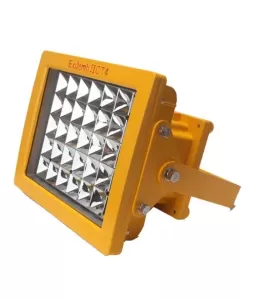
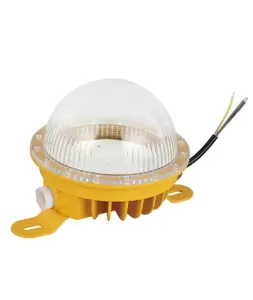
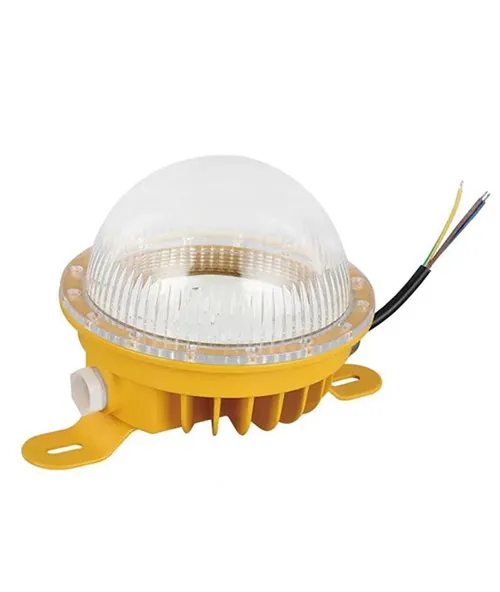
The BAD8599 floodlight and BAD8501B ceiling light are both offered in DC 24 V or AC/DC 36 V on request, with the same marking as the mains versions: Ex d IIC T6 Gb / Ex tD A21 IP66 T80 °C.
Voltage drop: the real limit
Power equals voltage times current. At low voltage the same wattage needs much more current, and voltage drop in the cable rises in proportion to current. A light’s driver also draws more current as its input voltage falls, which makes the drop worse at the far end.
The drop on a two-wire circuit is:
ΔV = I × 2 × L × ρ ÷ A
where I is current (A), L the one-way cable length (m), ρ the resistivity of copper (0.0172 Ω·mm²/m at 20 °C) and A the conductor cross-section (mm²).
One fitting: how far for a 5 % drop?
| Supply | Fitting | Current | 2.5 mm² cable | 4 mm² cable |
|---|---|---|---|---|
| 24 V DC | 30 W | 1.25 A | 70 m | 112 m |
| 24 V DC | 50 W | 2.08 A | 42 m | 67 m |
| 36 V | 30 W | 0.83 A | 157 m | 251 m |
| 36 V | 50 W | 1.39 A | 94 m | 151 m |
| 220 V AC (PF 0.95) | 50 W | 0.24 A | about 3.3 km | about 5.3 km |
These figures are our own arithmetic from the formula above, at 20 °C. Copper resistance rises by roughly 20 % at 70 °C conductor temperature, so in hot plant areas reduce the lengths accordingly.
Example: a 50 W fitting 50 m from a 24 V supply on 2.5 mm² cable loses 1.43 V, or 6 %. The same fitting at 220 V on the same cable loses 0.17 V, or 0.07 %.
Several fittings on one circuit
Take four 30 W fittings on one 24 V circuit: the first 20 m from the supply, then three more at 10 m intervals. Adding the drop on each section with the current that flows through it:
| Cable | Voltage drop at the last fitting | Percentage |
|---|---|---|
| 2.5 mm² | 2.41 V | 10.0 % |
| 6 mm² | 1.00 V | 4.2 % |
At 10 % drop the last fitting receives about 21.6 V. Whether it still works depends on the driver’s input range. Ask for that range before designing the circuit, and keep 24 V circuits short or use 36 V where the site allows. For comparison, our DC street lights guide shows the same problem on solar street lighting.
Design tips for low-voltage Ex lighting
- Put the transformer or power supply close to the lights. Run the long distance at mains voltage to a supply unit outside the zone, then a short low-voltage run to the fittings.
- Size the cable for voltage drop, not just current rating. A 2.5 mm² cable carries 2 A easily but loses too much voltage over 60 m at 24 V.
- Keep the supply unit outside the hazardous area, or use one certified for the zone.
- Check the cable gland range. Thicker cable for voltage drop may need a larger gland; the BAD8501B entry accepts 10–14 mm cable diameter.
- Record the design voltage at each fitting so maintenance teams can check it later.
Temporary lighting during shutdowns
During turnarounds, contractors light inside vessels and columns with temporary fittings. Many plants require these to be both extra-low voltage and Ex rated, because the vessel may not be fully gas-free everywhere. A 24 V fitting with an IIC rating covers every gas group. Our explosion-proof portable linear lights guide covers hand-held and hanging options.
Battery and solar systems
Remote wellheads, pipeline valve stations and offshore marker points often have no mains supply. A 24 V Ex fitting fed from a battery charged by a solar panel avoids running cable. Size the battery for the hours of darkness plus reserve days, and keep the battery and charge controller outside the zone or in a certified enclosure.
What to send us
- Supply type and voltage (DC 24 V, AC 36 V, battery, solar)
- Cable length from the supply to each fitting
- Zone, gas group and temperature class
- Number of fittings on each circuit
- Reason for low voltage (site rule, supply, confined space)
With these we will confirm the version, check the voltage at the farthest fitting, and recommend a cable size.
Sources
Frequently asked questions
Is a 24V explosion-proof light intrinsically safe?
No. Intrinsic safety (Ex i) limits the energy in the whole circuit with barriers and certified equipment. A 24 V flameproof light uses Ex d protection like a mains fitting. It needs the same zone rating; the low voltage only reduces shock risk.
When should I use a 24V explosion-proof light?
Inside tanks, vessels and other confined or wet conductive spaces where site rules require extra-low voltage, on battery- or solar-powered systems, and on mobile equipment with a 24 V supply.
How far can I run a 24V cable to a light?
For a 5 % voltage drop, a 30 W fitting on 2.5 mm² copper cable can be about 70 m away and a 50 W fitting about 42 m. Larger cable or 36 V extends that. Check the driver's input range: some tolerate more drop than others.
Do you supply explosion-proof lights in 24V?
Yes. The BAD8599 floodlight and BAD8501B ceiling light are available in DC 24 V or AC/DC 36 V versions on request; both are marked Ex d IIC T6 Gb / Ex tD A21 IP66 T80 °C. Tell us the voltage and supply type in the enquiry.