Confined Space Lighting: Lux Levels, Safe Voltages and Explosion-Proof Choices
How much light a confined space needs, why portable lamps inside metal vessels must run at extra-low voltage, when fittings must be explosion-proof, and a 6 × 4 m vault worked example.
Key points
- OSHA's construction rule sets 5 foot-candles (about 54 lux) as the minimum for general work areas; inspection and repair inside a space normally need 100–200 lux or more at the task.
- Hand lamps inside metal tanks, boilers and similar conductive spaces should run on SELV (separated extra-low voltage), as IEC 60364-7-706 requires.
- If the space can hold a flammable atmosphere, every light inside it must carry an Ex rating for that zone, gas group and temperature class.
- By our calculator, a 6 × 4 m valve vault, 3.5 m deep with dark walls, reaches about 166 lux with four 30 W IIC fittings.
- Fixed lights at a vault are often cheaper and safer over the plant's life than repeated portable setups.
A confined space is one that is large enough to enter but has restricted entry and exit and is not designed for people to stay in: tanks, silos, vessels, pits, manholes, sewer wet wells, valve chambers, ducts. Lighting such a space is a small part of the entry permit, but it combines three separate hazards: poor visibility, electric shock in a conductive enclosure, and, in many spaces, a flammable atmosphere. This guide covers the light level, the voltage and the Ex rating, and works through a typical vault.
How much light?
Confined space regulations focus on atmosphere, rescue and permits. They rarely give a lux number. The closest references are:
| Reference | Area | Minimum |
|---|---|---|
| OSHA 29 CFR 1926.56 | General construction areas; tunnels, shafts, general underground work | 5 fc (about 54 lux) |
| OSHA 29 CFR 1926.56 | General construction plant and shops | 10 fc (about 108 lux) |
| Common site practice | Inspection, welding, coating inspection inside vessels | 200–500 lux at the task |
Treat 54 lux as the floor for moving around, not for working. Reading gauges, checking welds or inspecting a coating needs several times that, and dark, dirty walls reflect very little. Our foot-candles to lux article covers the unit conversion if your procedure is written in foot-candles.
Safe voltage inside conductive spaces
Inside a metal tank or boiler, the worker is surrounded by earthed metal and often kneeling or lying on it. A fault in a mains-powered lamp can be fatal. IEC 60364-7-706, the wiring rule for “conducting locations with restricted movement”, requires hand lamps there to be supplied by SELV: separated extra-low voltage from a safety isolating transformer placed outside the space. National rules follow the same idea:
- portable hand lamps at 12 V or 24 V, or battery powered;
- the transformer outside the space, never inside;
- residual-current protection on the supply side, as local rules require.
Fixed mains lights are acceptable in large non-conductive spaces such as concrete vaults, if the installation follows local wiring rules and the fittings are suitable for wet, dirty conditions.
When the space is also a hazardous area
Many confined spaces can hold a flammable atmosphere: fuel tanks, sewer wet wells, digesters, solvent vessels, pipe chambers at gas plants. In those spaces:
- Every light inside must be Ex certified for the zone (often Zone 1, sometimes Zone 0 inside the vessel), the gas group and the temperature class.
- Portable lamps must be both extra-low voltage and Ex certified, often intrinsically safe or flameproof battery lamps.
- Gas testing comes first. No lamp, however rated, replaces atmosphere testing and ventilation.
Our explosion-proof portable linear lights article covers portable fittings for temporary work in classified areas.
Worked example: a 6 × 4 m valve vault
Take a concrete valve chamber 6 m long, 4 m wide and 3.5 m deep, classified as a Zone 1 area because of the gas pipework inside. Walls and floor are dark and dirty. The owner wants fixed lights so that crews no longer carry portable sets down the ladder. The target is 100 lux for access and routine checks.
Using our BDE507 at 30 W and 110 lm/W, wide beam, dark surfaces, a 0.8 m working plane and a maintenance factor of 0.8, our lighting calculator gives:
| Result | Value |
|---|---|
| Room index | 0.89 |
| Utilisation factor | 0.38 |
| Fittings | 4 (2 × 2) |
| Average illuminance | about 166 lux |
| Power density | 5.0 W/m² |
The low utilisation factor is the dark, narrow room at work: much of the light lands on walls and is absorbed. The calculator shows that 18 W per fitting would just reach 100 lux on the same grid, so the 20 W version is the minimum. With the target raised to 200 lux for maintenance work, six 30 W fittings give about 249 lux.
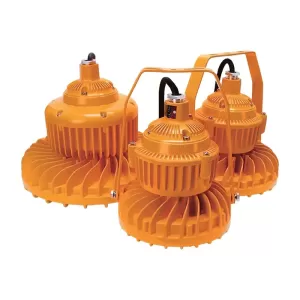
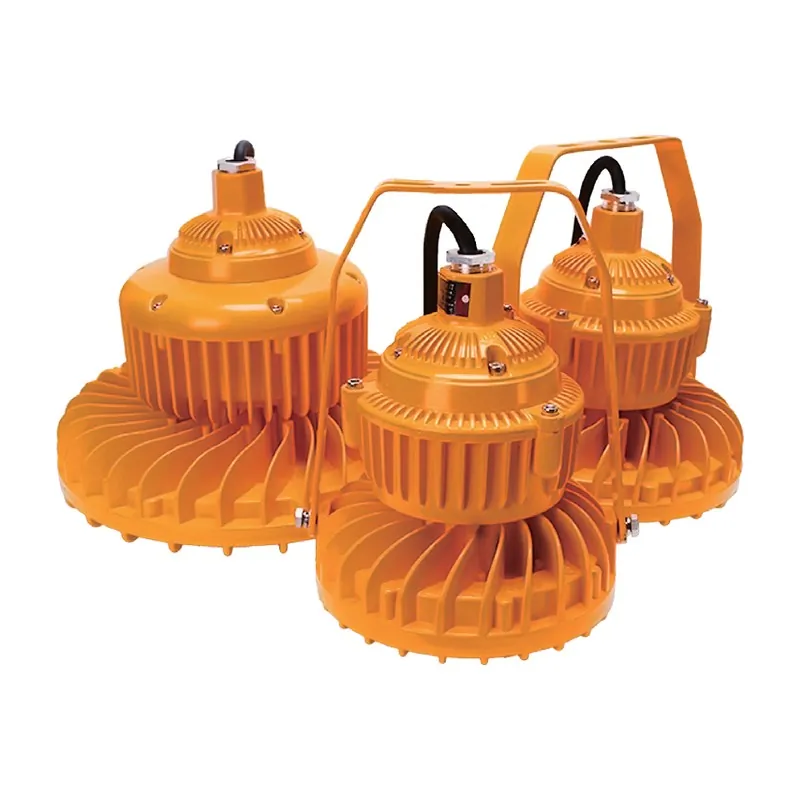
The BDE507 is marked Ex d IIC T6 Gb, so it suits Zone 1 and 2 with all gas groups, and it is rated IP66. Its certificate is supplied with the quotation. For larger spaces or higher outputs, our BED series runs from 30 W to 600 W under our own certificate ZJEx23.0914.
Fixed or portable?
| Fixed lights | Portable sets | |
|---|---|---|
| Setup time per entry | None | Lowering, cabling, testing |
| Shock risk | Handled once, at installation | Every setup, every cable |
| Light level | Designed and repeatable | Depends on the crew |
| Cost | Higher once | Lower once, higher over years of entries |
| Best for | Spaces entered monthly or more often | Tanks entered once every few years |
Pump stations and lift stations are typical cases where fixed lights pay back. Our lift station lighting and wastewater treatment plant lighting guides cover those sites in more detail.
Practical points for fixed fittings
- Mount out of the way. Ladders, hoists and pipe removal paths must stay clear. Wall mounting above head height is common in vaults.
- Switch from outside. The lights should be switched on before entry, from a point outside the space.
- Plan for washdown and condensation. Vaults are wet; IP66 or better, stainless or coated fixings and sealed cable glands last longer.
- Add emergency lighting. If the mains fails while a crew is inside, they need light to climb out. A battery-backed fitting at the ladder foot is the minimum.
- Count properly. Our how many explosion-proof lights do I need article explains the lumen method for classified rooms.
What to send us
Send the dimensions, the depth, the zone and gas list (or a statement that the space is unclassified), the surface condition and the target lux. We will return a fitting count and a calculator link like the one above, and the certificate for the fittings we propose.
Sources
Frequently asked questions
What lux level is required in a confined space?
Confined space rules rarely give a number. OSHA's construction illumination rule sets 5 foot-candles (about 54 lux) as a minimum for general areas. For inspection, welding or repair work inside the space, plan for 100–200 lux or more at the task, and follow any figure in your site's permit procedure.
What voltage should confined space lights use?
Inside conductive spaces such as metal tanks, hand lamps should be supplied by SELV, for example 12 V or 24 V from a safety isolating transformer, or be battery powered. Fixed lights at the entrance or in a large concrete vault can run on mains if the installation meets local wiring rules.
Do confined space lights need to be explosion-proof?
Only if the space can contain a flammable atmosphere, for example a fuel tank, a sewer wet well or a vessel being cleaned of solvent. Then every light inside must be certified for the zone, the gas group and the temperature class.
Which of your lights suit confined spaces?
For fixed lights in classified vaults and pump chambers, our BDE507 (20–70 W, Ex d IIC T6 Gb) and BED series (30–600 W, Ex db eb mb IIC T4 Gb) are typical choices. We do not make SELV hand lamps.