Lift Station Lighting: Pump Rooms, Wet Wells and Class 1 Div 2
How sewage lift stations and pump rooms are classified (Class 1 Div 1 or Div 2), which lights fit each space, and fitting counts for a dry well and a pump shelter from our calculator.
Key points
- In NFPA 820, an unventilated sewage wet well is Class 1 Division 1; continuous ventilation at 12 air changes per hour usually lowers it to Division 2.
- Sewer gas is mainly methane (Group D, IIA) and hydrogen sulphide (Group C, IIB), so a IIB or IIC light covers the gas group.
- Our calculator gives four 50 W BDE507 lights for a 6 × 5 m dry well at 4 m, about 279 lux; a 10 × 6 m pump shelter needs six, about 212 lux.
- Put wet-well lights outside the well or on the hatch frame wherever possible, so lamps can be changed without entering a confined space.
A sewage lift station is a small building with a large hazard. Sewer gas collects in the wet well, the pumps sit next to it, and maintenance staff often work alone. Lighting has to suit the classified area, survive hydrogen sulphide and be easy to maintain without entering the well. This guide covers how the spaces are typically classified, which lights fit, and how many fittings two common rooms need.
How the spaces are classified
Area classification is the design engineer’s job, normally following NFPA 820 in North America or IEC 60079-10-1 elsewhere. The typical outcome for a lift station is:
| Space | Typical classification (NFPA 820) | Condition |
|---|---|---|
| Wet well | Class 1 Division 1 | Not ventilated, or ventilated below 12 air changes per hour |
| Wet well | Class 1 Division 2 | Continuously ventilated at 12 air changes per hour or more |
| Dry well (pump room) | Unclassified | Physically separated from the wet well and ventilated |
| Dry well with openings to the wet well | Same as the wet well | No gas-tight separation |
| Valve vault, small enclosed pits | Often Division 1 or 2 | Depends on ventilation and connection to the sewer |
Check the edition of NFPA 820 your authority uses and the station’s ventilation design. A station that loses its ventilation fan in a power cut is exactly the case Division 2 is meant to cover, so the lights inside a ventilated wet well still need to be rated.
The zone system expresses the same thing as Zone 1 (Division 1) and Zone 2 (Division 2). Our Zone 1 vs Zone 2 guide shows how the two compare, and Class 1 Division 2 lighting explains what Division 2 allows.
Gas group and temperature class
Sewer gas is a mix. The two gases that set the rating are:
- Methane: Group D, IIA, ignition temperature about 600 °C.
- Hydrogen sulphide: Group C, IIB, ignition temperature about 260 °C, which needs T3.
So the minimum is Group C / IIB, T3. A IIC fitting is acceptable and gives margin if solvents or fuel ever reach the sewer. Our T3 vs T4 article explains the classes.
Which lights fit
| Series | Marking | Fits lift station gas? | Notes |
|---|---|---|---|
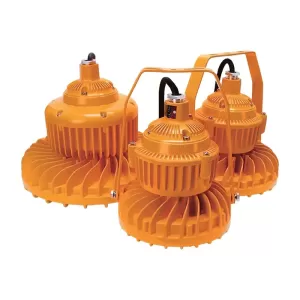
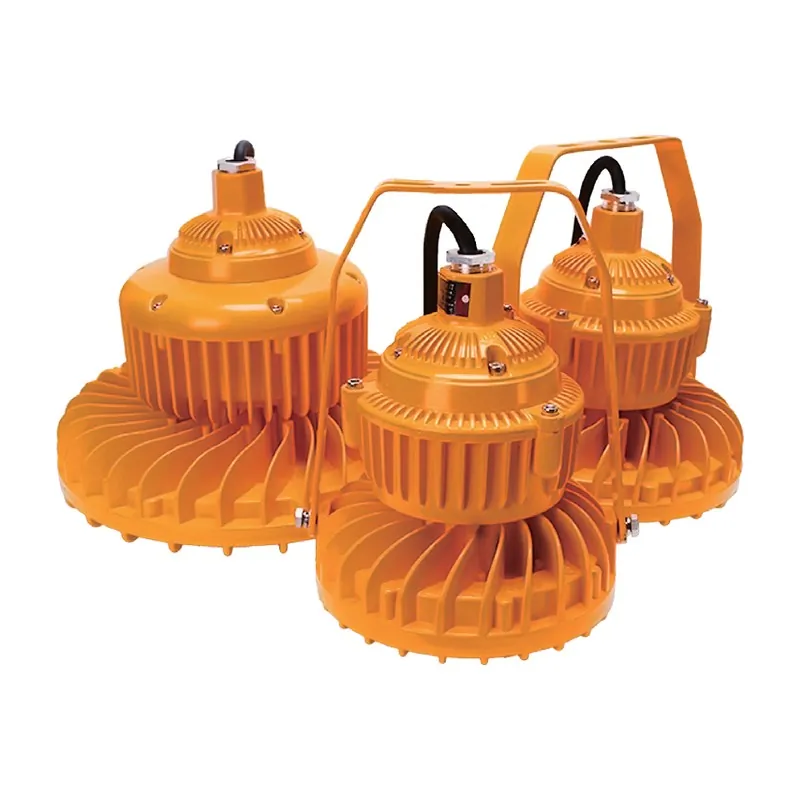
| BDE507, 20–70 W | Ex d IIC T6 Gb | Yes | Compact round light; die-cast aluminium, WF2 corrosion grade, IP66 |
| BED, 30–600 W | Ex db eb mb IIC T4 Gb | Yes | Our own certificate ZJEx23.0914 |
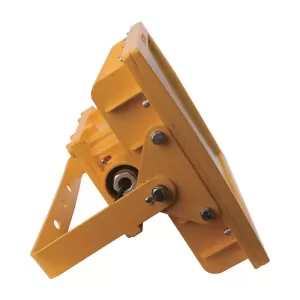
| ExF, 50–150 W | Ex d IIB T6 Gb | Yes | Floodlight for yards and hatch areas; IP67 |
For every model except the BED, the certificate for the exact model comes with the quotation. For a US project the light must also carry a listing your inspector accepts; tell us at the inquiry stage.
In a dry well that is unclassified, ordinary IP65 or IP66 industrial fittings are allowed. Many utilities still choose the same explosion-proof model everywhere so that one spare fits all rooms. That is a client decision; it costs more per fitting but simplifies stock.
Worked example 1: a dry well pump room
A 6 × 5 m dry well with two submersible pump motors and valves, fittings at 4 m. Light-coloured walls. Maintenance staff read nameplates and work on valves, so we aim for 200 lux.
With 50 W BDE507 lights at their rated 110 lm/W and a wide beam, our high bay lighting calculator gives (open the example):
- 4 fittings in a 2 × 2 grid, 3.0 × 2.5 m apart;
- about 279 lux average;
- 6.7 W per m².
The lumen method asks for three fittings, but a 2 × 2 grid avoids shadows behind the pumps. The calculator shows 36 W fittings would reach 200 lux in the same grid, so the 40 W BDE507 also works if the client prefers lower power.
Worked example 2: a pump shelter over the wet well
A 10 × 6 m shelter over the wet-well hatches, classified Division 2 because the hatches are opened for cleaning. Fittings at 4.5 m, 150 lux target, 50 W BDE507:
- 6 fittings in a 3 × 2 grid (open the example);
- about 212 lux average, 5 W per m².
Lights inside the wet well
Lamps inside a wet well are hard to maintain: entry is a permit-required confined space with gas testing and a standby attendant. Options, in order of preference:
- Light the well from outside, with a floodlight on the hatch frame aimed down when the hatch is open.
- Mount a fitting just below the hatch, reachable from the top without entering.
- Mount inside only if required, rated for Division 1 / Zone 1, with stainless hardware.
Wire through sealed conduit or glands that match the classification. Our explosion-proof light installation guide covers glands and seals.
Corrosion
Hydrogen sulphide turns copper black, attacks brass terminals and rusts plain steel. Specify:
- powder-coated die-cast aluminium or stainless housings;
- stainless fixings and brackets;
- glands with nickel-plated brass or stainless bodies;
- a corrosion grade such as WF2 where available.
Treatment plants face the same issue on a larger scale; see wastewater treatment plant lighting.
Emergency lighting
A pump room with no windows goes completely dark in a power failure. Add at least one emergency fitting at the door and one over the stairs or ladder, rated for the same area.
What to send us
The classification of each space, room sizes, mounting heights, target lux, and whether lights may be mounted inside the wet well. We will return fitting counts from our calculator, the model for each room and its certificate.
Sources
Frequently asked questions
Is a lift station a hazardous location?
Often, yes. NFPA 820 classifies the wet well of a sewage lift station as Class 1 Division 1 unless it is continuously ventilated, in which case Division 2 is common. A dry well that is physically separated from the wet well and ventilated may be unclassified. The design engineer decides for each station.
What gas group applies to a sewage pump station?
Methane, Group D (IIA), and hydrogen sulphide, Group C (IIB). Lights rated IIB or IIC, or Groups C and D, cover both.
What temperature class do I need?
Hydrogen sulphide ignites at about 260 °C, which needs T3 or cooler. T4, T5 and T6 lights are also acceptable.
Do lift station lights need to be corrosion resistant?
Yes. Hydrogen sulphide attacks copper, brass and ordinary steel. Choose powder-coated aluminium or stainless housings, stainless hardware and a corrosion grade such as WF2.