Class 1 Division 2 LED Lighting: What C1D2 Allows, and How It Compares with ATEX Zone 2
Class 1 Division 2 lighting explained: what Div 2 means, which protection methods are allowed, how C1D2 maps to ATEX Zone 2, typical Div 2 extents, and a worked fixture count.

Key points
- Class I, Division 2 is an area where flammable gas or vapour is present only under abnormal conditions, such as a leak or a ventilation failure. It is the North American counterpart of Zone 2.
- In Div 2, a luminaire does not have to be explosionproof: nonincendive and other Div 2 methods are allowed, and equipment listed for Zone 0, 1 or 2 may also be used for the same gas group and temperature class.
- A Zone-rated light can cover both Zone 2 and Div 2 only if it carries a North American listing or the authority having jurisdiction accepts its certificate. An ATEX or IECEx certificate alone is not a US listing.
- In our worked example, a 30 × 18 m process shed at 8 m needs 24 luminaires of 100 W for 200 lux, assuming 110 lm/W.
Most luminaires in hazardous-area projects end up in the less severe part of the site. In North American terms that is Class I, Division 2; in IEC and ATEX terms, Zone 2. The difference between buying for Division 2 and buying for Division 1 is large in weight, price and lead time, so it pays to know exactly what Division 2 allows. This guide covers the definition, the protection methods, the overlap with Zone 2 and a worked fixture count.
What Division 2 means
The National Electrical Code (NEC, NFPA 70) classifies hazardous locations by class (the kind of material) and division (how likely it is to be present):
- Class I — flammable gases or vapours
- Division 1 — ignitable concentrations can exist under normal operation, during repair, or because of frequent leaks
- Division 2 — ignitable concentrations are not normally present; they occur only through accidental rupture, abnormal operation or failure of ventilation, or the area adjoins a Division 1 area from which gas could occasionally spread
In practice, Division 2 covers the larger envelope around process equipment, enclosed spaces with reliable mechanical ventilation, and the margins of Division 1 areas. Our explainer on Class 1 Division 1 explosion-proof lighting covers the stricter case and the gas groups A to D.
Protection methods allowed in Division 2
Because the hazard is abnormal and short, Division 2 accepts equipment that does not spark or run hot in normal operation:
| Method | Principle | Typical use in lighting |
|---|---|---|
| Explosionproof | Enclosure contains an internal explosion | Any Division 1 luminaire, also valid in Division 2 |
| Nonincendive | Normal operation cannot ignite the gas | Most “C1D2-rated” LED luminaires |
| Hermetically sealed / sealed devices | Sparking parts sealed from the atmosphere | Switches and contacts inside fixtures |
| Purged and pressurised | Clean air keeps gas out | Panels and large enclosures, rarely lights |
| Zone-type equipment | Listed for Zone 0, 1 or 2 under NEC 505 | Permitted for the same gas and temperature class |
The last row matters for buyers sourcing internationally. NEC Article 501 allows equipment listed and marked for Zone 0, 1 or 2 to be used in Division 2 for the same gas and with a suitable temperature class. The word listed is important: in the USA that means certified by a Nationally Recognised Testing Laboratory such as UL, CSA, Intertek or FM.
Temperature code still applies
Division 2 relaxes the protection method, not the temperature limit. The luminaire’s maximum surface temperature, shown by its T-code, must stay below the auto-ignition temperature of the gas. LED luminaires help here: a T4 rating (135 °C) or better covers most hydrocarbons, while sodium and metal halide fixtures often struggled to get below T3. Our guide to explosion-proof light ratings lists the T-codes and their temperatures.
Class 1 Div 2 vs ATEX and IECEx Zone 2
| Item | NEC Division system | IEC / ATEX Zone system |
|---|---|---|
| Gas present continuously | Division 1 | Zone 0 |
| Gas likely in normal operation | Division 1 | Zone 1 |
| Gas only abnormally, short periods | Division 2 | Zone 2 |
| Gas groups | A, B, C, D | IIC, IIB, IIA |
| Equipment level for the mildest area | Division 2 listing | EPL Gc (Gb and Ga also acceptable) |
| Certificate | NRTL listing (US), CSA (Canada) | ATEX (EU), IECEx, national schemes |
So Zone 2 and Division 2 describe the same hazard, but certificates do not transfer automatically. A fixture with only an ATEX certificate is not listed for a US site, and a UL C1D2 listing is not ATEX. Projects in the Middle East, Africa and Asia often accept IECEx or a national certificate; US and Canadian sites normally require an NRTL or CSA mark. Agree this with the authority having jurisdiction before ordering. Our ATEX explosion-proof lights guide covers the European side.
Reading a real marking: our BED series
As an example of a Zone-system marking, our BED explosion-proof LED light (30–600 W) carries Chinese explosion-proof certificate ZJEx23.0914, issued under GB 3836, which is aligned with IEC 60079:
- Ex db eb mb — flameproof enclosure (db), increased safety terminals (eb) and encapsulation (mb)
- IIC — the most demanding gas group, which also covers IIB and IIA
- T4 — surface temperature not above 135 °C
- Gb — equipment protection level for Zone 1, which is also acceptable in Zone 2
- Ex tb IIIC T130 °C Db — dust protection for Zone 21 and 22
On a Zone-system site, a Gb, IIC, T4 light covers Zone 1 and Zone 2 for any gas with an ignition temperature above 135 °C. For a US Division 2 site, the same certificate is not an NRTL listing, so tell us at enquiry stage which certificates the site will accept, and we will confirm what can be supplied with the quotation. Our other explosion-proof lights carry their own markings; the ExF series, for example, is marked Ex d IIB T6 Gb and is therefore not suitable for hydrogen or acetylene (group IIC, NEC groups A and B).
How far does Division 2 extend?
The lighting designer does not set the boundaries; the area classification drawing does. Typical sources:
- Fuel stations — NFPA 30A. For example, the space up to 18 in (450 mm) above grade within 20 ft (6 m) horizontally of a dispenser enclosure is Division 2. Canopy lights high above that envelope are normally outside the classified area. See our square canopy light guide for a forecourt example.
- Refineries and petroleum facilities — API RP 500 (Division) or API RP 505 (Zone) diagrams for pumps, compressors, vents and separators.
- Chemical plants — NFPA 497 for the Division system, IEC 60079-10-1 for Zones.
- Wastewater treatment plants — NFPA 820 for headworks, screen rooms and digesters; see our wastewater treatment plant lighting guide for a screen room example.
Low-level lights, pit lights and fixtures near vents are the ones most likely to fall inside a Division 2 envelope. Heavier-than-air vapours collect low, so trenches and sumps are sometimes upgraded to Division 1.
Worked example: a process shed in Division 2
A compressor and pump shed, 30 × 18 m, with luminaires at 8 m and a 200 lux maintained target. We ran it through our high bay lighting calculator, assuming 110 lm/W for the luminaire (use the efficacy from your supplier’s test report):
| Luminaire power | Luminaires | Layout | Average lux | W/m² |
|---|---|---|---|---|
| 80 W | 28 | 7 × 4 | 222 | 4.15 |
| 100 W | 24 | 6 × 4 | 238 | 4.44 |
| 120 W | 20 | 5 × 4 | 238 | 4.44 |
| 150 W | 15 | 5 × 3 | 223 | 4.17 |
Fewer, larger fixtures save cable entries, glands and installation hours, which in hazardous areas cost more than the luminaires. But spacing still matters for uniformity and for redundancy: if one of 15 fixtures fails, the loss is larger than one of 24. Many designers choose the 100–120 W option here. Our explosion-proof LED lights buying guide lists what else to specify.
Installation differences from Division 1
- Wiring. Division 2 permits more wiring methods than Division 1 (for example, certain cable types instead of threaded rigid conduit in many cases). Seals are still required where conduit leaves an enclosure that contains sparking parts.
- Flexible connections. Pendant-mounted luminaires need approved flexible fittings and protection against swinging and impact.
- Guards. Luminaires exposed to physical damage need guards or a protected location.
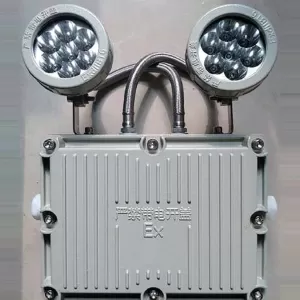
- Emergency lighting. Escape routes in classified areas need emergency luminaires rated for the area; our explosion-proof emergency light BG-FBYJ10A is marked Ex d IIC T4 with 2 hours of emergency operation.
Checklist for a Division 2 order
- The classification drawing, with division or zone, gas group and temperature class
- The certificates the site accepts (NRTL, CSA, ATEX, IECEx or national)
- Mounting height, area and lux target, so the wattage can be calculated
- Supply voltage and any dimming or emergency requirement
- Ambient temperature range, since certificates are usually limited to a range such as −20 to +40 °C
Send us these five items and we will propose fixtures, quantities and the certificate set for your project.
Sources
Frequently asked questions
Do lights in a Class 1 Div 2 area have to be explosion proof?
No. Explosionproof luminaires are allowed, but Division 2 also accepts luminaires listed and marked for Class I, Division 2, such as nonincendive or sealed designs, and equipment listed for the matching Zone. The luminaire must still carry a suitable temperature code and gas group.
Is ATEX Zone 2 the same as Class 1 Division 2?
They describe the same kind of hazard: gas present only abnormally and for short periods. But the systems certify equipment differently, so a fixture approved under one is not automatically approved under the other. In the USA, look for an NRTL listing.
Can Class 1 Div 1 fixtures be used in Div 2?
Yes. Equipment suitable for Division 1 is suitable for Division 2 of the same class and group. It is usually heavier and more expensive than needed, but it simplifies spares when a site has both.
What are typical Class 1 Div 2 distance requirements?
They come from the area classification, not from the lighting code. For example, NFPA 30A treats the space up to 18 in (450 mm) above grade within 20 ft (6 m) horizontally of a fuel dispenser as Division 2. Refineries and chemical plants use API RP 500 or NFPA 497 diagrams for their equipment.