LED Canopy Lights for Gas Stations: Square Canopy Fixtures, Light Levels and Hazardous Areas
How to choose LED square canopy lights for gas station forecourts: light levels, wattage per canopy, recessed vs surface mount, hazardous areas, retrofitting metal halide and a worked saving.
Key points
- Square LED canopy lights are flat, sealed fixtures for forecourt canopies, usually 60–150 W each, recessed into the canopy deck or surface mounted.
- In our worked example, a 30 × 15 m canopy at 200 lux needs about 1,450 W of LED, for instance 16 fittings of about 90 W.
- Replacing 16 × 400 W metal halide canopy lights with 90 W LED cut energy use by about 80% when the forecourt is lit all night.
- Parts of a forecourt are hazardous areas; the site's area classification drawing decides where certified explosion-proof fittings are required.
A gas station forecourt is often the brightest place on the road at night. Drivers judge the station from a distance by its canopy, staff need to see clearly, and cameras need good images. Square LED canopy lights now do this job at a fraction of the energy of the metal halide fittings they replace. This guide explains how to choose them, how much light a canopy needs and where hazardous-area rules apply.
What a square canopy light is
A canopy light is a low-profile, sealed fixture made for the underside of a forecourt canopy. The common square format, typically about 300–500 mm on a side, has:
- A die-cast aluminium housing that doubles as the heat sink
- A flat lens or diffuser, often PMMA or tempered glass, to keep glare low for drivers pulling in
- IP65 or IP66 sealing against rain blown under the canopy, washing and insects
- Wattage typically from 60 W to 150 W
Two mounting styles are common:
- Recessed: the fixture sits in a cut-out in the canopy deck, flush with the surface. This looks clean and keeps glare low.
- Surface mount: the fixture is fixed directly to the deck, useful for retrofits or canopies that cannot be cut.
How much light a canopy needs
There is no single international value. Many forecourts are designed for roughly 150–300 lux average under the canopy, and oil companies often set their own brand standard. Some cities and countries cap canopy lighting to limit glare and sky glow, especially near homes. Points to agree before design:
- Average lux under the canopy and around the dispensers
- Uniformity, so there are no dark spots between pumps
- Light on the vertical faces of vehicles and people, which matters for cameras
- The transition to the darker road and shop front, so drivers’ eyes can adapt
Over-lighting wastes energy and can dazzle drivers leaving the station into a dark road.
Worked example: how many canopy lights
Take a 30 × 15 m canopy (450 m²) and a target of 200 lux. With flat-lens canopy lights, a utilisation factor of about 0.6 and a maintenance factor of 0.8:
Lumens = 200 × 450 ÷ (0.6 × 0.8) = 187,500 lm
At 130 lm/W that is about 1,450 W of LED: for instance 16 fittings of about 90 W, or 12 of 120 W. The higher count gives better uniformity between pumps. A photometric calculation with the real canopy height, deck colour and pump layout refines the choice.
Retrofit: metal halide to LED
Many canopies still have 250–400 W metal halide fittings. Their light fades as lamps age, colours shift between fittings, and lamps need changing every two to three years, which on a canopy means a lift and traffic management.
A worked example in our LED retrofit savings calculator: 16 metal halide canopy lights of 400 W, with 15% ballast losses, replaced one-for-one with 90 W LED, the forecourt lit 24 hours a day under the canopy.
- Old system: about 64,500 kWh a year
- LED: about 12,600 kWh a year
- Saving: about 51,900 kWh a year, or about 80%
- At $0.15/kWh that is about $7,800 a year in energy, before counting lamp changes
Forecourts that switch off part of the lighting after closing will save less in absolute terms, but the percentage is similar.
For retrofit, look for LED canopy lights that fit the existing cut-out, or come with a cover plate for larger openings, so the canopy deck does not need new holes. Check that the existing wiring and junction boxes are in good condition; corrosion is common on older canopies.
Hazardous areas on a forecourt
Petrol vapour is heavier than air and collects near the ground around dispensers, fill points, vents and drains. National codes, based on IEC 60079-10-1 and guidance such as the Energy Institute’s filling station guide or NFPA 30A in North America, classify these areas into hazardous zones.
- Inside a hazardous zone, every electrical device, including lights, must be certified for that zone and gas group.
- Outside the zones, standard IP65 or IP66 fittings are generally allowed.
Canopy lights are usually mounted well above the zones around dispensers, so they are often standard fittings. But this is a decision for the site’s area classification drawing, not an assumption. Lights near vent pipes, in pump islands, in tank areas or in low-level positions may need explosion-proof fittings. See zone and division classifications and explosion-proof light ratings.
A real example: Sinopec station, Xiangtan
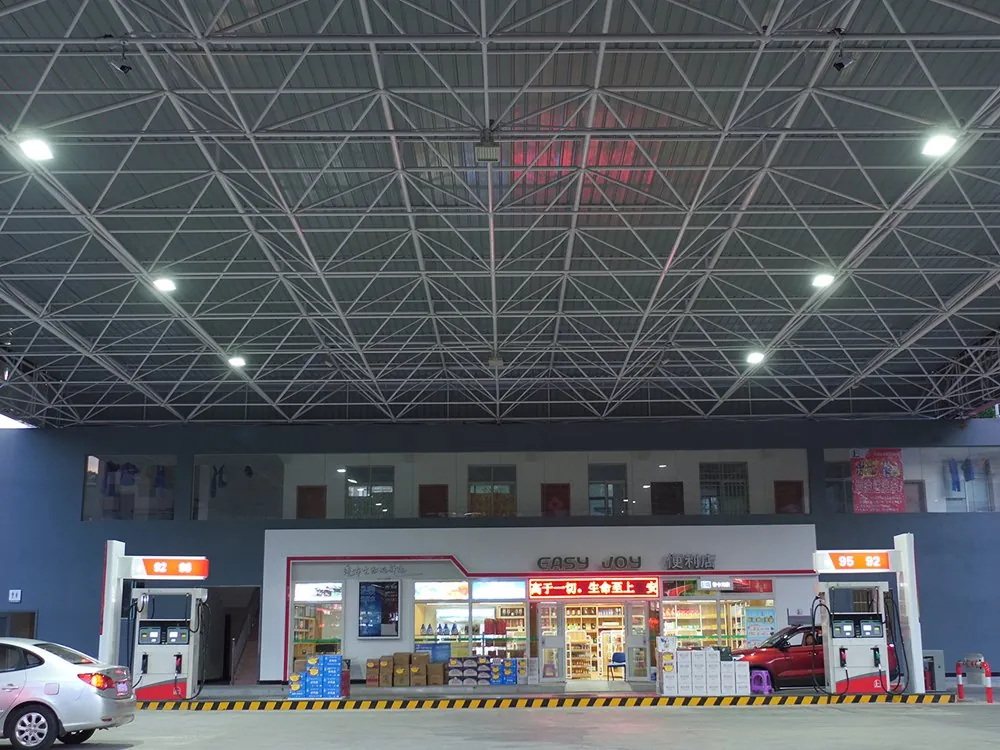
We supplied the forecourt lighting for a Sinopec petrol station in Hexi, Xiangtan. On forecourts like this, the design balances bright, even light for drivers and cameras with low-glare fittings and the hazardous-area requirements around the dispensers. For the zones that need them, our explosion-proof lights include the BED series, certified under China’s GB 3836 for Zone 1 and Zone 2 gas areas.
Canopy edge and brand lighting
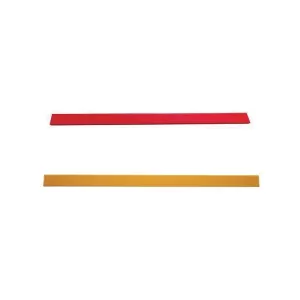
The canopy fascia carries the brand’s colour. LED edge strips replace the old fluorescent tubes behind acrylic panels. Our gas station canopy LED light strip BG-TXC20 uses red or yellow 4 mm acrylic on extruded aluminium, 20 W per metre at DC 12 V, IP65. Edge lighting makes the station visible from the road without adding glare under the canopy.
Choosing square canopy lights
- Wattage and lumens from a calculation for your canopy, not from the old fittings’ wattage alone
- Optics: wide, flat distribution for even light between pumps; asymmetric optics at the canopy edge to light approach lanes
- Colour temperature: 4000–5000 K; CRI 70 or higher, 80 for better camera images
- IP65 or IP66 and a corrosion-resistant finish
- Surge protection, as canopies are exposed to lightning
- Mounting: recessed for new canopies, retrofit or surface mount for existing ones
- Controls: dimming or part-night switching for stations that close or have low traffic at night
- Hazardous-area certification wherever the area classification requires it
Beyond the canopy
Forecourt lighting is part of a whole site: the shop front, car wash, air and water point, parking and the approach from the road. Light the approach with pole-mounted area lights at a lower level than the canopy so the transition is gradual; see LED parking lot lights for pole spacing.
Send us the canopy dimensions, height, pump layout and your target light level, and we will propose canopy lights, a layout and, where needed, explosion-proof fittings for the classified zones.
Sources
Frequently asked questions
How many lux does a gas station canopy need?
Many forecourts are designed for roughly 150–300 lux under the canopy, often set by the oil company's brand standard. Some local codes cap canopy lighting to limit glare and light pollution, so check both before choosing the wattage.
Do gas station canopy lights need to be explosion-proof?
Not always. Fittings inside a classified hazardous zone around dispensers, fill points and vents must be certified for that zone. Canopy lights mounted outside the zones, usually high on the canopy deck, are often standard IP65 or IP66 fittings. The area classification drawing decides.
Can I replace metal halide canopy lights with LED without cutting new holes?
Yes. Retrofit LED canopy lights are made to fit the existing cut-outs, or come with a cover plate that hides the old opening, so the canopy deck does not need new holes.
What colour temperature is best for gas station canopies?
4000–5000 K is common because it looks bright and clean and helps cameras. Near homes, 4000 K with low-glare optics is a good compromise.