Sports Lighting Retrofit: Replacing Metal Halide Floodlights with LED, with Two Worked Examples
How to retrofit sports lighting from metal halide to LED: one-for-one or redesign, pole and headframe checks, aiming, and worked savings for a football pitch and a tennis court.
Key points
- A sports lighting retrofit is not only a lamp swap: check the light level you need now, the pole and headframe capacity, the aiming and the controls before choosing the LED fittings.
- In our retrofit calculator, 48 metal halide floodlights of 1,500 W (about 1,605 W with ballast) replaced by 48 LED floodlights of 800 W save 46,368 kWh a year at 1,200 hours, about 50 %.
- Forty-eight of our 800 W stadium lights at 110 lm/W give about 284 lux on a 105 × 68 m pitch by the lumen method, enough for training and club play.
- On a tennis court, six 1,000 W metal halide lights replaced by eighteen of our 150 W court floodlights cut energy by 58 % at 900 hours a year.
Metal halide floodlights lit most community pitches and courts for decades. They take minutes to warm up, lose a large part of their output before the lamp fails and cannot dim. A sports lighting retrofit replaces them with LED floodlights, and done well it also fixes the uneven light and glare that older installations often have. This guide covers what to check, then works through two retrofits with our calculator and our floodlight data.
Step 1: decide what level of play you are lighting for
The retrofit is the moment to re-check the target. Many clubs were lit for training and now host matches, or the reverse. EN 12193 sets three classes:
| Class | Typical use | Football (outdoor) | Tennis (outdoor) |
|---|---|---|---|
| III | Training, recreation | 75 lux | 200 lux |
| II | Club competition | 200 lux | 300 lux |
| I | High-level competition | 500 lux | 500 lux |
Our sports field lighting lux levels guide covers other sports. If the facility will be filmed or broadcast, the target is set differently and needs a full photometric design.
Step 2: check the poles and headframes
LED fittings are usually lighter than metal halide floodlights with their gear trays, and present less wind area, but not always. Before reusing poles:
- get the weight and projected area (EPA) of the new fittings, and compare with the original design load;
- inspect the base, anchor bolts and welds for corrosion, especially on poles over 20 years old;
- check the cross-arms or headframe can take the new brackets and the new number of fittings.
Our stadium light pole design guide explains the wind check and headframe layout.
Step 3: one-for-one or redesign?
A one-for-one swap is quickest: same number of fittings, same brackets, similar aiming. It works when the old layout gave acceptable uniformity. A redesign changes the number of fittings and beam angles, and often gives better uniformity with less glare, because LED optics can be chosen per position: narrow beams for the far side of the pitch, wide beams for the near side. We provide a photometric layout with each quotation.
Worked example 1: a club football pitch
A 105 × 68 m pitch has 48 metal halide floodlights of 1,500 W on its poles. With a ballast loss of about 7 %, each one draws about 1,605 W. The club uses the lights about 4 hours a night, 300 nights a year (1,200 hours).
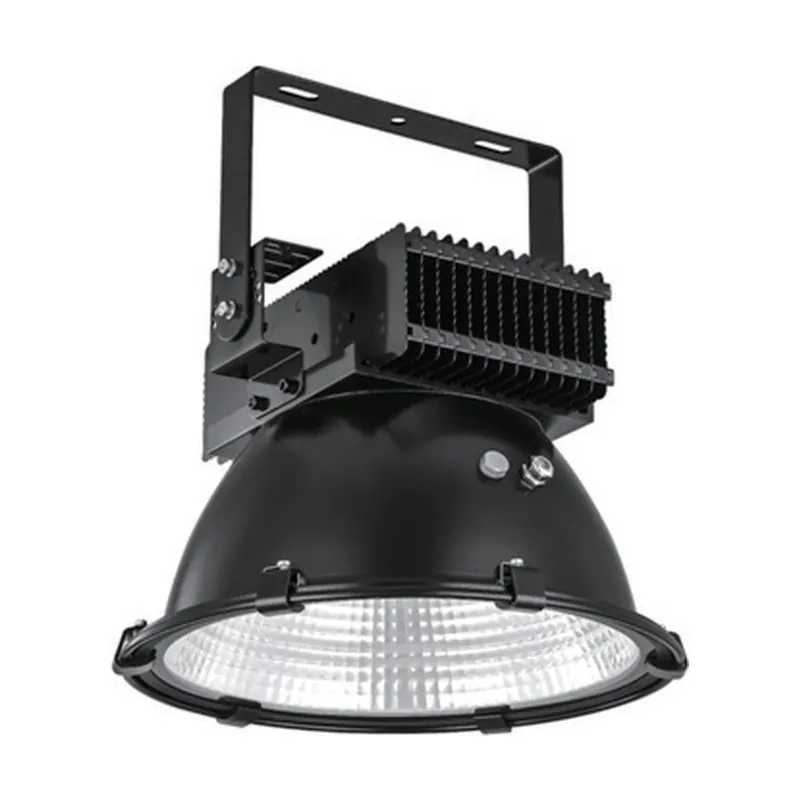
We replace them with 48 of our 800 W LED stadium lights (BG-TZ800H, more than 110 lm/W, IP67). Entering the figures in our LED retrofit savings calculator:
| Item | Metal halide | LED |
|---|---|---|
| Power per fitting | 1,605 W | 800 W |
| Annual energy | 92,448 kWh | 46,080 kWh |
| Saving | 46,368 kWh (50 %) | |
| At US$0.15/kWh | about US$6,955 a year | |
| CO₂ at 0.5 kg/kWh | about 23 t a year |
Light check by the lumen method, with a utilisation factor of 0.6 and a maintenance factor of 0.8:
48 × 88,000 lm × 0.6 × 0.8 ÷ 7,140 m² ≈ 284 lux
That covers Class II club play (200 lux) with margin, and the lights can be dimmed for training. The tariff and hours above are inputs, not our prices; put your own into the calculator. We have left the fitting price out because it depends on the final optics and quantities.
Worked example 2: a tennis court
An outdoor tennis court has six 1,000 W metal halide floodlights (about 1,080 W each with ballast) on four poles, used 3 hours a night, 300 nights a year (900 hours).
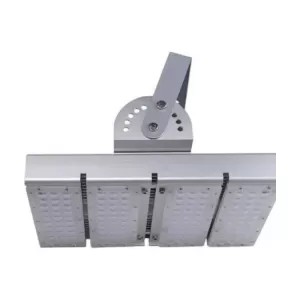
Our product data for the modular LED sports floodlight gives 18 fittings of 150 W on six poles for 200 lux of recreational play on a 36 × 18 m court. The retrofit:
| Item | Metal halide | LED |
|---|---|---|
| Installed power | 6,480 W | 2,700 W |
| Annual energy | 5,832 kWh | 2,430 kWh |
| Saving | 3,402 kWh (58 %) |
More fittings on more poles, each with an asymmetric lens, give a far more even court than six large floodlights. That needs two new poles, so compare the result with a one-for-one swap on the existing four. For 300 lux club play, 21 fittings of 200 W draw 4,200 W and save 35 %. See our tennis court lighting guide for layouts.
Step 4: controls
Metal halide lights cannot be switched off and on quickly; LED can. Add at least two scenes (training and match) and a timer. On a pitch used mostly for training, dimming to 40–50 % for training sessions saves more than the retrofit itself. Our sports lighting cost guide shows how hours and scenes drive running cost.
Step 5: glare and spill
Neighbours often complain about older floodlights more than about the new ones, but only if the new fittings are aimed and shielded properly. Use asymmetric optics where possible, keep aiming angles low, and add visors on positions facing houses. Our glare rating guide explains the GR values used in sports lighting design.
Common retrofit mistakes
- Copying the old wattage ratio blindly. “LED at half the watts” is a rule of thumb; the beam and aiming decide the result.
- Ignoring the supply. LED drivers are electronic; old ballast circuits may have capacitors and ignitors that must be removed, and surge protection should be added on tall poles.
- Skipping the aiming record. Write down the final tilt and rotation of each fitting; it makes maintenance and later replacements far easier.
- Forgetting disposal. Metal halide lamps contain mercury and must go to a lamp recycler.
What to send us
Send the pitch or court size, the pole positions and heights, the existing fittings and their number, the level of play, and your hours of use. We will return a fitting schedule, a photometric layout and the energy saving for your site.
Sources
Frequently asked questions
What LED wattage replaces a 1,500 W metal halide sports light?
Usually 600–800 W of LED, depending on the optics and the light level wanted. A 1,500 W metal halide lamp draws about 1,600 W with its ballast and loses a large part of its output over its life, while LED holds its output much better.
Can I keep my existing poles when retrofitting sports lighting?
Often yes, because LED floodlights are usually lighter and present less wind area than the metal halide fittings they replace. Check the headframe, the cross-arms and the pole's rated load with the new fittings' weight and projected area before reusing them.
Should I replace sports lights one for one?
Only if the existing layout already gives the light level and uniformity you need. A retrofit is a good moment to change the number of fittings, the beam angles and the aiming, so a short photometric design pays off.
How much does a sports lighting retrofit save?
Typically 50–60 % of lighting energy, plus lamp and ballast replacements avoided. Our worked football example saves 46,368 kWh a year at 1,200 hours; your figure depends on the hours of use and your electricity price.