Sports Field Lighting Lux Levels: Values by Sport and Class, and How Many Floodlights Each Needs
Lux and uniformity for football, rugby, tennis and athletics at training, club and competition level, and the floodlight count each level needs, worked out with the lumen method.
Key points
- EN 12193 sets three lighting classes for outdoor sports: Class III for training and recreation, Class II for club competition, Class I for high-level competition.
- For football the horizontal averages are 75, 200 and 500 lux; for outdoor tennis 200, 300 and 500 lux; for athletics 100, 200 and 500 lux.
- Lumens needed = lux × area ÷ (utilisation factor × maintenance factor). A full-size football pitch at 200 lux needs about 3.6 million lumens of floodlights with conservative factors.
- With 300 W sports floodlights at 100 lm/W, that is about 119 fittings and 36 kW; the same pitch at 75 lux for training needs about 45 fittings and 13.5 kW.
- Uniformity matters as much as the average: Class I football asks for a minimum of 70% of the average across the pitch.
Anyone planning flood lights for sporting grounds starts with the same question: how much light does the field need? The answer depends on the sport, the level of play and whether matches are filmed. This guide lists the common values from the European sports lighting standard, explains what the numbers mean, and turns them into a floodlight count you can use for a first budget.
How sports lighting levels are set
The main European reference is EN 12193, which most countries outside North America also use as a reference. It sets three lighting classes for each sport:
- Class III: training, school sport and recreational play.
- Class II: club and league competition, with spectators at moderate distances.
- Class I: high-level national and international competition, with spectators at long distances.
For each class it gives an average horizontal illuminance on the playing area (measured on the ground) and a uniformity: the minimum divided by the average. Television broadcast is handled separately, by vertical illuminance towards the cameras, and is set by the broadcaster or league.
Lux levels by sport (outdoor)
| Sport | Class III | Class II | Class I |
|---|---|---|---|
| Football (soccer) | 75 lux, U 0.5 | 200 lux, U 0.6 | 500 lux, U 0.7 |
| Rugby | 75 lux, U 0.5 | 200 lux, U 0.6 | 500 lux, U 0.7 |
| Tennis | 200 lux, U 0.6 | 300 lux, U 0.7 | 500 lux, U 0.7 |
| Athletics | 100 lux, U 0.5 | 200 lux, U 0.5 | 500 lux, U 0.7 |
These are the commonly quoted values; check the current edition of the standard and any federation rules for your project, because leagues often set their own higher figures. To compare with North American specifications in foot-candles, divide lux by 10.76; our page on converting foot-candles to lux has a full table.
Two things stand out. Tennis needs more light than football at the training level, because the ball is small and fast. And the step from Class III to Class I is large: more than six times the light for football.
Why uniformity matters
A pitch averaging 200 lux with dark patches near the touchlines is harder to play on than one averaging 180 lux evenly. Players lose the ball in the transition from bright to dark, and goalkeepers lose it in the dark corners. The uniformity figure protects against this: at U 0.6, no point on the playing area may fall below 60% of the average.
Uniformity is decided by the number of poles, their height and the aiming, more than by the total lumens. More, smaller floodlights spread across more poles give a more even field than a few large ones. Our guides to soccer field lighting and football field lighting show 4, 6 and 8-pole layouts.
Turning lux into a floodlight count
The lumen method gives a first estimate:
Lumens needed = lux × area ÷ (utilisation factor × maintenance factor)
- The utilisation factor (UF) is the share of the floodlights’ lumens that lands on the playing area. For floodlights on poles beside a field we use 0.5, a conservative figure for a first estimate. A photometric calculation with the actual optics often shows 0.6 to 0.7 for well-aimed asymmetric floodlights, which lowers the count.
- The maintenance factor (MF) allows for the light lost as the fittings age and get dirty. We use 0.8.
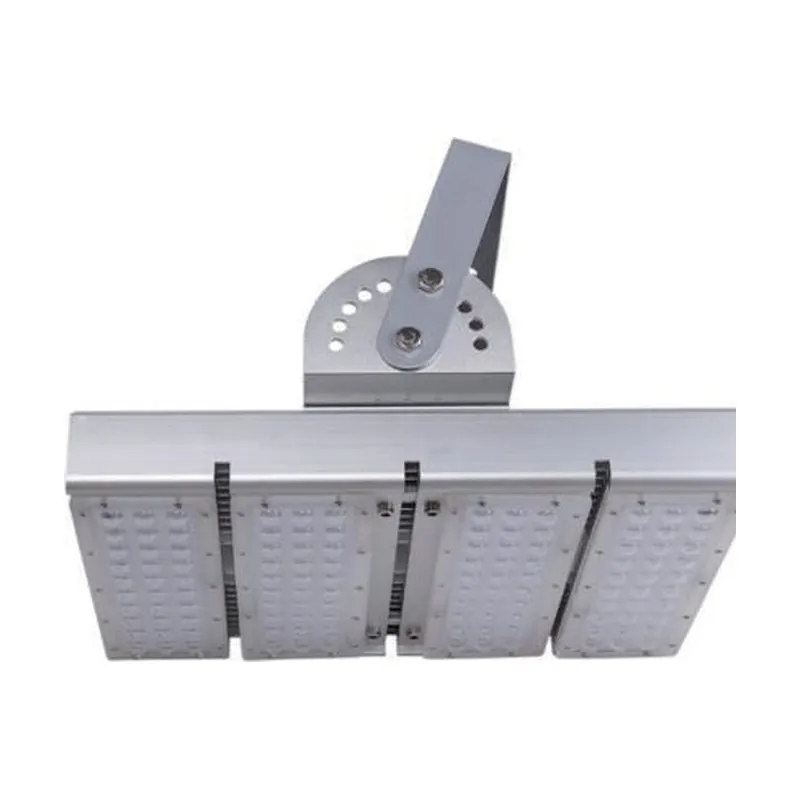
We then divide by the output of one floodlight. Our modular LED sports floodlight BG-TZ-M comes in 50 to 300 W at more than 100 lm/W, with a 140° × 80° beam with a 30° offset that keeps the fitting nearly flat and reduces glare. At 300 W and 100 lm/W one fitting gives at least 30,000 lumens.
| Field | Area | Level | Lumens needed | 300 W floodlights | Load |
|---|---|---|---|---|---|
| Football, full size 105 × 68 m | 7,140 m² | 75 lux (Class III) | 1.34 million | 45 | 13.5 kW |
| Football, full size | 7,140 m² | 200 lux (Class II) | 3.57 million | 119 | 35.7 kW |
| Football, full size | 7,140 m² | 500 lux (Class I) | 8.93 million | 298 | 89.4 kW |
| 7-a-side pitch 60 × 40 m | 2,400 m² | 75 lux | 0.45 million | 15 | 4.5 kW |
| 7-a-side pitch | 2,400 m² | 200 lux | 1.2 million | 40 | 12 kW |
| Tennis court 36.6 × 18.3 m | 669 m² | 300 lux (Class II) | 0.50 million | 17 | 5.1 kW |
Take these as upper estimates for budgeting. On a small area like a tennis court, lower-wattage fittings in larger numbers give better uniformity than a few 300 W units; the lumens stay the same.
Worked example: a club football pitch
A club wants to upgrade a full-size pitch from training to league level, 200 lux, Class II.
- Area: 105 × 68 m = 7,140 m².
- Lumens on the field: 200 × 7,140 = 1,428,000 lm.
- Allow for UF 0.5 and MF 0.8: 1,428,000 ÷ 0.4 = 3,570,000 lm of floodlights.
- At 30,000 lm per fitting: 119 floodlights, about 36 kW.
On six poles that is about 20 fittings per pole. The pole height follows from the field width and the aiming angle: tall poles let the floodlights point down steeply, which improves uniformity and cuts glare for players looking up at a high ball.
If the club trains three evenings a week for three hours and plays one two-hour match a week, the lights run about 11 hours a week, or 570 hours a year. At 35.7 kW that is about 20,350 kWh a year. Running training at 75 lux by switching off part of each pole cuts training energy by more than half; our sports lighting cost article shows how switching groups lowers the bill.
Glare and spill
High lux levels must not come at the price of glare:
- Keep floodlights nearly flat. Asymmetric optics like the 30° offset of the BG-TZ-M put the light on the field without tilting the fitting up towards players’ eyes.
- Use enough pole height. Low poles force steep upward tilts.
- Control spill towards neighbours. Visors, asymmetric optics and careful aiming keep light off nearby houses and roads, which matters for planning permission.
Indoor sports are different
Indoor halls are lit with high bays or sports fittings above the court, and the levels for indoor sports are often higher because the ball is seen against walls and ceiling rather than the night sky. Our guides to badminton court lighting, basketball court lighting and padel court lighting give the indoor figures.
For contractors and clubs
Send us the field dimensions, the sport, the class or the lux you need, the pole positions available and whether matches are filmed. We will work out the floodlight count and wattage per pole with the BG-TZ-M floodlights for each class, suggest switching groups for training and match modes, and list the fittings for your quotation.
Sources
Frequently asked questions
How many lux does a football field need?
Under EN 12193, about 75 lux for training and recreational play (Class III), 200 lux for club competition (Class II) and 500 lux for high-level competition (Class I). Televised matches need more, specified as vertical light towards the cameras.
What lux level is needed for tennis courts outdoors?
About 200 lux for recreational play, 300 lux for club competition and 500 lux for high-level competition, with uniformity of 0.6 to 0.7.
How do I convert sports lux levels to foot-candles?
Divide lux by 10.76. 200 lux is about 18.6 foot-candles; 500 lux is about 46 foot-candles.
How many floodlights does a sports field need?
Work out the lumens with the lumen method, then divide by the lumens of one floodlight. A full football pitch at 200 lux needs roughly 3.6 million lumens with conservative factors, about 119 floodlights of 30,000 lumens. A photometric layout with the real optics refines the count.