Badminton Court Lighting Design: Lux Levels, Side Lighting and a Four-Court Hall Example
Badminton court lighting standards and design: 300, 500 and 750 lux at 0.7 uniformity, mounting height, side rows never above the court, and a school gym and a four-court hall worked out.
Key points
- A school gym badminton court needs 300 lux at 0.7 uniformity (EN 12193 class III); a 20 × 15 m gym with two courts and fittings at 7 m needs about sixteen 150 W high bays in our calculator.
- Badminton needs about 300 lux for training, 500 lux for club competition and 750 lux for national and international play.
- The shuttle is small, white and fast, and players look up at it, so no fitting should hang above a court or behind the back lines.
- Light comes from the sides: continuous rows parallel to the side lines, in the gaps between courts.
- A four-court hall of 30 × 18 m with fittings at 9 m needs about 41 fittings of 150 W for 500 lux with medium walls, and 46 with dark walls.
- Dark, matt walls help players see the shuttle but absorb light, so the design must allow for them.
Badminton has the most demanding lighting of the common hall sports. The shuttle is small and white, it leaves the racket at very high speed, and players track it against the ceiling for much of the game. Enough light is the easy part. The design work is in keeping every light source out of the players’ line of sight. This guide sets out the levels, the layout rules and a worked example for a four-court hall.
Court and hall dimensions
| Item | Size |
|---|---|
| Court, doubles | 13.4 × 6.1 m |
| Court, singles | 13.4 × 5.18 m |
| Net height at the posts | 1.55 m |
| Typical run-off | About 2 m at the ends, 1.5–2 m at the sides and between courts |
| Clear height for competition | About 9 m is commonly required; more for top events |
A four-court hall with the courts side by side is about 30 × 18 m. Check the run-off and height rules of your own federation before fixing the hall size.
Light levels
| Class in EN 12193 | Level of play | Average illuminance | Uniformity (minimum ÷ average) |
|---|---|---|---|
| III | Training, schools, recreation | 300 lux | 0.7 |
| II | Club and regional competition | 500 lux | 0.7 |
| I | National and international | 750 lux | 0.7 |
Note the uniformity. Badminton asks for 0.7 even at the training level, because a shuttle passing through a darker patch seems to change speed.
Lighting standards for a school gym badminton court
For school PE and recreational play, the standard is EN 12193 class III: 300 lux average on the court with a uniformity of 0.7. If the gym hosts inter-school or club matches, design for class II, 500 lux, from the start; adding fittings later rarely fits the row layout. Other countries’ school sports standards set similar values, so check your national guidance.
School gyms are usually lower and brighter-walled than dedicated badminton halls. A typical case: a 20 × 15 m gym with a 7 m mounting height, two badminton courts side by side, medium wall reflectance, 300 lux. In our high bay lighting calculator with our UFO high bay at 100 lm/W:
| Fitting | By light level | Placed | Average | Load | Link |
|---|---|---|---|---|---|
| 100 W | 22 | 25 (5 × 5) | 350 lux | 2.5 kW | open |
| 150 W | 15 | 16 (4 × 4) | 336 lux | 2.4 kW | open |
As with the hall example below, take the count, not the grid: sixteen 150 W fittings go into three rows parallel to the side lines, one along each long wall and one in the gap between the two courts, five or six per row. Fit wire guards; school gyms also host ball games.
How high should badminton court lights be?
Above the shuttle’s highest flight and outside the players’ upward view: about 9 m or more in competition halls, and as high as the structure allows in school gyms of 6–8 m. The height matters less than the position: a fitting at 7 m beside the court is better than one at 10 m directly above it. Below about 6 m, use linear fittings with wide, shielded optics in the side rows, since round high bays at that height are too bright for players looking up.
Three layout rules
1. Nothing above the court. A player under a high clear looks straight up. Any bright fitting within the court outline will, sooner or later, be directly behind the shuttle.
2. Nothing behind the back lines. Players at the back of the court look towards the far end during rallies, and at the ceiling beyond the far baseline during serves. Keep that zone dark.
3. Light from both sides. Rows of fittings run parallel to the side lines, in the gaps between courts and along the outer walls. Each court is then lit from left and right, and the shuttle is visible from every angle.
In a four-court hall this means five rows: two along the outer side walls and three in the gaps between courts. If the gaps are narrow, the rows are tilted or use asymmetric optics to push light across the court.
Background and surfaces
The shuttle is seen against its background, so badminton halls are deliberately different from general sports halls:
- walls in a dark or medium matt colour, often green or blue, at least up to shuttle height;
- no windows behind the courts, or blinds over them;
- a matt floor, so the fittings are not reflected in it;
- a ceiling that is not bright white directly above the courts.
Dark surfaces absorb light. A design that reaches 500 lux in a white-walled hall will fall short in a dark green one, and the calculation must use the real surface colours.
Worked example: four courts, 30 × 18 m
The hall is 30 × 18 m with fittings at 9 m, using 150 W fittings at 100 lm/W with a medium beam. Our high bay lighting calculator gives the number of fittings needed for the lumens:
| Target | Medium walls | Dark walls | Lighting power with dark walls |
|---|---|---|---|
| 300 lux | 25 fittings | 28 fittings | 7.8 W/m² |
| 500 lux | 41 fittings | 46 fittings | 12.8 W/m² |
| 750 lux | 61 fittings | 69 fittings | 19.2 W/m² |
Open the example and enter your own hall.
Dark walls cost about 12% more fittings in this hall, because the utilisation factor falls from 0.56 to 0.49.
Now place them. The calculator proposes a regular grid, which is right for a warehouse and wrong for badminton. Take the count and rearrange it into the five side rows:
| Target | Fittings | Arrangement in five rows |
|---|---|---|
| 300 lux | 28 | 5 or 6 per row |
| 500 lux | 46 | 9 or 10 per row, about 1.4 m apart |
| 750 lux | 69 | 14 per row, close to a continuous line |
At 500 lux and above, the rows are nearly continuous. That is why many badminton halls use linear fittings instead of round high bays: a continuous line with a shielded side is easier on the eye than a row of bright points. Photometric software should then confirm the uniformity of 0.7 on each court, since side lighting puts more light on the outer courts’ edges than on the centre lines.
Choosing the fitting
| Property | What to ask for |
|---|---|
| Shape | Linear, or high bay with an anti-glare cover |
| Optics | Asymmetric or wide, shielded on the side facing the court |
| Colour temperature | 4,000–5,000 K |
| Colour rendering | Ra 80 or higher |
| Flicker | Low-flicker driver; a fast shuttle shows flicker as a broken trail |
| Protection | Impact-resistant cover or guard |
| Control | Dimmable, switched court by court |
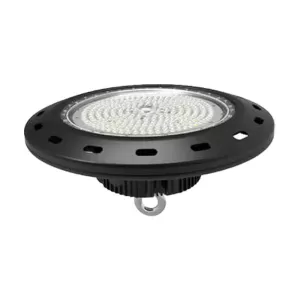
From our range, the UFO LED high bay GKP40F covers 100, 150 and 200 W with 45°, 60°, 90° and 120° beams and Ra 70, 80 or 90. For badminton, use it in the side rows with a wide beam and a guard, not above the courts. For the general method of counting fittings in a hall, see how many LED high bay lights do I need.
Switching court by court
Badminton halls are rarely full. Wire each row separately, so that:
- one court in use lights only its two neighbouring rows;
- training runs at a reduced level on dimmable drivers;
- match play uses all rows at full output.
With 46 fittings of 150 W the hall draws 6.9 kW at full output. Two rows for a single court draw about 2.8 kW.
Multi-sport halls
In a hall shared with basketball or volleyball, the badminton rules are the hardest to satisfy, because the other sports accept fittings in a regular grid. Two workable answers:
- design the grid so that its rows fall in the gaps between badminton courts, and switch off any row that cannot;
- add separate badminton side rows that are used on their own for badminton sessions.
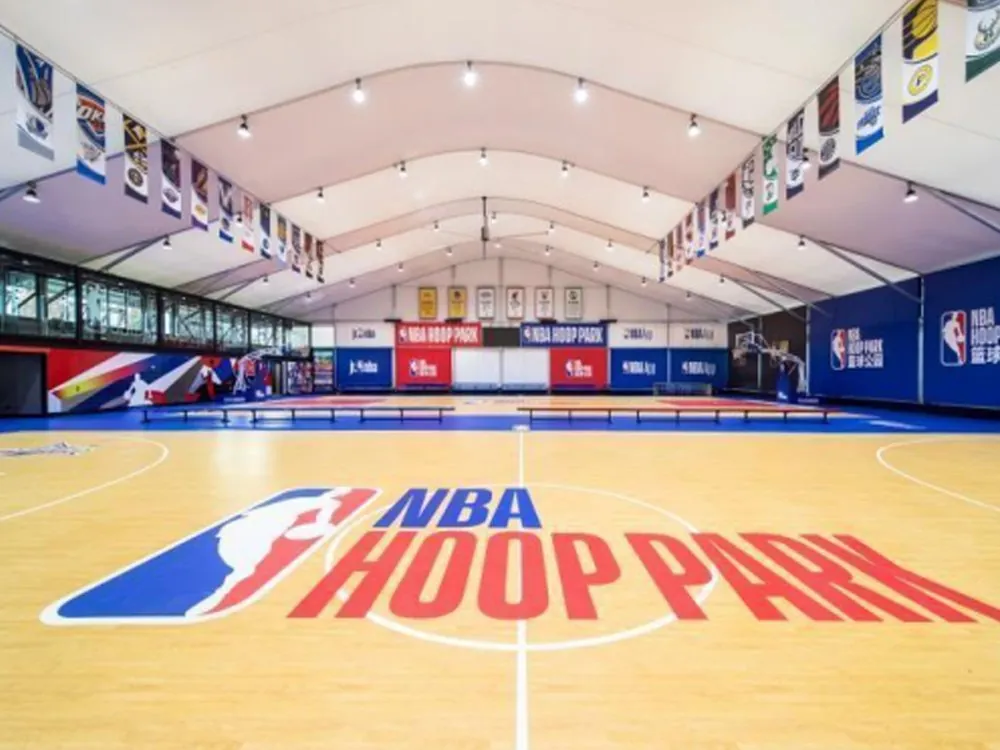
See our guides to basketball court lighting and gym lighting for the other requirements. Our own sports hall project shows fittings mounted high above indoor courts.
Professional and international tournaments
International play uses class I, 750 lux at 0.7 uniformity, on the court. Televised events go further: the Badminton World Federation and the broadcaster set vertical illuminance towards the main cameras, colour rendering and flicker limits for each event, and those requirements are part of the event contract. If your hall is bidding for such events, get the organiser’s lighting specification before the design starts; we then design the side rows and aiming to it.
Outdoor courts
Outdoor badminton is recreational: wind moves the shuttle more than lighting ever will. Four floodlights of 100–150 W on 6–8 m poles at the corners of a court, aimed across it and not along it, give comfortable light for casual play.
Common mistakes
| Mistake | Result |
|---|---|
| High bays in a grid over the courts | Players lose the shuttle in the light |
| White walls and ceiling | Shuttle hard to see against the background |
| Designing with white-wall reflectances for a dark hall | Light level well below target |
| Glossy floor | Reflected glare from every fitting |
| Checking only the average | Uniformity below 0.7 between the rows |
What to send for a design
The hall dimensions and clear height, the number and direction of courts, the wall, ceiling and floor colours, the level of play, and any other sports that use the hall. We return a row layout, a fitting schedule and the calculated illuminance on each court.
Sources
Frequently asked questions
What are the lighting standards for a school gym badminton court?
EN 12193 class III: 300 lux average with a uniformity of 0.7, for school PE and recreation. Gyms that host inter-school or club competitions should be designed for class II, 500 lux. Fittings go in rows beside the courts, never above them.
How many lux is needed for a badminton court?
EN 12193 gives 300 lux for training and recreation, 500 lux for club and regional competition and 750 lux for national and international play, all with a uniformity of 0.7. Major televised events are lit to higher levels set by the organiser.
Where should badminton court lights be placed?
Beside the courts, in rows parallel to the side lines, and above the height the shuttle reaches. Avoid fittings directly over the court and behind the back boundary lines, where players look during clears and serves.
What height should badminton court lights be?
Above the clear playing height. A clear height of about 9 m is commonly required for competition halls, and more for top events, so fittings usually hang at 9–12 m. Low halls need wider beams and more fittings.
Can I use ordinary high bay lights for badminton?
Yes, if they are placed between the courts and shielded. A bare high bay directly above a court is the classic mistake: the player loses the shuttle against it. Linear fittings or high bays with anti-glare covers in side rows work well.