Basketball Gym Lighting: Lux by Level of Play, Fitting Counts and Glare Over the Court
Indoor basketball gym lighting: EN 12193 lux and uniformity by level of play, fitting positions that avoid glare, and counts from our lighting calculator.
Key points
- EN 12193 gives about 200 lux for training and recreational basketball, 500 lux for club competition and 750 lux for national and international matches.
- For a 34 × 20 m hall at 9 m (court plus run-off), our lighting calculator gives 12, 28 and 48 high bays of 200 W at 130 lm/W for those three levels.
- Keep fittings out of the zone directly above the baskets, where players look up during shots and rebounds.
- Impact protection, flicker-free drivers and good uniformity matter as much as the average lux.
Basketball is played looking up. Shooters follow the ball to the ring, rebounders watch it fall from above, and passes travel through the air across the court. That makes glare the defining problem in basketball gym lighting, ahead of the average lux level. This guide covers the levels by class of play, a layout method that keeps fittings out of the players’ eyes, and fitting counts for a typical hall.
Court and hall size
A FIBA court is 28 × 15 m. With run-off and space around the court, a hall for one court is typically around 32–36 × 19–22 m. Our worked example uses 34 × 20 m, with fittings at 9 m. Many school gyms are smaller, with fittings at 7–8 m; community halls with seating are larger.
Light levels by class of play
EN 12193 groups indoor sports into three classes. For basketball:
| Class | Typical use | Average horizontal illuminance | Uniformity (Emin/Eavg) |
|---|---|---|---|
| III | Training, school sport, recreation | 200 lux | 0.5 |
| II | Club and regional competition | 500 lux | 0.7 |
| I | National and international competition | 750 lux | 0.7 |
Televised games need more, and the requirement is set by vertical illuminance on the players towards the main cameras, which needs a separate design. Our sports field lighting lux levels article covers outdoor sports; the indoor table above is the one for gyms.
Worked example: fitting counts at three levels
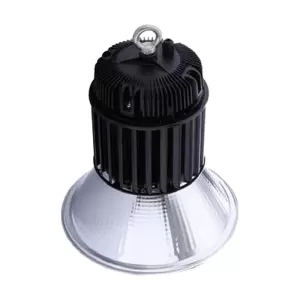
The hall is 34 × 20 m, fittings at 9 m, working plane at 1 m, medium reflectance. Using the GKP40G heat-pipe high bay at 200 W and 130 lm/W, our high bay lighting calculator gives:
| Target | Fittings | Grid | Average lux | Power density |
|---|---|---|---|---|
| 200 lux (Class III) | 12 | 4 × 3 | about 224 | 3.5 W/m² |
| 500 lux (Class II) | 28 | 7 × 4 | about 522 | 8.2 W/m² |
| 750 lux (Class I) | 48 | 8 × 6 | about 894 | 14.1 W/m² |
At 750 lux the calculator’s grid gives well over the target, because the fitting count is rounded up to a regular grid. It also shows that about 168 W per fitting would reach 750 lux on the 48-fitting grid. In practice, a 750 lux hall is often designed with 160–180 W fittings, or with a different grid that suits the roof structure.
The 200 lux and 500 lux designs share a principle worth noting: a Class III hall with 12 fittings cannot become Class II by swapping wattage alone, because 12 positions are too few for 0.7 uniformity. If competition use is planned later, install the 28-position wiring now and fit fewer or lower-wattage fittings first.
Keeping fittings out of the players’ eyes
The calculator gives a regular grid. On a basketball court, adjust it:
- Keep the zone above each basket clear. Fittings directly above the key and the ring are in the line of sight during shots and rebounds. Move them to the sides of the key or towards the baseline wall.
- Run rows along the length of the court. Rows parallel to the sidelines, set slightly outside the court edge, light the court without hanging over the most-watched airspace.
- Use medium or wide beams. Narrow beams create bright spots and high luminance seen from below. The GKP40G comes in 45°, 60°, 90° and 120°; 90° or 120° is usual in gyms at 7–9 m.
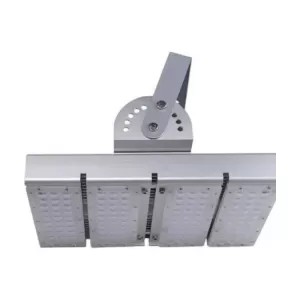
- Consider asymmetric floodlights along the sides in taller halls, aimed across the court with a cut-off that keeps the light source out of normal viewing angles. Our BG-TZ-M modular sports floodlight has a 140° × 80° beam with a 30° offset for this layout.
Our general gym lighting guide covers glare in fitness gyms and multi-use halls, where the problem is different.
Uniformity and the floor
Polished sports floors reflect the fittings, creating bright spots that dazzle in the same way as direct glare. Wider beams and more fittings of lower wattage reduce this effect. Uniformity also matters for players judging distance: a court that is bright in the middle and darker near the baseline makes the ball appear to change speed.
Impact, vibration and flicker
- Impact: basketballs hit fittings. Use a wire guard or an impact-rated fitting, and secure the fixing against repeated knocks. Chains and hooks should have safety clips.
- Vibration: sports halls with lightweight roofs move with wind and drumming feet; check that fittings and drivers are secured.
- Flicker: fast ball sports and video recording show flicker that the eye does not notice. Ask for low-flicker drivers; for broadcast, specify flicker below the camera’s requirement.
Colour
Colour temperature of 4000–5000 K and CRI of 80 or more are standard for sports halls. Video recording and streaming benefit from CRI 90. Our high bays are available at Ra 70, 80 and 90.
Controls and scenes
A gym rarely needs full competition lighting. Common scenes:
- Cleaning and maintenance: about 100 lux
- Training: 200–300 lux
- Competition: 500 lux or more
Dimmable drivers with DALI or 1–10 V let one installation provide all three. That way the hall is built for the highest level but runs most of the time at a lower one.
A real project
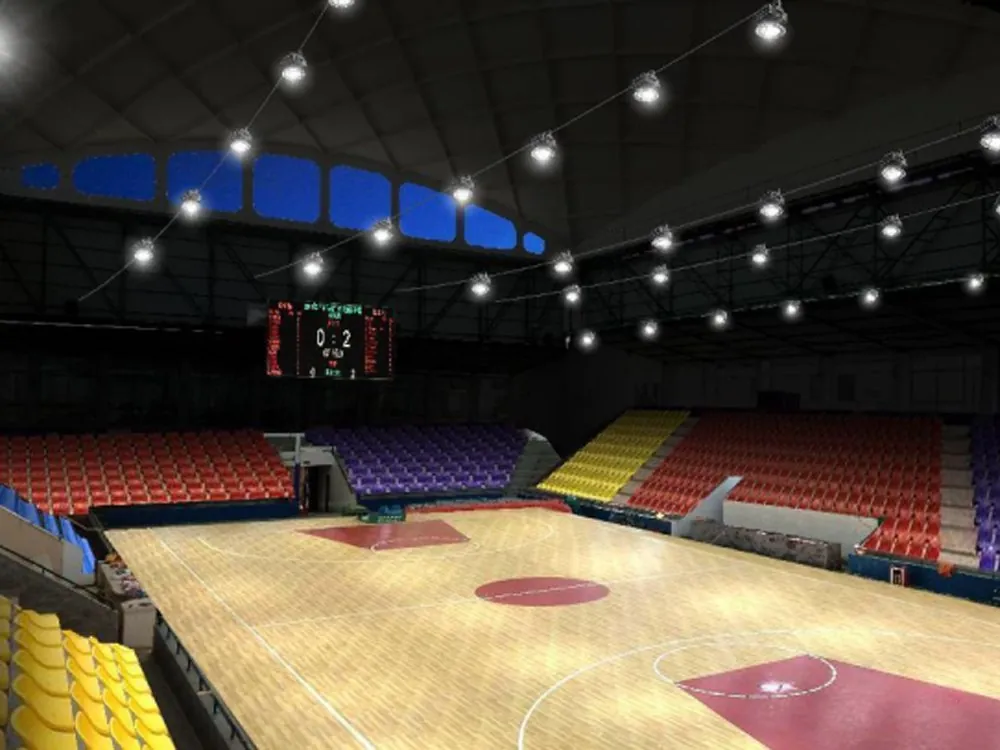
We have lit two indoor basketball arenas and a sports training hall in Hunan with LED fittings mounted high above the courts; the sports hall lighting project shows the installation. The same principles apply: fittings beside, not above, the main lines of play, guards for impact, and enough positions for good uniformity.
Outdoor courts
For outdoor courts, poles and floodlights replace high bays. See our guide to outdoor basketball court lighting for pole layouts and running costs.
What to send us
- Hall dimensions and the clear height to the underside of the roof structure
- Level of play and whether matches will be filmed
- Roof structure, so fittings can be placed on available supports
- Supply voltage and control requirements
We will return a layout with fitting positions that avoid the basket zones, plus calculated lux and uniformity for each scene.
Sources
Frequently asked questions
How many lux does a basketball gym need?
Under EN 12193, about 200 lux for training and school or recreational play, 500 lux for club competition and 750 lux for top-level matches. Televised games need more, defined by vertical illuminance towards the cameras.
How many lights does a basketball court need?
For a 34 × 20 m hall with fittings at 9 m, our calculator gives 12 high bays of 200 W for about 200 lux, 28 for 500 lux and 48 for 750 lux. Your hall size, height and fitting output change the count.
Where should lights go in a basketball gym?
Spread them over the court and run-off, but avoid placing fittings directly above the baskets and the key, where players look up most. Put them along the sides of that zone instead.
Do gym lights need guards?
Yes, in most halls. Balls hit the fittings. Use guards or impact-resistant fittings, and make sure the fixing is secure enough for repeated impacts.