Ethanol Plant Lighting: Gas Group, Temperature Class and Area-by-Area Layouts
Lighting a fuel ethanol plant: why ethanol is IIA T2, which areas from grain milling to loadout need Ex fittings, and calculated layouts for a distillation building and a hammer mill room.

Key points
- An ethanol plant has two hazards: grain dust at intake and milling (group IIIB), and ethanol vapour from distillation onwards (gas group IIA, temperature class T2, flash point about 13 °C).
- Ethanol vapour is heavier than air, so pits, trenches and the floor around pumps and loading arms are where it collects and where zones extend furthest.
- Our calculator gives 15 BED fittings of 60 W for about 166 lux in a 24 × 12 m distillation building at 6 m, and 12 BED fittings of 60 W for about 228 lux in a 15 × 10 m hammer mill room.
- Fermentation and DDGS buildings are often unclassified or only partly classified; there 15 GKP40G high bays of 150 W light a 40 × 20 m hall to about 173 lux.
A dry-mill ethanol plant turns grain into fuel in a straight line: receive the grain, grind it, cook and ferment the mash, distil the beer into ethanol, dehydrate it, then store and ship it. Two different explosion hazards appear along that line, at different ends. This guide follows the process and shows how lighting changes along it, with calculated layouts for the two most typical hazardous rooms.
Ethanol’s properties, and what they mean for lighting
| Property | Value | Consequence |
|---|---|---|
| Gas group | IIA | Any IIA, IIB or IIC fitting qualifies |
| Auto-ignition temperature | about 363 °C | Temperature class T2 or better |
| Flash point | about 13 °C | Flammable vapour at normal room temperature |
| Vapour density | about 1.6 (air = 1) | Collects low, in pits, trenches and sumps |
IIA T2 is an easy requirement for a fitting to meet; almost every certified luminaire is better. The harder part is the zoning, because ethanol is handled in large volumes and the vapour spreads along the ground. Our guides to IIB vs IIC gas groups and T3 vs T4 temperature classes explain the markings in more depth.
The process, area by area
| Area | Hazard | Typical classification |
|---|---|---|
| Grain receiving pit, elevator, bins | Grain dust | Zone 20 inside equipment, Zone 21/22 around |
| Hammer mill room | Grain dust | Zone 21 or 22 |
| Cook and liquefaction | Hot mash, steam | Usually unclassified |
| Fermentation | CO₂, small ethanol content | Often unclassified; local zones at vents |
| Beer well, distillation, rectifier, molecular sieve | Ethanol vapour | Zone 2, with Zone 1 at pumps, sample points, pits |
| Tank farm (200 proof, denaturant, E85 blend) | Ethanol, gasoline vapour | Zone 1 inside bunds near vents, Zone 2 around |
| Truck and rail loadout | Ethanol vapour | Zone 1 near the loading arm, Zone 2 around |
| DDGS dryers and storage | Organic dust, heat | Local dust zones depending on design |
Denaturant is usually natural gasoline, which is also IIA but with a lower auto-ignition temperature, around T3. Where denaturant is handled, the fittings should be T3 or better. A T4 fitting covers both.
Calculation 1: the distillation building
Many plants put distillation columns outdoors in a structure, with the reboilers, pumps and condensers in a building at the base. Take a 24 × 12 m pump and distillation building, fittings at 6 m, medium reflectance, 150 lux, classified Zone 2 with Zone 1 around the pump seals.
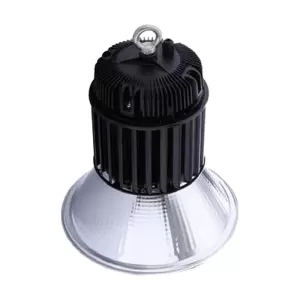
With our BED explosion-proof LED light at 60 W and a conservative 110 lm/W, the high bay lighting calculator gives:
| Result | Value |
|---|---|
| Room index | 1.54 |
| Fittings | 15 (5 × 3) |
| Spacing | 4.8 m × 4.0 m |
| Average illuminance | about 166 lux |
| Power density | 3.1 W/m² |
The BED’s gas marking, Ex db eb mb IIC T4 Gb, covers Zone 1 and Zone 2, and its certificate is ZJEx23.0914. In practice the layout is adjusted around pipe racks and column skirts so that pumps, valves and gauges are not in shadow. Add extra fittings at sample points and level glasses, where operators read small markings.
Calculation 2: the hammer mill room
At the other end of the plant, grain is ground in hammer mills. The mills themselves are enclosed, but dust escapes at transfer points and seals. Take a 15 × 10 m mill room, fittings at 6 m, 200 lux, classified Zone 22 outside the equipment.
With BED fittings at 60 W, the same calculator gives 12 fittings (4 × 3) at 3.8 m × 3.3 m spacing, about 228 lux. The BED’s dust marking, Ex tb IIIC T130 °C Db, applies here; the 130 °C surface temperature has to be checked against the grain dust’s ignition data as described in our flour mill lighting guide. Grain receiving and elevators follow the grain elevator lighting guide.
Fermentation and DDGS buildings
Fermenters are large tanks, often outdoors, with a building for the beer well, heat exchangers and CIP equipment. Where the area classification leaves these unclassified, standard industrial high bays are fine and cheaper. For a 40 × 20 m hall at 10 m and 150 lux, 15 GKP40G heat-pipe high bays of 150 W give about 173 lux in the calculator. Warm, humid air from cooking and fermentation means IP65 is the minimum.
The fermentation area has another hazard that lighting does not solve but should support: carbon dioxide. Fermentation releases large volumes of CO₂, which is heavier than air and can collect in pits and tank entries. Good lighting at confined-space entries, gas detectors and alarms helps people see warning signs and escape.
Tank farm and loadout
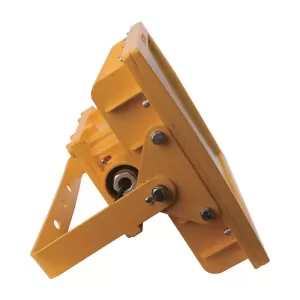
Outdoor tank farms and loading racks are lit with Ex floodlights on poles or structures, kept outside the most severe zones where possible. Light the loading arm, bonding connection and the truck’s dome or bottom-loading couplings. Our tank farm lighting and fuel loading rack lighting guides cover pole positions and levels in detail. The ExF series (Ex d IIB T6 Gb, IP67) suits IIA ethanol vapour outdoors; its certificate is provided with the quotation.
Common mistakes
- Classifying by building, not by source. A whole building marked “Zone 1” costs more than needed; a building marked “safe” because the columns are outside can still have a Zone 1 pit inside.
- Forgetting the denaturant. It changes the temperature class requirement from T2 to T3.
- Leaving the mill room to the end. Dust zones are easier to miss than vapour zones, and the dust marking on the fitting is a separate check.
- Ignoring heat. Dryers, evaporators and distillation reboilers heat the air under the roof. Check the fitting’s rated ambient.
Emergency lighting
Escape routes in classified areas need emergency fittings with the same Ex rating as the normal ones. Our explosion-proof emergency light guide covers placement and duration.
What to send us
- The area classification drawings for vapour and dust areas
- Building and structure dimensions with mounting heights
- Required lux per area and the owner’s lighting standard, if any
- Supply voltage and emergency lighting requirements
We return a fitting list and a layout per area, using Ex fittings only where the classification calls for them.
Sources
Frequently asked questions
What gas group and temperature class is ethanol?
Ethanol is gas group IIA with an auto-ignition temperature of about 363 °C, which puts it in temperature class T2. Any fitting marked IIA, IIB or IIC and T2 or better (T3, T4, T5, T6) meets that requirement, subject to the zone.
Which areas of an ethanol plant are hazardous?
Typically the distillation and dehydration area, the 200-proof and denaturant tank farm, product pumps and the truck and rail loadout for vapour; and grain receiving, conveying and hammer milling for dust. Fermentation is often unclassified but depends on the design. The plant's area classification drawing decides.
Can one fitting cover both ethanol vapour and grain dust?
Yes, if it carries both a gas and a dust marking. Our BED series is marked Ex db eb mb IIC T4 Gb for gas and Ex tb IIIC T130 °C Db for dust, so the same fitting can be used in Zone 1 or 2 gas areas and Zone 21 or 22 dust areas.
How much light does an ethanol plant need?
Around 150 lux in process buildings, 100 lux on outdoor process structures and walkways, 200 lux in mill rooms and maintenance areas, and more in control rooms and laboratories. The owner's or EPC contractor's standard usually sets the final values.