Flour Mill Lighting: Dust Zones, Surface Temperature and a Roller-Floor Layout
Which parts of a flour mill need dust-protected Ex lighting, how to check a fitting's surface temperature against flour ignition data, and a 30 × 18 m roller floor calculated both ways.
Key points
- Flour is a combustible, non-conductive dust (group IIIB, or Class II Group G in North America). Bins, filters and elevator legs are usually Zone 20; bag tipping and packing points Zone 21; well-kept mill floors Zone 22 or unclassified.
- Check the fitting's maximum surface temperature against two limits: two-thirds of the dust cloud ignition temperature, and the 5 mm layer ignition temperature minus 75 K.
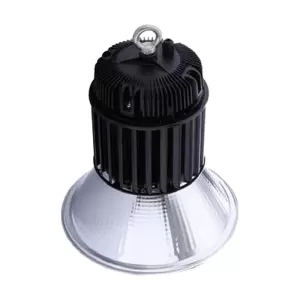
- For a 30 × 18 m roller floor at 8 m and 200 lux, our calculator gives 24 BED explosion-proof fittings of 100 W (about 238 lux) if the floor is Zone 21 or 22, or 20 ordinary GKP40G high bays if it is unclassified.
- Smooth, dust-tight housings mounted where they can be cleaned matter as much as the certificate: a thick dust layer raises surface temperature and is fuel for a secondary explosion.
Flour is food, so it is easy to forget that it is also fuel. Finely divided flour suspended in air burns fast enough to explode, and mills have a long history of dust explosions. Lighting is one of the few electrical items installed in every part of the building, including the dusty ones, so it deserves a careful choice. This guide follows a mill from intake to packing, shows how to check a fitting’s temperature against flour data, and calculates a roller floor two ways.
Where the hazardous areas are
Dust zones are defined by IEC 60079-10-2 according to how often a combustible dust cloud is present. In a flour mill the pattern is usually:
| Area | Typical zone | Why |
|---|---|---|
| Inside silos, bins, filters, cyclones, elevator legs | Zone 20 | Dust cloud present continuously or for long periods |
| Bag tipping, intake pits, packing and bulk loading points | Zone 21 | Dust released in normal operation |
| Roller floor, sifter floor, purifier floor | Zone 22 or unclassified | Dust only from leaks, if enclosed equipment and housekeeping are good |
| Warehouse for packed flour | Usually unclassified | Dust contained in bags |
| Control room, laboratory, offices | Unclassified | Separated and kept clean |
Lighting fittings are not normally installed in Zone 20. Light inside a bin or filter comes from outside through an inspection port, or from a portable certified lamp during maintenance. The question for fixed lighting is therefore mostly Zone 21 and Zone 22, and whether a floor is classified at all.
In North America the equivalent is Class II, Group G (grain and flour dust), Division 1 or 2. NFPA 61 covers dust explosion prevention in food processing and grain facilities. See our guide to Class II Division 1 lighting for the Division wording.
Checking surface temperature against flour data
Dust areas do not use T-classes for the selection limit. Instead the fitting is marked with its maximum surface temperature, for example T130 °C, and IEC 60079-14 compares it with two properties of the dust:
- Cloud limit: the surface temperature must not exceed two-thirds of the minimum ignition temperature of the dust cloud.
- Layer limit: for layers up to 5 mm, it must not exceed the 5 mm layer ignition temperature minus 75 K. Thicker layers need a larger margin and laboratory advice.
Use test data for your own product; ignition temperatures vary with particle size, moisture and additives. As a worked illustration only, suppose a test report gave a cloud ignition temperature of 380 °C and a 5 mm layer ignition temperature of 300 °C:
| Limit | Calculation | Result |
|---|---|---|
| Cloud | 2/3 × 380 °C | 253 °C |
| Layer (5 mm) | 300 °C − 75 K | 225 °C |
| Permitted maximum surface temperature | Lower of the two | 225 °C |
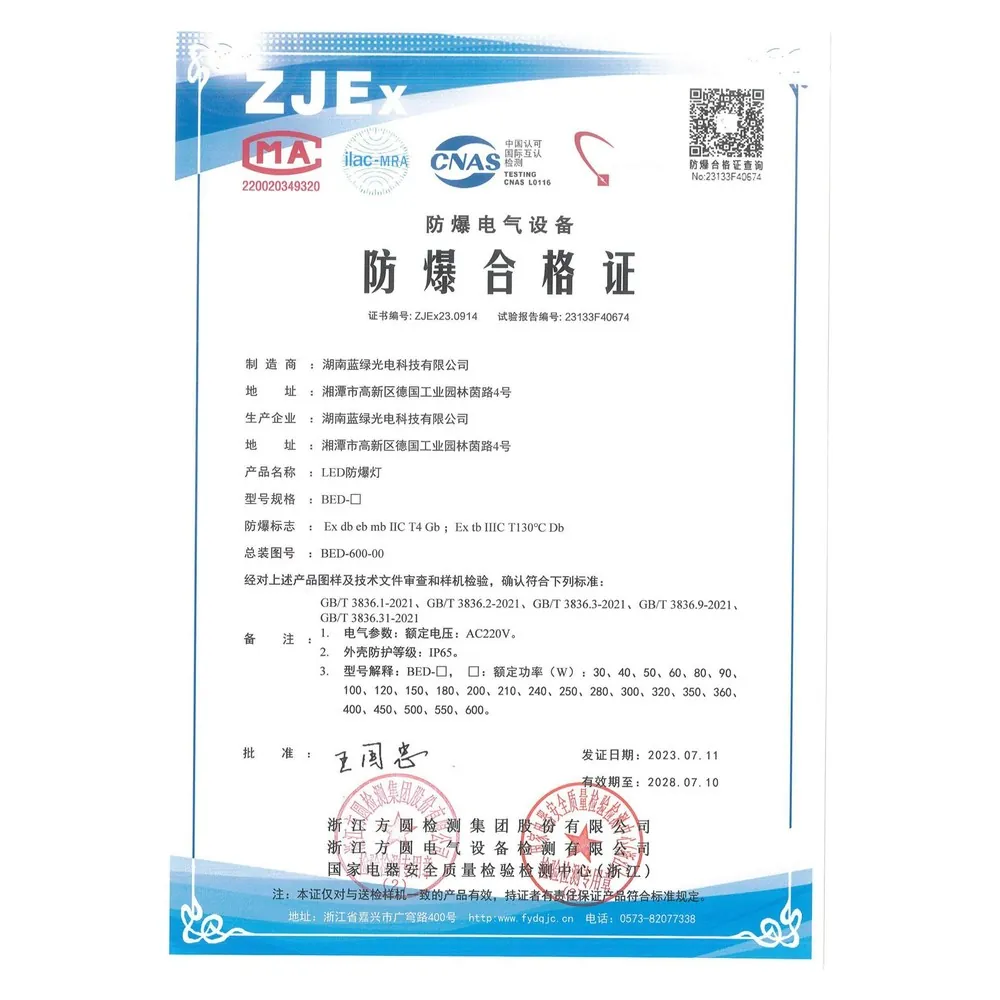
A fitting marked T130 °C would then pass with a wide margin. Our BED explosion-proof LED light carries Ex tb IIIC T130 °C Db for dust, alongside its gas marking, under certificate ZJEx23.0914. Group IIIC covers conductive dusts as well, so it also covers non-conductive flour (IIIB). EPL Db means it is suitable for Zone 21 and Zone 22.
Calculating a roller floor
Take a roller floor of 30 × 18 m, 8 m to the underside of the roof, medium surface reflectance, and a target of 200 lux on the working plane.
If the floor is classified Zone 21 or 22. With BED fittings at 100 W and a conservative 110 lm/W, our high bay lighting calculator gives:
| Result | Value |
|---|---|
| Room index | 1.56 |
| Fittings | 24 (6 × 4) |
| Spacing | 5.0 m × 4.5 m |
| Average illuminance | about 238 lux |
| Power density | 4.4 W/m² |
If the floor is unclassified. With the GKP40G heat-pipe high bay at 100 W and 130 lm/W, the same calculation gives 20 fittings (5 × 4) at 6.0 m × 4.5 m spacing and about 234 lux.
The four extra fittings come from the lower efficacy assumed for the Ex fitting. The bigger cost difference is in the fittings themselves and in certified cable glands and installation to IEC 60079-14. That is why the classification should be done properly before the lighting is chosen, not after. Our explosion-proof lights count guide explains the method in more detail.
Dust on the fittings
A dust layer acts as insulation. It raises the fitting’s surface temperature and, if disturbed by a primary explosion, becomes the fuel for a much larger secondary one. For lighting this means:
- Smooth tops and few ledges. Fin heat sinks collect dust; flat, sloped or easily wiped surfaces are better in Zone 21.
- Dust-tight enclosures. IP6X is required in Zone 21. The BED series is rated IP65.
- Access for cleaning. Mount fittings where they can be reached by the cleaning routine, not tucked above conveyors where nobody goes.
- No open wiring or loose glands. Use certified glands for the Ex fittings and seal unused entries.
The general principles for dust areas are in our Zone 21 and 22 combustible dust lighting guide.
Intake, silos and the elevator
Grain intake pits, elevator boots and silo tops are often the dustiest parts of a mill site, and they are covered in our grain elevator lighting guide. Inside a mill building the same rules apply around bucket elevators and screw conveyors: keep fixed fittings outside the equipment and away from inspection hatches that are opened in operation.
Packing and loading
Packing machines and bulk loading spouts release dust every time a bag is filled or a tanker is loaded. Zone 21 around these points is common. Light the operator position from the side so the operator does not stand in their own shadow, and use more light at check-weighers and labelling, where reading accuracy matters. Bulk loading bays are often semi-open, so fittings must also handle temperature swings and condensation.
Emergency lighting
Mills have long escape routes through multi-storey buildings with stairs between floors. In classified areas the emergency fittings must carry the same dust protection as the normal ones. Plan an emergency fitting at each stair, each exit and over the emergency stops on the roller floor.
What to send us
- Floor plans with heights for each floor
- The area classification drawing, or a description of where dust is released
- Dust test data: cloud and layer ignition temperatures, if available
- Supply voltage and emergency lighting requirements
We return a fitting choice and a layout for each floor, Ex where the classification requires it and ordinary high bays where it does not.
Sources
Frequently asked questions
Does a flour mill need explosion-proof lighting?
Parts of it do. Inside bins, filters and conveyors the dust cloud is present often enough to make Zone 20; around bag tipping, packing and open transfer points Zone 21 is common. General floors may be Zone 22 or unclassified, depending on housekeeping and enclosure. The area classification decides, area by area.
What temperature class do I need for flour dust?
Dust areas use a maximum surface temperature in °C rather than T-classes. The limit is the lower of two-thirds of the cloud ignition temperature and the 5 mm layer ignition temperature minus 75 K, using test data for your flour. Thicker layers need a bigger margin.
What IP rating is needed for lights in a flour mill?
Dust-tight, IP6X, for fittings in Zone 21. In Zone 22 with non-conductive dust such as flour, IP5X is allowed by IEC 60079-14, but most mills use dust-tight fittings throughout to simplify cleaning.
How much light does a flour mill need?
Around 200 lux on roller and sifter floors is a common design value, with more at control panels, laboratories and packing inspection. Storage and conveyor galleries can be lower.