Lighting for Combustible Dust Areas: Zone 21 and 22, Dust Groups and the Temperature Margin
How to choose lights for combustible dust areas: Zone 20, 21 and 22, dust groups IIIA–IIIC, Ex t protection, and the cloud and layer temperature rules worked for a real T130 °C light.

Key points
- Dust areas are zoned like gas areas: Zone 20 (cloud present continuously or often), Zone 21 (likely in normal operation) and Zone 22 (not likely, short duration). Lights need EPL Da, Db or Dc to match.
- Dust groups are IIIA (fibres), IIIB (non-conductive dust) and IIIC (conductive dust). A IIIC light covers all three.
- IEC 60079-14 limits the light's surface temperature to two-thirds of the dust-cloud ignition temperature and to 75 K below the 5 mm layer ignition temperature.
- Our BED series is marked Ex tb IIIC T130 °C Db, so by those rules it suits dusts whose cloud ignition temperature is at least 195 °C and whose 5 mm layer ignition temperature is at least 205 °C.
Flour, sugar, grain, starch, wood, coal, plastics, pharmaceutical powders and metal powders all burn. Suspended as a cloud in the right concentration they explode; settled as a layer on a hot surface they smoulder and can ignite a cloud later. Lighting in these areas must be selected for dust, not just for gas, and the key number is not a T class but a temperature in degrees Celsius. This guide covers the zones, groups and protection types, and works the temperature rules through for a real light.
Dust zones
IEC 60079-10-2 classifies dust areas by how often a combustible cloud is present:
| Zone | Description | Typical locations | EPL required |
|---|---|---|---|
| Zone 20 | Cloud present continuously, for long periods or often | Inside silos, mills, hoppers, filters | Da |
| Zone 21 | Cloud likely in normal operation | Around bag-tipping stations, open transfer points, filling heads | Da or Db |
| Zone 22 | Cloud not likely; short duration if it occurs | Rooms around Zone 21, near flanges that may leak | Da, Db or Dc |
Lights are rarely placed in Zone 20; most dust-area lighting sits in Zone 21 or 22. In North America the equivalent is Class II, Division 1 or 2; our Class 2 Division 1 lighting guide covers that side, and the Class/Division vs Zone table translates between them.
Dust groups
| Group | Material | Examples |
|---|---|---|
| IIIA | Combustible flyings and fibres | Cotton, sisal, wood fibres |
| IIIB | Non-conductive dust | Flour, grain, sugar, starch, most plastics |
| IIIC | Conductive dust | Metal powders such as aluminium, some carbon dusts |
A IIIC light may be used for IIIB and IIIA as well. A IIIB light must not be used where conductive dust is present, because conductive dust entering an enclosure can short live parts.
Protection types for lights
The usual protection for dust-area luminaires is Ex t, protection by enclosure (IEC 60079-31): a dust-tight housing (IP6X) whose surface temperature is limited and verified. It comes in three levels:
- ta, for Zone 20 (Da)
- tb, for Zone 21 and 22 (Db)
- tc, for Zone 22 (Dc)
Some lights combine a gas marking and a dust marking on the same fitting, which is useful in plants with both hazards. A light with only a gas marking, however good, has not been assessed for dust layers and should not be used in a dust zone. Our hazardous area light fixtures guide shows which fitting types suit which rooms.
The temperature rules
Dust markings give the maximum surface temperature in °C, for example T130 °C, instead of a gas T class. That figure must be compared with two properties of the dust, both found in its safety data or test report:
- Tcl, the minimum ignition temperature of a dust cloud
- T5mm, the minimum ignition temperature of a 5 mm layer
IEC 60079-14 then sets two limits, and the light must meet both:
- Cloud rule: Tmax ≤ ⅔ × Tcl
- Layer rule: Tmax ≤ T5mm − 75 K (for layers up to 5 mm)
For layers thicker than 5 mm the allowed temperature drops further, and very thick layers need laboratory assessment. That is why housekeeping, keeping dust off fittings, is part of the protection concept, not just tidiness.
Worked example: a T130 °C light
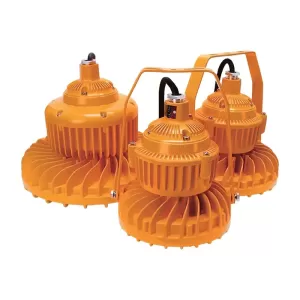
Our BED series, 30–600 W, carries a dust marking of Ex tb IIIC T130 °C Db alongside its gas marking, under our own certificate ZJEx23.0914 (valid to 10 July 2028). Turning the two rules around gives the dusts it may be used with:
| Rule | Requirement | Minimum dust property |
|---|---|---|
| Cloud: 130 ≤ ⅔ × Tcl | Tcl ≥ 130 × 1.5 | Cloud ignition temperature ≥ 195 °C |
| Layer: 130 ≤ T5mm − 75 | T5mm ≥ 130 + 75 | 5 mm layer ignition temperature ≥ 205 °C |
So for any dust whose test data show a cloud ignition temperature of at least 195 °C and a 5 mm layer ignition temperature of at least 205 °C, the BED meets the temperature requirement in Zone 21 and 22, with layers kept to 5 mm or less. Its IIIC group covers conductive and non-conductive dust, and its Db level covers both zones. Always check the actual values for your dust; some materials and blends have much lower ignition temperatures, and local codes may add their own margin.
By contrast, our BDE507 is marked Ex d IIC T6 Gb for gas only. It is a good gas-zone light but has no dust marking, so it is not for Zone 21 or 22.
Typical sites and where the lights go
- Flour and feed mills: Zone 21 around open transfer points and bagging; Zone 22 in the surrounding rooms. Mount lights away from the plume of tipping stations.
- Grain terminals and silos: Zone 20 inside bins; lights go in the head house and galleries, typically Zone 21 or 22.
- Sugar and starch plants: fine, easily ignited dust; check the ignition data carefully.
- Woodworking: extraction reduces zones, but filter housings and collection rooms are often Zone 21 or 22.
- Pharmaceutical powder handling: small rooms, often with both solvent vapour and dust; combined gas and dust markings help.
- Metal powder processing: conductive dust, IIIC required.
Light levels
Dust zones are usually production or handling areas, so the normal task levels apply: around 200 lux for handling and packing, 300 lux where operators read gauges or labels. Count the fittings with the high bay and warehouse lighting calculator, and choose a smooth housing that sheds dust; fins and ledges collect layers.
Installation and maintenance
- Use cable glands certified for the dust zone and keep unused entries plugged with certified stoppers.
- Keep the enclosure seals intact; an open or damaged gasket defeats Ex t.
- Clean fittings regularly so layers never approach 5 mm.
- Inspect to IEC 60079-17, including the condition of glass and seals. Our explosion-proof light installation guide covers the common steps.
What to send us
The area classification with dust zones, the dust type with its cloud and layer ignition temperatures, any gas zones in the same area, the room sizes and mounting heights. We will check the temperature margin for the proposed series and return a fitting count and the certificate.
Sources
Frequently asked questions
What lights are needed in Zone 21 and Zone 22?
Lights certified for combustible dust with equipment protection level Db (Zone 21 and 22) or Dc (Zone 22 only), of the right dust group, and with a maximum surface temperature low enough for the dust present. They are usually marked Ex tb or Ex tc.
What does Ex tb IIIC T130 °C Db mean?
Ex tb: dust protection by enclosure, level b. IIIC: suitable for conductive dust, which also covers non-conductive dust and fibres. T130 °C: the maximum surface temperature. Db: suitable for Zone 21 and Zone 22.
Is an IP6X light enough for a dust zone?
No. Dust-tightness is one part of Ex t protection, but certification also covers the surface temperature, materials, impact and the enclosure's construction. Only a certified Ex t (or other dust-protected) light is acceptable.
Can a gas-rated explosion-proof light be used in a dust area?
Only if it also carries a dust marking. A light marked only for gas, such as Ex d IIC T6 Gb, has not been assessed for dust layers and cloud ignition and should not be used in Zone 21 or 22.
How thick can a dust layer get on a light?
The temperature rule assumes layers up to 5 mm. Thicker layers insulate the surface and lower the ignition temperature further, so IEC 60079-14 requires a larger margin or special assessment. Good housekeeping keeps layers thin.