
Class II Division 1 Lighting: Combustible Dust Areas, Zone 21 and Surface Temperature
What Class II Division 1 means for LED lighting in grain, flour, sugar, wood and metal dust areas, how it maps to Zone 21, how to check surface temperature, and a dusty hall layout.
Key points
- Class II is the North American class for combustible dust. Division 1 means ignitable dust clouds are present in normal operation, or conductive (Group E) metal dust is present; Groups E, F and G cover metal, carbon and other dusts such as grain, flour, sugar, wood and plastics.
- In the IEC zone system, the closest equivalents are Zone 20 and Zone 21, with dust groups IIIA, IIIB and IIIC. The two systems are not interchangeable: a North American project needs a Class/Division or Zone listing recognised there.
- Surface temperature is the key check: under IEC 60079-14 the marked temperature must stay below two-thirds of the dust cloud ignition temperature and 75 K below the 5 mm layer ignition temperature.
- For a 36 × 18 m dusty storage hall at 10 m, our calculator gives 24 fittings of 150 W for 150 lux with dark surfaces and a 0.7 maintenance factor, about 194 lux.
Combustible dust is easy to underestimate. Flour, sugar, grain, starch, wood, coal, plastics and many metal powders can explode when suspended in air and ignited, and layers of dust on hot surfaces can smoulder and start fires. Lighting in these areas has to keep dust out and stay cool enough not to ignite it. In North America, these areas are described as Class II locations; Division 1 is the more severe category. This guide explains what that means, how it compares with the IEC zone system, and how to choose and lay out fittings.
Class II: the dust class
The US National Electrical Code (Article 500) divides hazardous locations into three classes: Class I for gases and vapours, Class II for combustible dust, and Class III for fibres and flyings. Class II is divided into groups by dust type:
| Group | Dust type | Examples |
|---|---|---|
| E | Combustible metal dust | Aluminium, magnesium and their alloys |
| F | Carbonaceous dust | Coal, carbon black, coke |
| G | Other combustible dust | Grain, flour, starch, sugar, wood, plastics, chemicals |
Division 1 covers locations where dust is in the air in ignitable quantities during normal operation; where mechanical failure or abnormal operation could produce an explosive mixture and also an ignition source; or where conductive Group E dust may be present. Division 2 covers locations where ignitable dust clouds occur only abnormally, or where dust layers could build up and interfere with heat dissipation.
How it compares with the zone system
Outside North America, and in NEC Article 506 as an option, dust areas are classified into zones under IEC 60079-10-2:
| Zone | Dust cloud presence | Rough North American equivalent |
|---|---|---|
| Zone 20 | Continuously, for long periods or frequently | Class II Division 1 |
| Zone 21 | Likely occasionally in normal operation | Class II Division 1 |
| Zone 22 | Not likely, and only briefly | Class II Division 2 |
Dust groups in the IEC system are IIIA (combustible flyings), IIIB (non-conductive dust) and IIIC (conductive dust). IIIC equipment can be used for IIIB and IIIA.
The equivalence is approximate, and the approval systems are separate. A project in the US or Canada needs equipment listed for Class II Division 1 (or for the matching zone under the North American code), by a body recognised there. A fitting certified under IECEx, ATEX or a national zone scheme is not automatically accepted. Our guide to who certifies explosion-proof lights explains the main schemes.
Surface temperature: the most important check
Dust ignites in two ways: as a cloud touching a hot surface, or as a layer that slowly heats on top of a fitting. IEC 60079-14 sets the margins:
- The fitting’s maximum surface temperature must not exceed two-thirds of the dust cloud ignition temperature.
- It must be at least 75 K below the ignition temperature of a 5 mm dust layer.
- For thicker layers, a larger reduction applies.
A worked example with illustrative dust data: for a dust with a cloud ignition temperature of 420 °C and a 5 mm layer ignition temperature of 290 °C, the limits are 420 × 2/3 = 280 °C and 290 − 75 = 215 °C. The lower figure, 215 °C, governs. A fitting marked T130 °C passes with a wide margin. Use the measured values for your dust; they vary widely between products and particle sizes.
North American codes have their own temperature rules for Class II equipment; the listing and the code article for your group decide.
Our dust-rated fitting
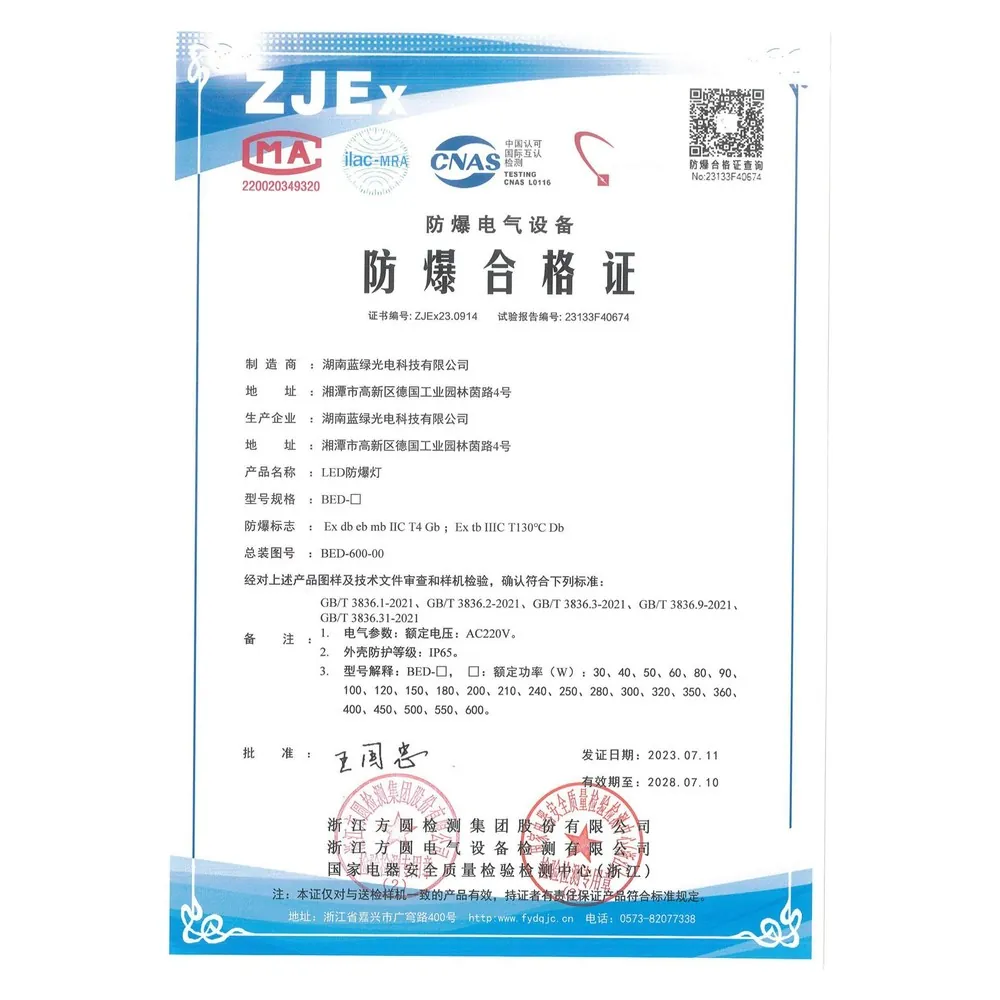
Our BED series LED explosion-proof light, 30–600 W, carries two markings under our certificate ZJEx23.0914:
- Gas: Ex db eb mb IIC T4 Gb (Zone 1 and Zone 2 gas areas)
- Dust: Ex tb IIIC T130 °C Db (Zone 21 and Zone 22 dust areas, including conductive dust)
It is IP65. The “tb” means protection by enclosure: the housing is dust-tight and its outside surface stays below the marked 130 °C. This certificate is a zone-system certificate; it is not a North American Class II listing. For projects that require one, tell us at the enquiry stage so certification can be confirmed for the exact model before anything is ordered. See our guide to explosion-proof light ratings for how to read each part of a marking.
Worked example: a dusty storage hall
We ran a 36 × 18 m grain or flour storage hall with a 10 m mounting height through our high bay lighting calculator: 150 lux target, dark reflectances (dust settles on walls and roof), a maintenance factor of 0.7 rather than 0.8 because lenses get dirty faster, medium beam, and 150 W fittings at an assumed 100 lm/W (check the datasheet of the model selected).
| Result | Value |
|---|---|
| Fittings | 24, in a 6 × 4 grid |
| Spacing | 6.0 × 4.5 m |
| Average illuminance | about 194 lux |
| Wattage that would just reach 150 lux | about 116 W per fitting |
The grid is set by the hall shape and the spacing limit, not only by lumens, which is why the result overshoots. A lower wattage per fitting would reach the target with the same grid. Fewer, more powerful fittings would mean fewer cable entries and glands to maintain, a real benefit in dust areas.
Installation and maintenance in dust areas
- Glands and conduit seals: use certified dust-tight glands matched to the cable; an open entry defeats the enclosure.
- Housekeeping: dust layers on fittings raise their temperature and insulate them. Clean before layers build up; never let them approach the thickness assumed in the design.
- Avoid horizontal ledges where possible; mount fittings so dust slides off.
- Lens cleaning: a clean lens restores light and reduces heat in the fitting.
- Inspection: check seals, gaskets and fixings at intervals set by your inspection regime.
For gas areas, see our guides to Class 1 Division 1 and Class 1 Division 2 lighting; for high halls with both gas and dust, our explosion-proof high bay lighting guide.
What to send for a quotation
- The area classification: Division or zone, dust group, and the code that applies.
- Dust type with its cloud and layer ignition temperatures.
- Hall dimensions, mounting height and target lux.
- Ambient temperature range and any corrosive conditions.
- The certification your authority requires.
Frequently asked questions
What is a Class II Division 1 location?
Under the US National Electrical Code, a Class II location has combustible dust. Division 1 means the dust is in the air in ignitable quantities during normal operation, or that abnormal operation could create an explosive mixture and an ignition source at the same time, or that conductive Group E metal dust is present.
Is Class II Division 1 the same as Zone 21?
They are close but not identical. Division 1 covers conditions that in the zone system fall in Zone 20 or Zone 21. Equipment must be approved for the system your authority uses; a Zone 21 marking alone is not automatically accepted for a Class II Division 1 area in North America.
What temperature rating do I need for dust areas?
Under IEC 60079-14, the maximum surface temperature of the fitting must not exceed two-thirds of the dust cloud's ignition temperature, and must be at least 75 K below the ignition temperature of a 5 mm dust layer. Thicker layers need further reduction. Get the dust data from your process engineer or a laboratory test.
Can an explosion-proof gas fitting be used in a dust area?
Only if it is also marked and certified for dust. Gas and dust protection are separate: check that the fitting carries a dust marking such as Ex tb IIIC with a maximum surface temperature, or a Class II listing where that system applies.
