Tire Plant Lighting: Carbon Black, Solvent Cement, Curing Heat and Inspection
A tire factory has four lighting problems in one building: carbon black dust, solvent cement areas, hot and humid curing halls, and inspection that needs high lux. Fittings and layouts for each.
Key points
- Most of a tire plant is not a hazardous area. The exceptions are solvent cement and spraying points, which can be Zone 1 or 2, and carbon black and chemical handling, where conductive dust may create Zone 21 or 22.
- Curing halls are the hardest place for an ordinary LED high bay: heat and steam under the roof can exceed a +50 °C rating. Our BG-NGW is rated to +65 °C; a 40 × 20 m hall at 10 m and 300 lux needs 32 of them at 150 W.
- A solvent cement room of 12 × 8 m classified Zone 2 needs 12 BED explosion-proof fittings of 60 W for about 336 lux in our calculator.
- Final inspection needs far more light than production: a 20 × 12 m inspection area at 750 lux takes 24 GKP40G high bays of 150 W.
A tire plant is a long chain of very different processes under one roof. Raw rubber and carbon black are mixed in heavy mixers, the compound is extruded and calendered, tires are built on drums, cured in hot presses, then inspected and stored. Each stage asks something different of the lighting. Get the hazardous areas wrong and you either waste money on Ex fittings or break the rules. Get the curing hall wrong and ordinary LED fittings fail early from heat.
Map of a tire plant
| Area | Lighting issue | Typical choice |
|---|---|---|
| Raw material store, carbon black silos and conveying | Conductive dust may create Zone 21/22 | Dust-certified IIIC fittings where classified |
| Mixing hall (internal mixers) | Dust, heat, vibration; usually unclassified | Robust industrial high bays |
| Extrusion and calendering | Heat and humidity near lines | Sealed high bays |
| Tire building | Precision work; solvent cement if used | Good uniformity; Ex near solvent points |
| Solvent cement, spraying, solvent store | Gas zones possible | Explosion-proof fittings |
| Curing (vulcanizing) hall | High ceiling temperature, steam | High-temperature high bays |
| Final inspection | High lux, colour rendering | High-output fittings, local light |
| Finished goods warehouse | Tall racks, forklifts | Aisle-optimised high bays |
Carbon black and rubber chemicals
Carbon black is a fine, conductive, combustible dust, group IIIC under IEC. Modern plants convey it in closed systems, so the hazard is mainly inside silos, filters and conveying lines, and at bag tipping or big-bag discharge points if those are used. Where the area study finds Zone 21 or 22 outside the equipment, fittings must be certified for IIIC and dust-tight. Some rubber chemicals and powdered additives are combustible too.
Our BED explosion-proof LED light is certified Ex tb IIIC T130 °C Db as well as for gas, under certificate ZJEx23.0914 (GB 3836). Our combustible dust lighting guide explains how dust zones are set.
Solvent cement and spraying
Many tire plants have replaced solvent-based cements with water-based ones, but naphtha or similar solvent cements are still used in some processes and repair areas. Where solvent is applied, sprayed, or stored in open containers, the vapour can create Zone 1 close to the source and Zone 2 around it.
Take a solvent cement room of 12 × 8 m with a 5 m roof, classified Zone 2, needing 300 lux for close work. Using BED fittings at 60 W and a conservative 110 lm/W, our high bay lighting calculator gives 12 fittings (4 × 3) at 3.0 m × 2.7 m spacing and about 336 lux, 7.5 W/m². With a 5 m roof, the spacing rule rather than the light output sets the count, so smaller fittings in a tighter grid give better uniformity than a few large ones.
The vapour from typical naphtha-type solvents falls within gas group IIA and temperature class T3, so the BED’s IIC T4 marking covers it with margin. Always check against the classification.
Curing halls: the heat problem
Curing presses run at high temperature with steam or hot water, and the hall above them traps heat and moisture. On a summer afternoon the air near the roof can exceed the +50 °C rating of a standard LED high bay. LED drivers age quickly at high temperature, and many fittings dim themselves to survive.
| Fitting | Rated ambient | Efficacy |
|---|---|---|
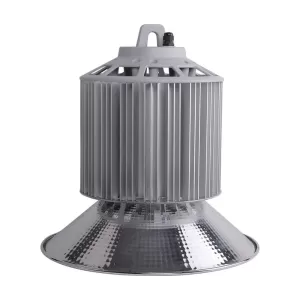
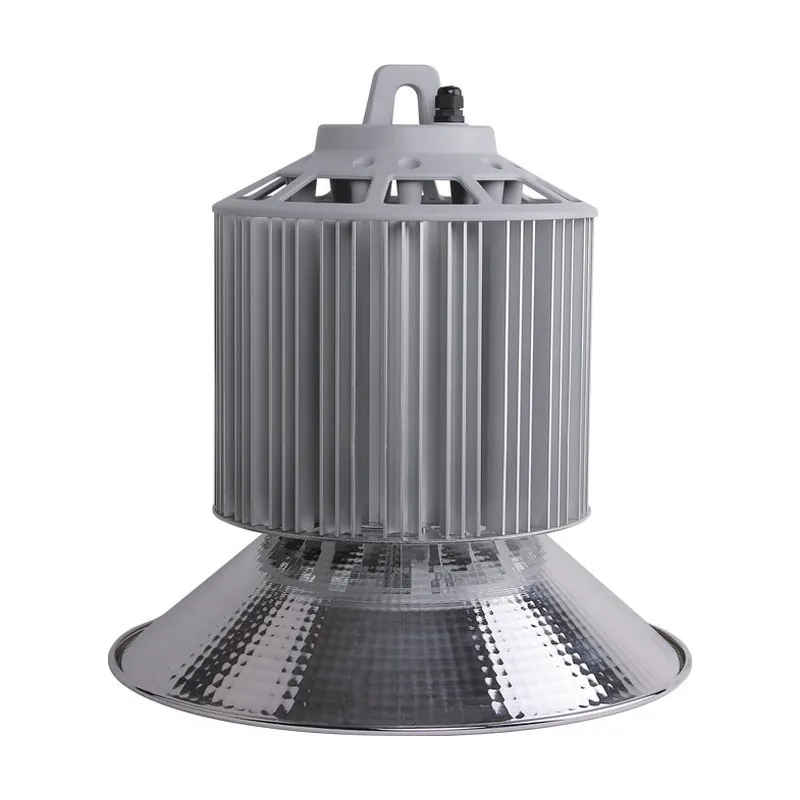
| GKP40G heat-pipe high bay | −30 °C to +50 °C | > 130 lm/W |
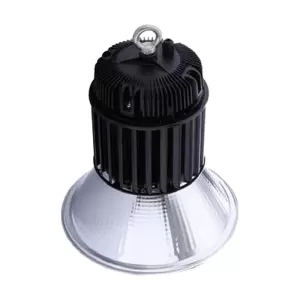
| BG-NGW high-temperature high bay | −30 °C to +65 °C | > 110 lm/W |
For a curing hall of 40 × 20 m with a 10 m roof and 300 lux, the BG-NGW at 150 W and 110 lm/W gives, in our calculator, 32 fittings (8 × 4) at 5.0 m spacing and about 313 lux. The same hall with GKP40G fittings would need 28 at 150 W for about 323 lux. Four extra fittings is a small price for staying within the temperature rating. If the measured temperature stays below about 45 °C, the GKP40G is the efficient choice; above that, use the BG-NGW. Our guide to high-temperature LED high bay lights explains how heat affects LED life.
Mount fittings between the press rows rather than directly above press openings, where steam rises when the press opens.
Mixing and extrusion
Internal mixers are heavy machines that cause vibration through the building structure. Fittings should have safety cables and secure mounting. The mixing hall is often dusty even when not classified, so sealed fittings (IP65) reduce cleaning. Extruders and calenders run hot, and the same heat check applies near the lines.
Final inspection
Inspectors look for small defects in tread and sidewall, so inspection needs much more light than production. A common target is 750 lux or more, with CRI 80 or higher. For an inspection area of 20 × 12 m with a 6 m roof and light-coloured surfaces, the GKP40G at 150 W gives, in our calculator, 24 fittings at 3.3 m × 3.0 m spacing and about 937 lux. Add local lighting at the inspection stands, angled to show surface relief.
Warehouse
Finished tires are stacked high in racks or on the floor. Narrow-beam high bays over aisles work better than a uniform grid. Our warehouse lighting lux levels guide gives targets for storage and picking.
Vulcanizing machines and “flameproof”
Buyers sometimes ask whether a vulcanizing machine should be flameproof or explosion-proof. In most plants the curing press sits in an unclassified area, so neither applies to the machine. Where it does, “flameproof” (Ex d) is one method of explosion protection: the enclosure contains any internal explosion. It is not an alternative to explosion protection. Our article on explosion-proof vs flameproof explains the terms.
What to send us
- Plant layout with roof heights for each hall
- The area classification for solvent and dust areas
- Measured ceiling temperatures in the curing hall
- Lux targets for inspection and any special areas
We return a fitting choice and layout per hall, combining Ex, high-temperature and standard high bays as each area requires.
Sources
Frequently asked questions
Do tire factories need explosion-proof lighting?
Only in specific areas. Solvent-based cement application, spraying and solvent storage can create gas zones, and carbon black or rubber chemical handling can create dust zones. Mixing, extrusion, building, curing and warehousing are usually unclassified, provided the solvent and dust areas are properly separated.
Is a vulcanizing machine explosion-proof?
A curing press or vulcanizing machine is normally installed in an unclassified area, so it is not built as explosion-proof equipment. Where solvents are used near it, the area classification may require Ex-rated electrical parts. Flameproof (Ex d) is one way of achieving explosion protection, not a separate standard.
What lights work in a hot curing hall?
High-temperature LED high bays rated for the measured ceiling temperature, with sealed housings for steam. Our BG-NGW is rated for −30 °C to +65 °C and IP65. Measure the temperature at mounting height with the presses running before choosing.
How much light does tire inspection need?
Much more than production areas. 750 lux or more with good colour rendering is a common target for visual inspection of finished tires, with local lighting at inspection stands.