Paint Manufacturing Plant Lighting: Solvent Vapour, Pigment Dust and a Mixing Hall Layout
Lighting a paint or coatings factory: where solvent vapour and powder dust zones overlap at the mixers, which fittings carry both ratings, and a 30 × 20 m mixing hall at 300 lux.

Key points
- Solvent-based paint plants have gas zones around mixers, filling lines and solvent tanks; powder additions and powder coating lines add dust zones, sometimes in the same place.
- Where pigment or resin powder is tipped into solvent, the area can be both a gas and a dust zone, so the fitting needs both markings.
- A 30 × 20 m mixing hall with an 8 m roof needs 24 BED fittings of 150 W for about 327 lux by our lighting calculator.
- Colour matching needs high CRI light at the tinting and quality control stations, which ordinary hazardous-area fittings are rarely chosen for.
A paint factory combines two hazards that are usually found in different industries: flammable solvent vapour, as in a refinery, and combustible powder, as in a flour mill. Both appear at the mixing stage, sometimes in the same spot. Lighting the plant means mapping both sets of zones and choosing fittings that carry the right ratings for each.
The process and where zones form
A typical solvent-based paint plant follows these steps:
| Stage | Hazard | Typical classification |
|---|---|---|
| Solvent tank farm and transfer pumps | Solvent vapour | Zone 2 around pumps and flanges; Zone 1 at vents |
| Powder store and bag tipping | Pigment, filler and resin dust | Zone 22 in the room, Zone 21 at tipping points |
| Premixing and high-speed dispersion | Vapour and dust together | Zone 1 at open lids, Zone 21 where powder is charged |
| Let-down and tinting tanks | Solvent vapour | Zone 1 at open hatches, Zone 2 around |
| Filling and capping lines | Solvent vapour | Zone 1 at filling heads, Zone 2 around |
| Finished goods warehouse | Closed cans | Usually unclassified |
Gas zones are classified with IEC 60079-10-1, dust zones with IEC 60079-10-2. In the US, NFPA 30 covers the flammable liquids side. Our article on flammable liquid storage room lighting covers the drum store, and paint booth lighting covers the customer’s side of the product.
Hybrid mixtures at the disperser
When pigments, fillers or resins are tipped into a mixer that already contains solvent, the air above the mixer can hold both vapour and dust. Such a hybrid mixture can ignite at a lower energy than either component alone, and the flammable range widens. This is the most demanding spot in the plant:
- The area is a gas zone, often Zone 1, because of the open lid and solvent.
- It is also a dust zone, often Zone 21, because of the powder addition.
- Electrostatic discharge from bags and liners is a well-known ignition source, so earthing and bonding matter as much as the lighting.
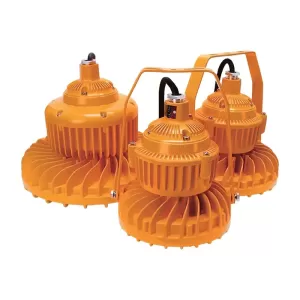
A fitting in this area must be certified for both. Our BED series carries Ex db eb mb IIC T4 Gb for gas and Ex tb IIIC T130 °C Db for dust, IP65, and is covered by our own certificate ZJEx23.0914 under GB 3836. Gb covers Zone 1 and Zone 2; Db covers Zone 21 and Zone 22.
Gas group, temperature class and dust temperature
Common paint solvents such as xylene, toluene, butyl acetate and white spirit are group IIA. Their auto-ignition temperatures are generally covered by T3; T4 gives margin and covers most others. A IIC fitting covers all gas groups, which helps when the formulation list changes.
For the dust side, the fitting’s maximum surface temperature must be checked against the cloud and 5 mm layer ignition temperatures of the powders handled. Our sawmill dust lighting article works that check through for a T130 °C fitting: the dust needs a cloud ignition temperature of at least 195 °C and a layer ignition temperature of at least 205 °C. Ask your powder suppliers for test data, particularly for organic pigments and resins.
Worked example: a 30 × 20 m mixing hall
The hall is 30 × 20 m with 8 m to the roof steel. It contains six dispersers and let-down tanks on a mezzanine, with bag tipping stations at each disperser. The area study shows Zone 1 and Zone 21 at the disperser lids and tipping points, Zone 2 and Zone 22 over the rest of the hall. Target: 300 lux at working level.
Using the BED at 150 W and a conservative 110 lm/W with a medium beam, our lighting calculator gives:
| Result | Value |
|---|---|
| Room index | 1.67 |
| Utilisation factor | 0.62 |
| Fittings | 24 (6 × 4) |
| Spacing | 5.0 m × 5.0 m |
| Average illuminance | about 327 lux |
| Power density | 6.0 W/m² |
| Wattage that would just reach 300 lux | about 137 W |
The mezzanine changes things in practice. Fittings under the mezzanine need to be lower-power units mounted beneath it, because the high bays above cannot light through the floor. The 20–70 W BDE507 (Ex d IIC T6 Gb, IP66) suits that space; we supply its certificate, including any dust rating, with the quotation. On the mezzanine, place fittings so operators at the disperser lids are lit from the front, not from behind.
Colour matching and quality control
Paint plants judge colour every day: tinting to a standard, checking batches, approving drawdowns. Hazardous-area fittings are usually chosen for their rating, not their colour quality. At tinting and quality control stations:
- ask for CRI 90 or above and a stated colour temperature;
- keep the colour temperature consistent across the station;
- where possible, move final colour checks into an unclassified lab or a light booth outside the zone, where standard D65 viewing booths can be used.
Filling lines
Filling heads release vapour every time a can is filled, so the area around them is often Zone 1. Fittings over filling lines should be mounted where they can be reached without stopping the line, and kept clear of the can conveyor. Use certified glands; our guide to explosion-proof cable glands covers selection.
Water-based and powder coating plants
Water-based paint lines may have few or no gas zones, but the powders are the same, so dust zones at tipping points remain. Powder coating manufacturing is mainly a dust hazard: extruders, mills and classifiers produce fine powder, and the grinding and sieving rooms often contain Zone 21 and Zone 22. The chemical plant lighting guide covers larger resin and solvent production on the same principles.
What to send us
- Building plans and heights, including mezzanines
- Gas and dust area classification drawings
- Solvents and powders used, with data sheets or test data
- Lux targets, colour requirements and supply voltage
We return a fitting schedule by area, layout and calculated levels, with the certificate for each model.
Sources
Frequently asked questions
Does a paint factory need explosion-proof lighting?
A factory making solvent-based paints usually has classified areas around mixers, dispersers, filling machines, solvent tanks and drum stores, which need certified fittings. Water-based paint lines may have few or no gas zones, but powder handling can still create dust zones.
What is a hybrid mixture?
A mixture of a flammable gas or vapour with a combustible dust in air. It can ignite at lower energy than either on its own. It occurs where powder is added to solvent, for example when pigments are charged into a disperser.
Which gas group do paint solvents fall in?
Most common paint solvents, such as xylene, toluene, butyl acetate and white spirit, are group IIA. Check each solvent's safety data sheet for its group and auto-ignition temperature.
What lighting do colour matching stations need?
A high colour rendering index (CRI 90 or above) and a controlled colour temperature, often 5000–6500 K, at the station. If the station is inside a classified area, those fittings must be certified too.