Flammable Liquid Storage Room Lighting: Zones, Fittings and a 10 × 6 m Layout
How to light a solvent, paint or fuel store: how the room is classified, which Ex fittings suit it, where switches go, and a 10 × 6 m layout from our calculator.
Key points
- A store that only holds closed containers is often classified Zone 2 or Division 2; rooms where liquids are poured or dispensed usually have a Zone 1 or Division 1 area near the openings.
- Ventilation decides the zone as much as the liquid does, so ask for the area classification before choosing fittings.
- A 10 × 6 m store at 150 lux needs 6 BDE507 fittings of 40 W by our lighting calculator.
- Put switches outside the door so nobody operates a switch inside the classified area, and keep fittings over aisles, not above shelving.
Small flammable liquid stores are among the most common hazardous areas in ordinary factories. Paint stores, solvent rooms, fuel cages and chemical stores are found in workshops, laboratories and maintenance yards, often far from any refinery. The lighting has to be safe for the vapour that can collect there, bright enough to read labels, and simple to maintain.
How a storage room is classified
The classification depends on three things: what is stored, how it is handled and how the room is ventilated.
| Situation | Typical classification |
|---|---|
| Closed containers only, mechanical ventilation, no dispensing | Zone 2 / Division 2 for the whole room, or unclassified if the area study allows |
| Dispensing or decanting from drums | Zone 1 / Division 1 close to the openings, Zone 2 / Division 2 for the rest of the room |
| Floor sumps, pits or trenches | Zone 1 / Division 1, because heavy vapour collects low |
| Poor or no ventilation | Larger and more severe zones |
In the US, NFPA 30 sets requirements for inside storage rooms, including ventilation and the electrical classification of rooms that store Class I liquids. Under the IEC system, IEC 60079-10-1 is used to work out zones from the release sources and the ventilation. Our guide to Zone 1 vs Zone 2 lighting explains what the zone means for the fitting, and the Class 1 Division 2 guide covers the Division system.
Most flammable vapours are heavier than air. They collect at the floor and flow under doors and into drains. That is why fittings near the floor or in pits get the strictest treatment, and why the zone often extends a short distance outside the doorway.
Choosing the fitting
For a typical store, three properties matter:
- Equipment protection level. Gb (Zone 1) fittings can be used in Zone 1 and Zone 2. In a room with any dispensing, choose Gb for the whole room; it removes the need to map small zones around each drum.
- Gas group. Most solvents and fuels are group IIA. IIB covers ethylene and some others; IIC covers hydrogen and acetylene. A IIC fitting covers all three.
- Temperature class. Must be below the auto-ignition temperature of every liquid stored. Our article on T3 vs T4 temperature classes lists common substances.
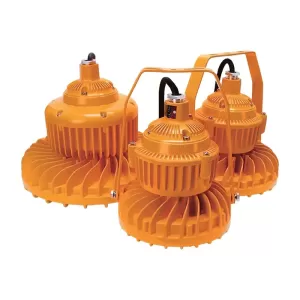
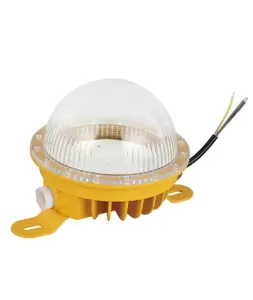
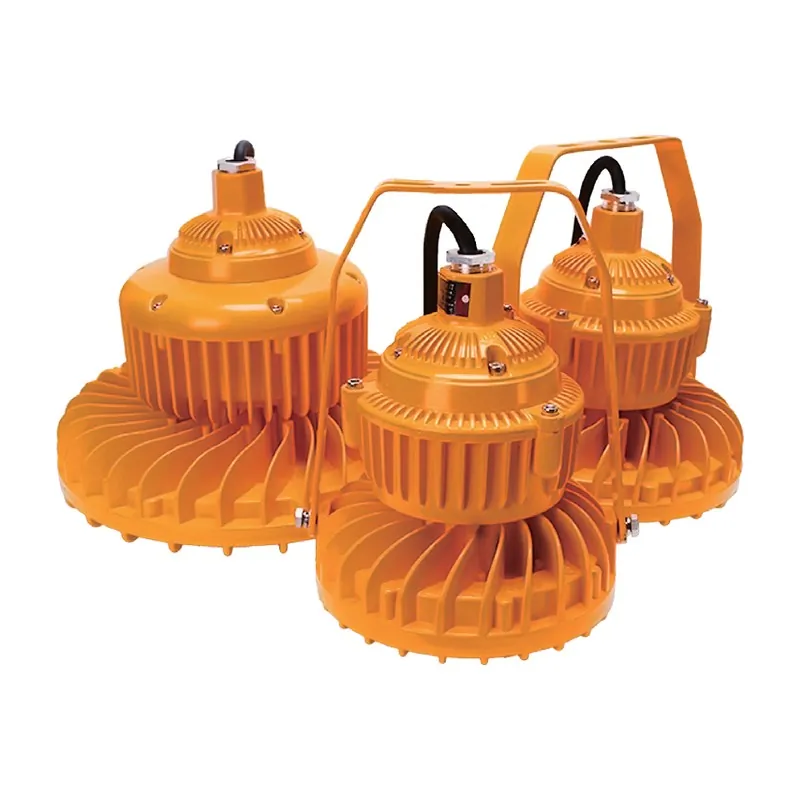
For rooms of this size we usually propose the BDE507: 20–70 W, Ex d IIC T6 Gb, IP66, 110 lm/W, with ceiling, wall or pendant mounting. Its IIC T6 marking covers almost any liquid a general store will hold. For low ceilings, the 15–30 W BAD8501B ceiling light (Ex d IIC T6 Gb, Ø150 mm) is an alternative.
Worked example: a 10 × 6 m solvent store
The store is 10 × 6 m with a 4 m ceiling, painted walls and steel shelving along both long walls. Target: 150 lux at 0.8 m. Using the BDE507 at 40 W and 110 lm/W, our lighting calculator gives:
| Result | Value |
|---|---|
| Room index | 1.17 |
| Utilisation factor | 0.54 |
| Fittings | 6 (3 × 2) |
| Spacing | 3.3 m × 3.0 m |
| Average illuminance | about 192 lux |
| Power density | 4.0 W/m² |
| Wattage that would just reach 150 lux | about 31 W |
The calculator shows that the 30 W BDE507 would give almost exactly 150 lux on the same grid, so either size works. We would pick 40 W for the margin, because shelving blocks more light than an empty room model assumes, and because the lower shelves are where labels are hardest to read.
Place the two rows over the aisles between shelving, not over the shelves. Light from above a tall rack only lights its top. If the store has one central aisle, a single row of three fittings over the aisle plus one at each end often works better than the calculated grid; check the vertical light on the shelf faces.
Switches, emergency lights and the doorway
- Switch outside. A normal switch outside the door, with a pilot light, keeps switching out of the zone. Inside switches must be rated for the zone.
- Emergency lighting. One explosion-proof emergency fitting near the door lets staff leave in a power failure. Our twin-head BG-FBYJ10A (Ex d IIC T4, 2 h) suits small rooms.
- The doorway. The zone often extends 1 m or more beyond the door. Fittings in the corridor just outside may need a rating too; check the drawing.
- Exhaust fan interlock. Where the area study relies on mechanical ventilation, many sites interlock the lighting circuit with the fan so the fan runs whenever someone is inside.
Installation points
- Use glands certified for the fitting and keep the IP rating; see our guide to explosion-proof cable glands.
- Seal conduits or cables where they leave the room, so vapour cannot travel along them to non-classified areas.
- Earth every fitting and bond the shelving.
- Keep fittings at least 1 m above the floor where possible; vapour concentration is highest at floor level.
Stores inside larger buildings
Paint kitchens, ink rooms and solvent recovery rooms inside larger production halls follow the same logic. We have covered two related cases: paint booth lighting, where spraying creates a much larger Zone 1, and pharmaceutical plant lighting, where solvent stores sit next to clean areas.
Maintenance
LED fittings remove the routine relamping that used to bring electricians into the store every year. What remains:
- visual inspection of glass, glands and fixings at the interval in your inspection plan;
- cleaning the glass if dust or vapour residue builds up;
- checking that nobody has added non-rated equipment, such as a portable fan or a phone charger.
What to send us
- Room size, ceiling height and shelving layout
- Liquids stored, with their safety data sheets
- The area classification drawing, if available
- Supply voltage and whether emergency lighting is needed
We will return a fitting list and layout, with the certificate for each model. Our own certificate, ZJEx23.0914, covers the BED series; for the BDE507 and BAD8501B we supply the certificate that applies to each model with the quotation.
Sources
Frequently asked questions
Does a paint store need explosion-proof lights?
Usually yes, if it holds solvent-based paints, thinners or other flammable liquids. Even with closed containers, a spill or leaking lid can release vapour, so codes normally treat the room as at least Zone 2 or Division 2.
What light level does a storage room need?
EN 12464-1 gives 100 lux for stores and stockrooms. We often design for about 150 lux so labels on low shelves can be read without a torch, which matters when hazard data must be checked.
Can the light switch be inside the store?
It can if it is rated for the zone, but the simpler and safer option is a standard switch outside the door, with an indicator so staff know the lights are on.
Which temperature class do I need?
Most common solvents, such as acetone, ethanol, toluene and petrol vapour, are covered by T3 or T4. Carbon disulphide needs T6. Check the safety data sheets of every liquid stored.