Pharmaceutical Plant Explosion-Proof Lighting: Solvent Rooms, Cleanrooms and T-Class by Solvent
How to light pharmaceutical solvent areas: temperature class by solvent (ether needs T4), combining Ex ratings with cleanroom requirements, 500 lux in production, and a dispensing-room layout.
Key points
- The solvent with the lowest ignition temperature decides the T class: ethanol and methanol need T2, hexane T3, and diethyl ether, at about 160–180 °C, needs T4.
- Diethyl ether and tetrahydrofuran are gas group IIB, so a plant using them needs IIB or IIC fittings, not IIA.
- In classified cleanrooms the fitting must satisfy both worlds: Ex marking for the zone, and a smooth, sealed, cleanable body for the cleanroom grade.
- A 10 × 6 m solvent dispensing room at 500 lux needs 12 compact Ex fittings of 50–60 W by our lighting calculator.
Pharmaceutical plants use flammable solvents for synthesis, extraction, crystallisation, cleaning and coating. Many of those rooms are also clean areas with strict rules on surfaces and cleaning. The lighting has to meet both sets of rules at once. This guide covers how the solvent sets the Ex rating, how to combine it with cleanroom needs, and how many fittings a dispensing room needs.
The solvent decides the rating
Plants rarely handle a single solvent. The table shows common ones; the lowest ignition temperature and the most demanding gas group present decide the specification.
| Solvent | Gas group | Auto-ignition temperature | Minimum T class |
|---|---|---|---|
| Acetone | IIA | about 465 °C | T1 |
| Toluene | IIA | about 480 °C | T1 |
| Methanol | IIA | about 440 °C | T2 |
| Isopropanol | IIA | about 400 °C | T2 |
| Ethanol | IIA | about 363 °C | T2 |
| n-Hexane | IIA | about 225 °C | T3 |
| Tetrahydrofuran (THF) | IIB | about 230 °C | T3 |
| Diethyl ether | IIB | about 160–180 °C | T4 |
Two lessons:
- Ether changes everything. A plant that uses diethyl ether anywhere needs T4 or better and group IIB in that area. Specifying T4 IIB across the plant avoids mistakes when processes move between rooms.
- Use the actual values from the safety data sheets. Published figures vary slightly between sources; the plant’s own data decides.
Our guide to T6 temperature class lighting covers when a T6 fitting is worth it, and IIB vs IIC explains the groups.
Typical zones in a pharmaceutical plant
| Area | Typical zone |
|---|---|
| Inside reactors, receivers and dryers | Zone 0 (no lights) |
| Around reactor manways, charging ports and centrifuge lids | Zone 1 |
| Solvent dispensing and drum rooms | Zone 1 near open containers, Zone 2 elsewhere |
| Tablet coating with solvent-based coatings | Zone 1 inside the coater, Zone 2 around |
| Solvent store and tank farm | Zone 2, Zone 1 at vents and pumps |
| Packaging, QC labs (small quantities, with fume hoods) | Usually unclassified |
Solvent vapours are heavier than air, so drains, floor gullies and the lower part of a room are often classified more widely.
Cleanroom requirements on top
A fitting in a classified clean area must also meet the cleanroom rules:
- Smooth, sealed surfaces with no ledges or gaps that collect particles;
- IP65 or better so wash-down and disinfectants do not get in;
- Resistance to cleaning agents such as hydrogen peroxide, alcohols and quaternary compounds;
- Sealing to the ceiling where the fitting is flush-mounted, so it does not leak air between clean and technical spaces.
Compact round Ex fittings with tempered glass and a powder-coated aluminium body, like our BDE507 (IP66, Ex d IIC T6 Gb), work in Grade C and D areas when mounted on the ceiling surface. For the higher grades, check with the QA team: flush-mounted, teardrop-shaped cleanroom fittings may be required, and few of those carry an Ex rating. The usual solution is to keep solvents out of the highest-grade rooms where possible. Our explosion-proof IP rating guide explains IP65 vs IP66 for wash-down.
Worked example: a 10 × 6 m solvent dispensing room
Assume a dispensing room 10 × 6 m, ceiling 3.2 m, light-coloured walls and ceiling, and 500 lux on the working plane, the EN 12464-1 value for pharmaceutical production. With the BDE507 at 60 W and 110 lm/W, a wide beam and a maintenance factor of 0.8, our lighting calculator gives:
| Result | Value |
|---|---|
| Room index | 1.56 |
| Utilisation factor | 0.62 |
| Fittings by the lumen method | 10 |
| Fittings after the spacing check | 12 (4 × 3) |
| Spacing | 2.5 m × 2.0 m |
| Average illuminance | about 652 lux |
| Power density | 12.0 W/m² |
The calculator shows about 46 W per fitting would meet 500 lux on that grid, so the BDE507-50 gives about 545 lux with the same 12 positions. The low ceiling, not the lumens, sets the count: the spacing rule keeps fittings within 1.5 times the mounting height for even light on weighing balances and labels.
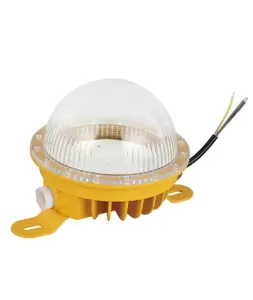
For corridors and airlocks in classified areas, the BAD8501B ceiling light (15–30 W, Ø150 mm, IP66) is smaller and easier to fit between ceiling services.
Larger halls
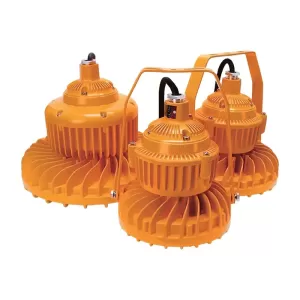
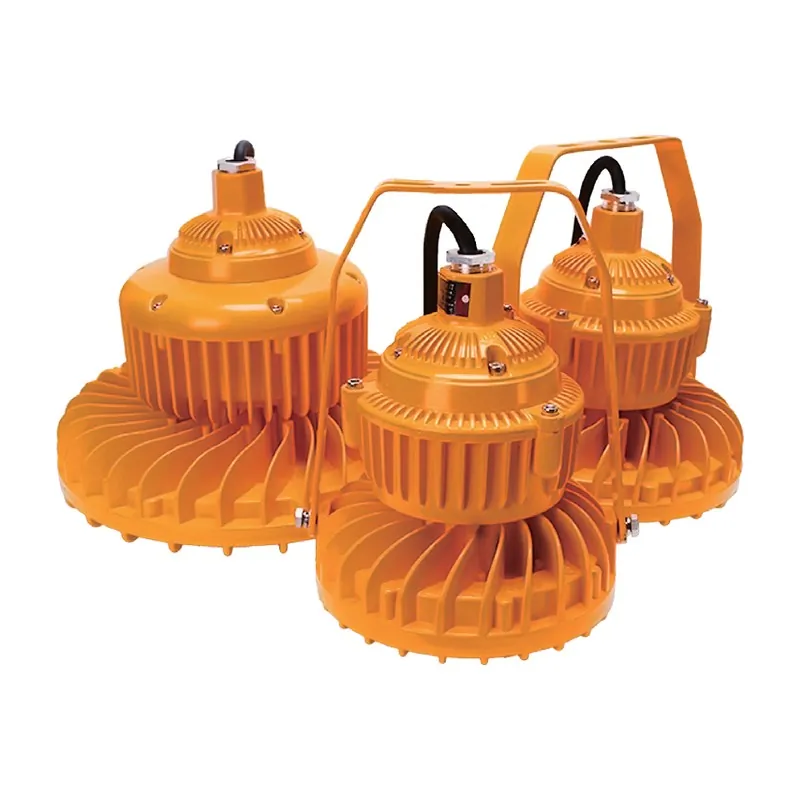
Solvent recovery plants, API production halls and warehouses have higher roofs and fewer cleanroom constraints. Our BED series runs from 30 W to 600 W under our own certificate ZJEx23.0914, marked Ex db eb mb IIC T4 Gb, with the dust marking Ex tb IIIC T130 °C Db for powder handling areas.
Powder handling
Many APIs and excipients are combustible dusts. Milling, blending and granulation rooms may be dust zones (Zone 21 or 22) as well as, or instead of, gas zones. A fitting may need both a gas and a dust marking. Our combustible dust lighting guide explains the surface-temperature check for dust.
Colour and inspection
- Ra 80 minimum for reading labels and colour-coded components; Ra 90 for visual inspection of tablets and solutions.
- 4000–5000 K is usual in production areas.
- Local task lighting at inspection booths, rather than raising the whole room.
Validation and change control
In a GMP plant, the lighting is part of the validated facility. Changing a fitting type later means a change control and may mean requalification. Choose a fitting that will still be available and keep spare units in stock.
What to send us
- Room list with sizes, ceiling heights and cleanroom grades
- Area classification, with the solvent list
- Target lux levels and any inspection areas
- Cleaning agents used
- Certificate scheme required (IECEx, ATEX or national)
With these we will return a fitting list and room layouts like the example, marking where an Ex fitting is needed and where a standard cleanroom fitting is enough.
Sources
Frequently asked questions
What temperature class do pharmaceutical solvent areas need?
The solvent with the lowest auto-ignition temperature decides. Ethanol, methanol and isopropanol need T2, hexane needs T3, and diethyl ether needs T4. Many plants standardise on T4 or T6 so every room is covered.
Can explosion-proof lights be used in a cleanroom?
Yes, if the fitting is also suitable for the cleanroom: smooth surfaces, sealed to IP65 or better, resistant to the cleaning agents and with no dust traps. Flush or surface-mounted fittings with a sealed lens are typical.
How much light does pharmaceutical production need?
EN 12464-1 gives 500 lux for pharmaceutical production. Inspection tasks, such as visual inspection of vials, need more, usually from local task lighting.
Which of your lights suit pharmaceutical plants?
The BDE507 (20–70 W, Ex d IIC T6 Gb, IP66) and BAD8501B ceiling light (15–30 W, Ex d IIC T6 Gb, IP66) for solvent rooms and corridors, and our BED series (Ex db eb mb IIC T4 Gb, certificate ZJEx23.0914) for larger production halls.