Solvent Extraction Plant Lighting: Hexane, T3 and the Extraction Building
Lighting an oilseed solvent extraction plant: hexane's gas group and temperature class, how the extraction building is zoned, and a calculated layout with BED explosion-proof fittings.

Key points
- Hexane is gas group IIA with an auto-ignition temperature around 225 °C, so fittings must be T3 or better. Its flash point is about −22 °C, and the vapour is three times heavier than air.
- Because hexane is present throughout the process, the extraction building is often classified as a whole, with Zone 1 around the extractor, desolventiser-toaster and pumps and Zone 2 elsewhere; NFPA 36 sets the rules in North America.
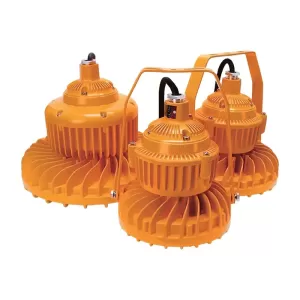
- For a 30 × 15 m extraction building at 8 m and 150 lux, our calculator gives 15 BED explosion-proof fittings of 100 W, about 171 lux and 3.3 W/m².
- Preparation (cracking, flaking, expanding) has oilseed dust rather than vapour, and needs a separate dust check.
Most vegetable oil is pressed out of the seed and then extracted with a solvent, nearly always food-grade hexane. Hexane is an excellent solvent and a serious fire hazard: it evaporates at almost any temperature and its vapour sinks and spreads. That is why extraction buildings stand apart from the rest of an oil mill, and why their lighting is chosen differently. This guide explains the classification, shows a calculated layout for an extraction building and covers the areas around it.
Hexane in numbers
| Property | Approximate value | What it means |
|---|---|---|
| Gas group | IIA | IIA, IIB or IIC fittings all qualify |
| Auto-ignition temperature | 225–235 °C | T3 or better (T3 limit = 200 °C) |
| Flash point | about −22 °C | Flammable vapour at any normal temperature |
| Lower explosive limit | about 1.1 % by volume | A small leak is enough |
| Vapour density | about 3 (air = 1) | Collects at floor level, in pits and drains |
The temperature class is the point to watch. Many fittings are T4, T5 or T6, so this is rarely a problem, but some older or cheaper fittings are T2 or T3 only at reduced ambient. Check the marking and the rated ambient together. Our guide to T3 vs T4 temperature classes explains how the class relates to the fitting’s hottest surface.
How an extraction plant is laid out
| Section | What happens | Hazard |
|---|---|---|
| Seed preparation | Cleaning, cracking, conditioning, flaking or expanding | Combustible oilseed dust |
| Extraction building | Extractor, desolventiser-toaster, evaporators, stripper, solvent recovery | Hexane vapour |
| Solvent tank farm | Fresh and working hexane storage | Hexane vapour |
| Meal handling | Drying, cooling, grinding, storage | Combustible meal dust |
| Oil refinery | Degumming, neutralising, bleaching, deodorising | Mostly unclassified; local hazards |
NFPA 36 requires separation distances between the extraction building and other buildings, and keeps sources of ignition out of a “restricted area” around it. IEC-based codes reach a similar result through IEC 60079-10-1. The classification is the starting point for every electrical choice, including lights.
Zoning inside the extraction building
Inside the building, hexane is present in the extractor, desolventiser-toaster, miscella tanks, evaporators, condensers, pumps and all the piping between them. Typical classification:
- Zone 1 around pump seals, sample points, sight glasses opened in operation, drains, pits and the extractor’s hatches
- Zone 2 for the rest of the building, where vapour only appears in abnormal conditions
- Zone 1 or 2 extending outside doors and vents for a distance set by the classification
Because the zones cover almost all the building, the usual practice is to use Zone 1 fittings throughout. That avoids mistakes when equipment is added later and keeps spares simple.
Calculated layout: a 30 × 15 m extraction building
Take a building of 30 × 15 m, fittings at 8 m under the roof steel, medium reflectance, 150 lux at floor level. With our BED explosion-proof LED light at 100 W and a conservative 110 lm/W, the high bay lighting calculator gives:
| Result | Value |
|---|---|
| Room index | 1.39 |
| Fittings | 15 (5 × 3) |
| Spacing | 6.0 m × 5.0 m |
| Average illuminance | about 171 lux |
| Power density | 3.3 W/m² |
The BED is marked Ex db eb mb IIC T4 Gb under our certificate ZJEx23.0914: Zone 1 and Zone 2, any gas group, and a maximum surface temperature of 135 °C, well below hexane’s ignition temperature.
An extraction building is multi-level: the extractor and desolventiser-toaster pass through several floors of steel grating. The roof-level fittings light the top floor; each lower floor needs its own fittings under the grating above. For low platforms and stair landings, the compact BDE507 (Ex d IIC T6 Gb, IP66, 20–70 W) fits under beams where a larger fitting would not; its certificate is provided with the quotation. Our explosion-proof lights count guide shows how to handle multi-floor structures.
Installation details that matter here
- Cable entries. Use certified glands for each fitting and seal unused entries. Our explosion-proof cable glands guide covers barrier versus compound glands.
- Seal off conduits where they leave the classified area, so vapour cannot travel down the conduit to an unclassified switch room.
- Low-level fittings. Avoid mounting fittings in pits or trenches unless they are certified for the zone there, which is often Zone 1.
- Heat from the process. The desolventiser-toaster and evaporators run hot. Check the fitting’s rated ambient where it sits close to them.
Preparation and meal handling: dust, not vapour
Flaking mills, expanders and meal grinders release combustible dust. These areas are classified for dust (Zone 21 or 22 around equipment) under IEC 60079-10-2. Fittings there need a dust marking, such as the BED’s Ex tb IIIC T130 °C Db, and their surface temperature must be checked against the meal or seed dust’s ignition data. The method is the same as for flour or grain, set out in our Zone 21 and 22 dust lighting guide.
Solvent tank farm
Hexane storage tanks sit in a bunded area outside the building. Light the tank stairs, valves and the unloading point with Ex floodlights on poles placed outside the bund where possible. The principles are those in our tank farm lighting guide.
Emergency and escape lighting
Extraction buildings need clear escape routes from every floor, with emergency lighting rated for the zone. Twin-head Ex emergency fittings on each landing and at each exit, with at least the duration the local code requires, are standard.
What to send us
- Area classification drawings for the extraction building, tank farm and preparation
- Floor plans and heights for each level
- Required lux per floor and operating temperatures near hot equipment
- Supply voltage
We return a layout floor by floor with BED Ex fittings in the classified areas.
Sources
Frequently asked questions
What temperature class is needed for hexane?
T3 or better. n-Hexane has an auto-ignition temperature of roughly 225–235 °C, which is above the T3 limit of 200 °C but below the T2 limit of 300 °C. A T4 fitting such as our BED series (surface temperature up to 135 °C) gives extra margin.
Is the whole extraction building a hazardous area?
Usually, yes. Hexane is handled in almost every piece of equipment in the building, and NFPA 36 and most IEC-based classifications treat the extraction building as classified, with Zone 1 (Division 1) near sources of release and Zone 2 (Division 2) elsewhere.
Why does hexane vapour collect at floor level?
Its vapour density is about 3 times that of air. Leaked vapour flows down and along the floor into pits, trenches and drains. That is why zones extend horizontally at low level and why sumps and pits are often Zone 1.
Can oilseed dust and hexane occur in the same place?
They are usually separated: preparation (dust) and extraction (vapour) are in different buildings with a gap or firewall between them, as NFPA 36 requires. Conveyors linking them carry flakes or meal, so the zone at each end of the conveyor needs checking for both.