Explosion-Proof Cable Glands for Light Fittings: Ex d, Ex e, Barrier Glands and Thread Types
Choosing cable glands for explosion-proof lights: Ex d or Ex e, when a barrier gland is needed, thread types, cable diameter and IP, using our fittings as examples.
Key points
- The gland must carry a protection type that suits the compartment it enters: an Ex d gland for a flameproof chamber, an Ex e (or Ex d) gland for an increased-safety terminal box.
- Barrier (compound-filled) glands are needed where the cable itself could let gas or flame travel through its core; IEC 60079-14 sets the selection rules, so check the edition your project follows.
- Match three things before ordering: the entry thread, the cable's outer diameter and the gland's IP rating.
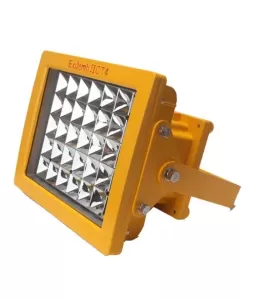
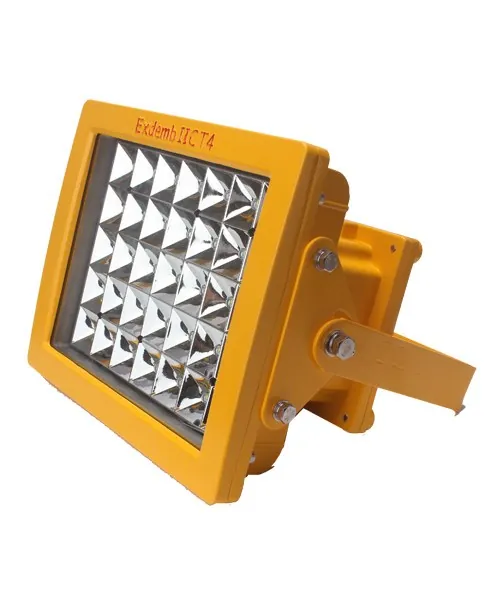
- Our BAD8599 floodlight and BAD8501B ceiling light have a G3/4" entry for 10–14 mm cable; the BED series is wired through an Ex eb terminal box.
A cable gland looks like a minor accessory, but on an explosion-proof light it is part of the protection. A flameproof enclosure is only flameproof if every opening, including the cable entry, stops a flame from getting out. An increased-safety terminal box only stays safe if dust and water stay outside it. This guide explains how to pick the gland, what to check on the cable, and how our own fittings are set up.
Why the gland is part of the certificate
Each explosion-proof light is certified as a whole, with its entries. The certificate assumes the entry will be closed by a gland or plug that keeps the protection intact. That is why a gland must:
- carry its own Ex certificate for the protection type of the compartment it enters;
- fit the thread of the entry exactly, with enough threads engaged;
- clamp and seal the cable you actually use;
- keep the IP rating of the light.
A light that is correctly rated but closed with the wrong gland is not compliant, and an inspector will reject it. Our guide to explosion-proof junction boxes covers the same question for the boxes feeding the lights.
Ex d glands and Ex e glands
The protection type of the compartment decides the gland type.
| Compartment | What it does | Gland needed |
|---|---|---|
| Flameproof chamber (Ex d / db) | Contains an internal explosion; joints cool escaping gas | Ex d certified gland, or barrier gland where required |
| Increased-safety terminal box (Ex e / eb) | Prevents sparks by design; relies on IP and creepage distances | Ex e certified gland (an Ex d gland is also accepted) |
| Dust protection (Ex t / tb) | Keeps dust out; limits surface temperature | Gland certified for Ex t with the required IP |
Many modern fittings combine types. Our BED series is marked Ex db eb mb IIC T4 Gb: the LED chamber is flameproof and sealed at the factory, the driver is encapsulated, and the site wiring goes into an increased-safety terminal compartment. The installer therefore only opens the Ex eb box, and the gland on it needs an Ex e (or Ex d) certificate and must keep IP65. The increased-safety Ex e guide explains why that terminal box design makes field wiring simpler.
Fittings that are fully flameproof, such as the BAD8599 floodlight (Ex d IIC T6 Gb), have their terminals inside the flameproof enclosure. Here the gland itself forms part of the flame path, so it must be an Ex d gland.
Barrier glands: when compression is not enough
A standard Ex d compression gland seals around the outer sheath of the cable. Gas can still travel inside the cable, between the cores and fillers, from one enclosure to another. Where that matters, a barrier gland is used: the cores are separated and set in a compound that cures into a solid plug.
IEC 60079-14 gives the selection rules for glands on flameproof enclosures. The rules have changed between editions, but the factors are the same:
- whether the cable is of a compact, filled construction that resists gas migration;
- whether the enclosure contains an ignition source in normal operation;
- the gas group, with IIC treated most strictly;
- the zone, with Zone 1 stricter than Zone 2;
- the length of cable between enclosures.
Barrier glands take longer to fit, because the compound needs time to cure before the light is energised. Plan that time into the installation schedule. Our article on explosion-proof light installation shows where gland fitting sits in the sequence.
Threads: metric, NPT and G
Three thread families appear on Ex equipment:
| Thread | Where it is common | Notes |
|---|---|---|
| Metric (M20 × 1.5, M25 × 1.5) | IEC and ATEX projects in Europe, Middle East, Asia | Most common in IEC installations |
| NPT (1/2″, 3/4″) | North America, many oil and gas projects | Tapered thread; sealing depends on engagement |
| G (BSPP, e.g. G3/4″) | Chinese and some Asian equipment | Parallel pipe thread |
Never force a gland of one thread into an entry of another. Where a project standardises on metric or NPT, a certified thread adapter can be fitted, but each adapter adds a joint, and the combination must stay within what the light’s certificate allows. Flameproof threaded joints also need a minimum number of full threads engaged, which IEC 60079-1 sets; a gland that bottoms out early does not meet it.
Our BAD8599 floodlight and BAD8501B ceiling light come with a G3/4″ entry for cable of 10–14 mm outer diameter. If your project uses metric glands only, say so when you ask for a quotation, so the entries can be discussed before production, not on site.
Cable diameter and armour
Every gland has a clamping range. If the cable is smaller than the range, the seal does not grip and the IP rating is lost. If it is larger, the gland cannot be assembled.
- Measure the outer sheath of the actual cable, not the conductor size. Two 3 × 2.5 mm² cables from different makers can differ by several millimetres.
- Armoured cable (SWA or braided) needs a gland that clamps the armour as well as the sheath; the armour clamp usually provides the earth continuity.
- Check whether a second seal on the inner sheath is needed for your cable type and zone.
For the BAD8599 and BAD8501B entry range of 10–14 mm, many unarmoured 3-core cables fit; armoured cables often do not, and then a different entry or an intermediate junction box is used.
IP rating and environment
The gland must reach at least the IP rating of the light. For our fittings that means IP65 on the BED series and IP66 on the BAD8599, BAD8501B and BDE507. Outdoors and in wash-down areas, specify:
- a sealing washer or O-ring between the gland and the entry face;
- nickel-plated brass or stainless glands near the coast or chemicals;
- a shroud over the gland where UV and salt spray are heavy.
Our guide to explosion-proof IP ratings explains why the IP rating of an Ex light matters more than its marking suggests.
Worked example: entries for a pump bay
Take a pump bay with eight BAD8599 floodlights of 100 W, fed through two junction boxes. The cable chosen is a 3-core unarmoured cable with an outer diameter of 11.5 mm.
- At each floodlight: one Ex d gland, G3/4″, clamping range covering 11.5 mm, IP66, nickel-plated brass. The floodlight terminals sit inside the flameproof chamber, so Ex d is required.
- Barrier or compression: check the cable construction and the selection rule in the edition of IEC 60079-14 that the project uses. In a IIC area with a cable that is not filled, plan for barrier glands.
- At each junction box: glands of the protection type of the box. An Ex e box takes Ex e glands; an Ex d box takes Ex d glands.
- Spare entries: certified stopping plugs in every unused hole, including on boxes kept for future circuits.
That gives 8 floodlight glands, 10 junction-box glands (one incoming and four outgoing per box) and any plugs for spare entries. Order 10 % spare glands; seals are easy to damage on site.
Common mistakes
- Mixing metals. Stainless glands in aluminium enclosures near the sea can cause galvanic corrosion; use a suitable washer or matching material.
- Cutting the sheath too short. The sheath must pass through the seal; if only the cores do, the gland does not seal.
- Uncured compound. Energising before a barrier gland has cured leaves a soft plug that does not stop flame.
- Painting over the gland. Paint hides damage and prevents inspection.
- Losing the certificate. Keep the gland certificates in the site’s inspection file with the light certificates; inspectors ask for both.
What to send us
- Area classification (zone, gas group, temperature class)
- Cable type and measured outer diameter, armoured or not
- Thread standard used on the project (metric, NPT or G)
- Whether glands should be supplied with the lights
We will confirm the entry details of each fitting against your cable and send the light certificates with the quotation. For the BED series, the certificate is our own, ZJEx23.0914; for other models we supply the certificate that applies to that model.
Sources
Frequently asked questions
Can I use a normal industrial gland on an explosion-proof light?
No. Any gland on equipment in a hazardous area must be certified for the protection type of the enclosure it enters. A standard nylon or brass gland voids the certification of the light, even if it seals well.
When do I need a barrier gland?
Typically where the cable is not of a filled, compact construction, or where the edition of IEC 60079-14 used on your project requires one for the enclosure type, gas group or zone. Barrier glands are filled with a setting compound that blocks the path through the cable core.
What thread do your explosion-proof lights use?
The BAD8599 floodlight and BAD8501B ceiling light have a G3/4" entry for cable of 10–14 mm outer diameter. Other entries and metric or NPT adapters can be discussed with the quotation; any adapter must itself be certified.
Do unused entries need anything?
Yes. Every unused entry must be closed with a certified stopping plug of the right protection type and thread. A dust cap from the factory is only for transport.