Explosion-Proof IP Rating: What IP65, IP66 and IP67 Add to an Ex Marking
Why an explosion-proof light needs an IP rating as well as an Ex marking, what IP65, IP66 and IP67 mean on site, the ratings of our Ex series, and a loading-bay example.
Key points
- The Ex marking says the light will not ignite the atmosphere; the IP rating says how well it keeps dust and water out. They are separate tests and you need both.
- For dust zones the IP rating is part of the protection: IP6X is required for conductive dust and for Zone 20 and 21 fittings.
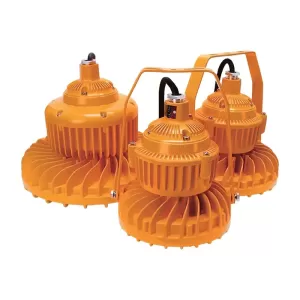
- Our Ex series range from IP65 (BED) and IP66 (BDE507, BAD8599, BAD8501B) to IP67 (ExF).
- In our calculator, a covered 24 × 10 m tanker loading bay at 7 m reaches about 119 lux with eight 80 W ExF lights (IP67, WF2).
Buyers often ask whether an explosion-proof light is also “waterproof”, or treat a high IP rating as a sign of a better Ex fitting. Both are understandable, and both mix up two different tests. The Ex marking deals with ignition. The IP code deals with dust and water getting in. A good hazardous-area specification asks for both, and this guide shows how to read them together.
Two different questions
| Question | Answered by | Standard |
|---|---|---|
| Can this light ignite the gas or dust around it? | Ex marking (zone, group, T class) | IEC 60079 series |
| Can dust and water get inside? | IP code | IEC 60529 |
A flameproof “Ex d” enclosure is built so that an explosion inside is contained and the gas escaping through its flame paths is cooled below ignition. That design allows gas to pass through the joints. On its own it is not a water seal. Gaskets and seals, tested separately, give the IP rating. For the background on Ex d, see explosion-proof vs flameproof; for the full marking, explosion-proof light ratings explained.
How to read the IP digits
The first digit is solids, the second is water:
- 5X — dust-protected: some dust can enter, not enough to interfere.
- 6X — dust-tight: no dust enters in the test.
- X5 — water jets from a 6.3 mm nozzle.
- X6 — powerful water jets from a 12.5 mm nozzle.
- X7 — temporary immersion, 1 m for 30 minutes.
IP67 is not “better than IP66” in every way. Immersion and jets are different tests, and a fitting may pass one and not the other. Lights that pass both are labelled IP66/IP67. Our IP65 vs IP66 vs IP67 guide covers the general case for outdoor lights.
Where IP is part of the Ex protection
In gas areas, IP is a separate durability requirement. IEC 60079-0 sets IP54 as a general minimum for Ex equipment, and the installation code may ask for more outdoors.
In dust areas, IP becomes part of the protection itself. Protection by enclosure (“tb” for Zone 21, “tc” for Zone 22) depends on keeping dust out, so:
- Zone 21 fittings (EPL Db) need IP6X;
- Zone 22 fittings need IP6X for conductive dust (IIIC) and at least IP5X for non-conductive dust (IIIB).
That is why older dust markings such as “Ex tD A21 IP66 T80 °C” put the IP rating inside the marking. Our combustible dust lighting guide covers dust zones in detail.
IP ratings of our explosion-proof series
| Series | Ex marking | IP | Corrosion |
|---|---|---|---|
| BED | Ex db eb mb IIC T4 Gb / Ex tb IIIC T130 °C Db | IP65 | — |
| BDE507 | Ex d IIC T6 Gb | IP66 | WF2 |
| BAD8599 floodlight | Ex d IIC T6 Gb / Ex tD A21 IP66 T80 °C | IP66 | WF1 / WF2 |
| BAD8501B ceiling light | Ex d IIC T6 Gb / Ex tD A21 IP66 T80 °C | IP66 | WF1 / WF2 |
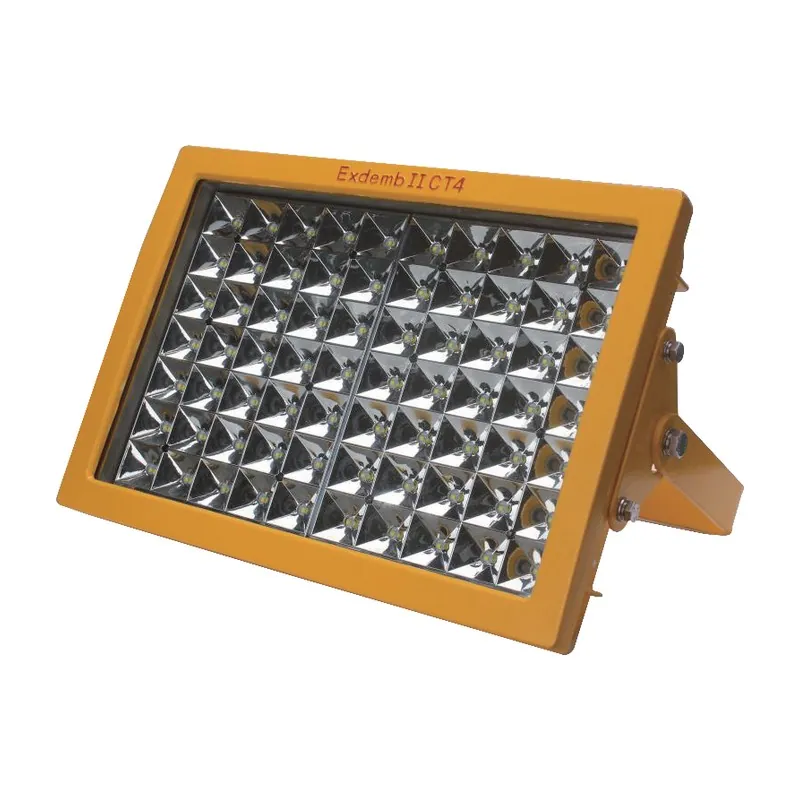
| ExF | Ex d IIB T6 Gb | IP67 | WF2 |
The BED series is the one under our own certificate, ZJEx23.0914 (GB 3836, IEC 60079-aligned; not ATEX or IECEx). Its IP65 is enough for indoor process areas and covered outdoor areas, and its dust marking includes the IP6X dust-tightness that “tb” requires. For the other series, the certificate for the exact model comes with the quotation. The WF grades are corrosion resistance; see WF1 vs WF2.
Choosing IP by location
| Location | Typical water exposure | Starting point |
|---|---|---|
| Indoor process room, dry | Dust, occasional splash | IP65 |
| Pump house or compressor room with washdown | Hose cleaning | IP66 |
| Outdoor tank farm, refinery unit | Rain, storms, jets from cleaning | IP66 |
| Jetty, loading arm, low-lying pit | Spray, possible flooding | IP66/IP67 |
| Coastal or offshore | Salt spray and jets | IP66 plus WF2 |
High IP only lasts if the installation keeps it. Use certified glands sized to the cable, blank unused entries, and replace gaskets when a cover is opened. Our explosion-proof light installation guide lists the checks.
Worked example: a covered tanker loading bay
A 24 × 10 m canopy over two tanker loading lanes, 7 m to the underside of the roof. Rain drives in from the open sides and the slab is hosed down after spills, so we want IP66 or better with WF2 corrosion protection. The area is Zone 1 IIA/IIB around the loading arms. Target: 100 lux.
The ExF, IP67 and WF2, fits. Using 110 lm/W, its rated efficacy, and a wide beam, our high bay lighting calculator gives (open the example):
- 8 fittings in a 4 × 2 grid, 6.0 × 5.0 m apart;
- about 119 lux with the 80 W size;
- 2.7 W per m².
The calculator shows 67 W would reach exactly 100 lux, so the 80 W size gives some margin for dirt on the glass, which builds faster under an open canopy. The 80 W model uses the larger ExF housing, 446 × 306 × 166 mm and 14.5 kg.
Common mistakes
- Accepting an IP rating that is not on the certificate or label. A brochure claim is not enough in a hazardous area.
- Choosing IP67 for a hose-down area. If jets are the risk, ask for IP66 as well.
- Ruining the rating at installation. The wrong gland or an open entry turns IP66 into nothing.
What to send us
The zone, gas or dust group, temperature class, and how the area is cleaned or exposed to weather. We will propose a series with the right Ex marking and IP rating, a fitting count from our calculator, and the certificate for the model.
Sources
Frequently asked questions
Is an explosion-proof light automatically waterproof?
No. A flameproof enclosure is designed to contain an internal explosion and cool the escaping gases; it is not by itself a water seal. The IP rating is tested separately and must be on the label or certificate.
What IP rating does an explosion-proof light need?
IEC 60079-0 sets a minimum of IP54 for most Ex equipment. Dust-zone fittings with protection 'tb' need IP6X. Outdoors, IP65 or IP66 is the usual minimum, and IP67 where lights may be flooded or hosed at close range.
What is the difference between IP66 and IP67 for an Ex light?
IP66 resists powerful water jets from any direction. IP67 survives temporary immersion, 1 m for 30 minutes in the test. IP67 does not automatically include IP66; a fitting must pass both tests to carry both.
Does a higher IP rating make a light safe in a higher zone?
No. The zone, gas group and temperature class come only from the Ex marking. An IP67 industrial light without an Ex marking is not allowed in Zone 1 or 2.
What IP ratings do your explosion-proof lights have?
BED series IP65, BDE507 IP66, BAD8599 floodlight IP66, BAD8501B ceiling light IP66 and ExF IP67.