WF1 vs WF2 Corrosion Rating for Lights: What the Letters Mean and Where Each Is Needed
WF2 is the strong outdoor anti-corrosion grade for electrical equipment, used at chemical plants, ports and coastal sites; WF1 is moderate. WF vs IP, and what to ask.
Key points
- WF is a Chinese corrosion-protection designation for electrical equipment: W means outdoor use and F means anti-corrosion; 1 is moderate protection, 2 is strong.
- F1 and F2 without the W are the indoor versions of the same grades.
- IP rating and WF rating answer different questions: IP is about dust and water getting in, WF is about the materials resisting chemical and salt attack.
- WF2 is the usual choice for chemical plants, coastal sites, ports, fertiliser and wastewater plants; WF1 suits outdoor industrial sites with mild pollution.
- Ask what the rating is based on: housing material, coating system, fasteners, seals and the tests the product passed.
Datasheets for industrial and explosion-proof lights made in China often carry a line such as “Corrosion grade: WF2” next to the IP rating. Buyers outside China rarely see it anywhere else, and it is easy to confuse with an ingress rating. This guide explains what the letters mean, how WF1 and WF2 differ, and what to check before relying on either.
What the letters mean
The designation combines a location letter and a protection grade:
| Mark | Meaning |
|---|---|
| W | Outdoor use (exposed to weather) |
| F | Anti-corrosion |
| 1 | Moderate anti-corrosion protection |
| 2 | Strong anti-corrosion protection |
So:
| Grade | Use |
|---|---|
| F1 | Indoor, moderate corrosion protection |
| F2 | Indoor, strong corrosion protection |
| WF1 | Outdoor, moderate corrosion protection |
| WF2 | Outdoor, strong corrosion protection |
The grades come from Chinese practice for electrical equipment used in chemical and other corrosive environments, where luminaires, junction boxes and control stations are specified with them alongside explosion-protection markings.
IP rating vs WF rating
The two are often printed next to each other but measure different things:
| IP rating | WF rating | |
|---|---|---|
| Question | Can dust and water get inside? | Will the materials survive the chemistry? |
| Tests | Dust chamber, water jets, immersion | Salt spray, humidity, corrosive gas exposure on materials and coatings |
| Failure it prevents | Water in the driver, short circuits | Corroded housings, seized screws, cracked seals |
A light can be IP66 and still corrode badly at a fertiliser plant if its coating and fasteners are ordinary. Equally, a highly corrosion-resistant housing is no use if water gets in through the cable gland. Corrosive sites need both. Our guide to IP65 vs IP66 vs IP67 covers the ingress side.
Where each grade is used
| Site | Typical corrosive agent | Usual grade |
|---|---|---|
| Outdoor industrial yards, general manufacturing | Rain, mild pollution | WF1 |
| Power plants, steelworks outdoors | Sulphur compounds, dust | WF1 or WF2 |
| Chemical and petrochemical plants | Acid and alkaline vapours, solvents | WF2 |
| Fertiliser plants | Ammonia, nitrates | WF2 |
| Wastewater treatment | Hydrogen sulphide, humidity | WF2 (F2 indoors) |
| Ports, offshore and coastal sites | Salt spray | WF2 |
| Indoor plating shops, pickling lines | Acid mist | F2 |
| Indoor pools, livestock buildings | Chloramines, ammonia | F1 or F2 |
The site’s corrosivity should be judged from its actual conditions, not only from its type. A coastal chemical plant downwind of its own vents may need more than the table suggests.
What makes a light WF2
There is no single recipe, but corrosion-resistant luminaires share the same features:
- Housing material: die-cast aluminium with low copper content, or stainless steel, rather than plain steel.
- Surface treatment: pre-treatment followed by an anti-corrosion powder coat or electrostatic spray, often with a thicker or multi-layer coating than standard.
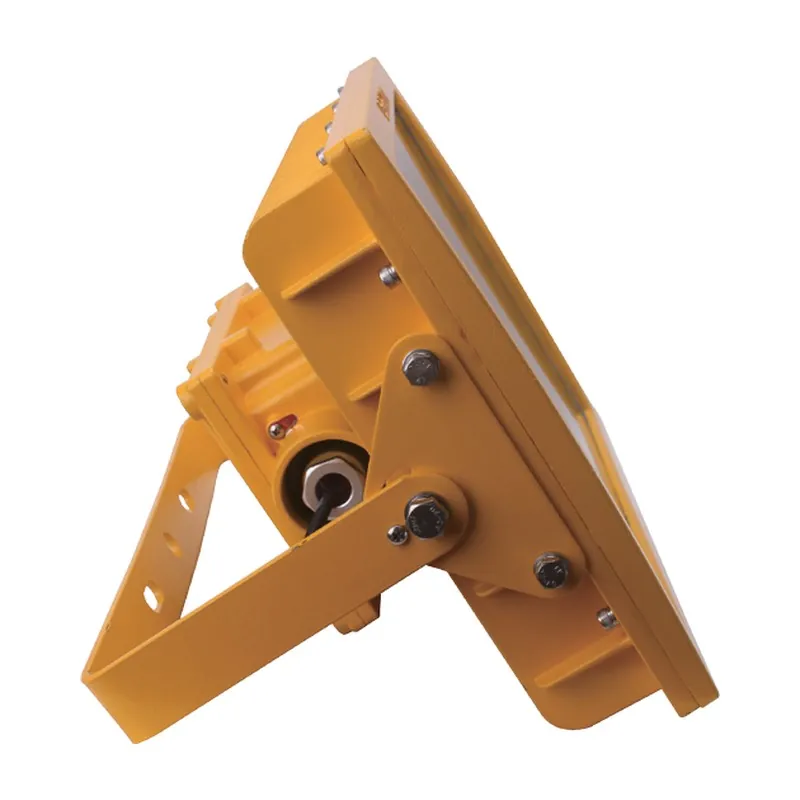
- Fasteners: stainless-steel screws, bolts and hinges, including the bracket hardware.
- Seals and glands: silicone or other chemical-resistant gaskets, and cable glands of brass with nickel plating or stainless steel.
- Glass: tempered glass rather than plastics that may craze in solvents.
Corrosion usually starts at the weakest point, so the fasteners, bracket and gland matter as much as the housing.
Our products with WF grades
Several of our fittings for corrosive sites carry the grade:
| Product | Protection | Corrosion grade |
|---|---|---|
| ExF explosion-proof LED light, 50–150 W | Ex d IIB T6 Gb, IP67 | WF2 |
| BDE507 round explosion-proof light, 20–70 W | Ex d IIC T6 Gb, IP66 | WF2 |
| BAD8599 explosion-proof floodlight and BAD8501B ceiling light | IP66 | WF1 / WF2 |
| BG-FZD anti-vibration crane light, 100–300 W | IP66 | WF2 |
For these models, the explosion-proof certificate for the exact model is supplied with the quotation. Our GKP40H heat-pipe high bay and floodlight is not given a WF grade, but its stainless-steel hardware passed a 500-hour salt spray test for coastal and corrosive sites.
How WF relates to ISO 12944
Outside China, site corrosivity is often described with ISO 12944-2, which classes atmospheres from C1 (very low) to C5 (very high) and CX (extreme, such as offshore), mainly for paint systems on steel structures. There is no official conversion between ISO 12944 classes and WF grades. In practice:
- describe the site with its ISO 12944 class, or with the agents present;
- ask the supplier which grade they propose and why;
- ask for the coating specification and test results for the housing and hardware.
This avoids two suppliers quoting “WF2” for products with very different protection.
What to ask the supplier
- Which standard or internal specification the WF grade refers to.
- Housing material and alloy.
- Coating type, thickness and pre-treatment.
- Fastener and bracket material.
- Gasket and cable gland materials.
- Salt spray or corrosive gas test results, with hours and pass criteria.
- Whether the grade covers the bracket and mounting hardware or only the housing.
In explosion-proof installations
In hazardous areas, the corrosion grade sits beside the Ex marking. Corrosion is a safety issue there: a corroded flamepath or a seized cover screw can compromise an explosion-proof enclosure. Inspection schedules for hazardous-area equipment include checking for corrosion for that reason. Our guide to explosion-proof light ratings explains the Ex marking itself, and our guide to Class 1 Division 1 lighting covers the North American area system.
Maintenance on corrosive sites
- Inspect fixings and brackets at each maintenance visit; replace any corroded screws with stainless ones.
- Touch up damaged coating before rust or white corrosion spreads.
- Check that gaskets are still elastic and glands tight.
- Wash salt deposits off fittings at coastal sites when cleaning.
- Record findings, so a pattern of corrosion in one area can be traced to its source.
Ordering
Tell us the site type, the corrosive agents present, whether the area is hazardous and the zone, and the mounting. We will propose fittings with the right Ex marking, IP rating and corrosion grade, and send the material and coating details with the quotation.
Sources
Frequently asked questions
What does WF2 mean on a light fixture?
It is a corrosion-protection grade used on Chinese industrial and explosion-proof equipment. W means suitable for outdoor use, F means anti-corrosion, and 2 means strong protection, for outdoor sites with heavy chemical or salt exposure.
What is the difference between WF1 and WF2?
Both are outdoor anti-corrosion grades. WF1 is moderate protection, for outdoor sites with mild corrosive conditions; WF2 is strong protection, for sites where corrosive gases, vapours or salt spray are present much of the time.
Is WF2 the same as IP66?
No. IP66 says the enclosure keeps out dust and powerful water jets. WF2 says the materials and coatings resist corrosion. A light for a chemical plant or a coastal site usually needs both.
Is WF2 equivalent to an ISO 12944 class?
There is no official one-to-one mapping. ISO 12944 classifies environments (C1 to CX) for paint systems on steel; WF grades classify equipment protection. Use ISO 12944 to describe the site and ask the supplier to show how the product's protection suits it.