Marina Fuel Dock Lighting: Where Ex Fittings Are Needed and How to Light the Pier
Fuel docks combine petrol vapour, salt spray and night operation over water. Which parts are classified, why vapour behaves differently on a floating dock, and a pier spacing example.
Key points
- On a marine fuel dock, the classified areas are usually small: inside and close around dispensers, around vents and fill points, and in any pits or enclosed spaces below the deck. Most of the pier is unclassified.
- Petrol vapour is heavier than air and spreads along the water surface and under floating docks, so spaces below deck need particular attention.
- For a 4 m wide fuel pier lit to 50 lux from 5 m poles with 60 W fittings, our spacing calculator gives one pole every 12 m on one side.
- Salt spray decides fitting life as much as the hazardous rating: look for IP66/67, a marine-grade corrosion rating and stainless fixings.
A marina fuel dock is a petrol station on water. It has the same vapour hazard as a roadside forecourt, plus salt spray, wave motion, and a floating structure with voids underneath where vapour can collect. It is used at night, often by people tying up unfamiliar boats. Good lighting is a safety measure in itself, and the hazardous-area rules decide where special fittings are needed.
Which parts are classified
In the US, marine fuel dispensing is covered by NFPA 30A, and marinas more generally by NFPA 303. Elsewhere, the area classification under IEC 60079-10-1 sets zones based on release sources and ventilation. The pattern is similar in both:
| Location | Typical classification |
|---|---|
| Inside dispenser enclosures | Division 1 / Zone 1 |
| Close around dispensers and hose nozzles | Division 2 / Zone 2 |
| Around tank vents and fill connections | Division 1 near the outlet, Division 2 further out |
| Pits, sumps and enclosed spaces below the deck near fuel lines | Division 1 / Zone 1 is common |
| Open pier away from fuel equipment | Unclassified |
| Fuel dock office, shop | Unclassified if separated |
Read the actual distances from the applicable code or the site’s classification drawing. The point for lighting is that the classified envelope is usually limited to a few metres around fuel equipment. Placing fittings outside it is often simpler and cheaper than certifying them for it.
Why vapour behaves differently on water
Petrol vapour is heavier than air. On a roadside forecourt it flows across the ground and into drains. On a dock it flows across the deck and onto the water, and on a floating dock it can enter the voids beneath the deck boards and float pontoons. Those enclosed or semi-enclosed spaces may hold vapour long after a spill. Electrical equipment, including lighting and its wiring, should not be placed in them unless certified for the zone.
The same logic applies to boat bilges, which is why fuelling procedures require hatches to be closed and blowers run before starting engines. Lighting cannot fix a vapour-filled bilge, but it can let the attendant see spills and hose positions clearly.
Choosing fittings for the classified area
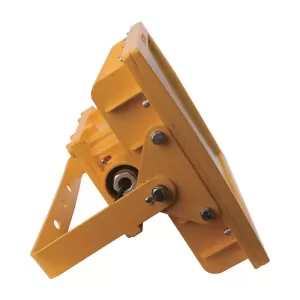
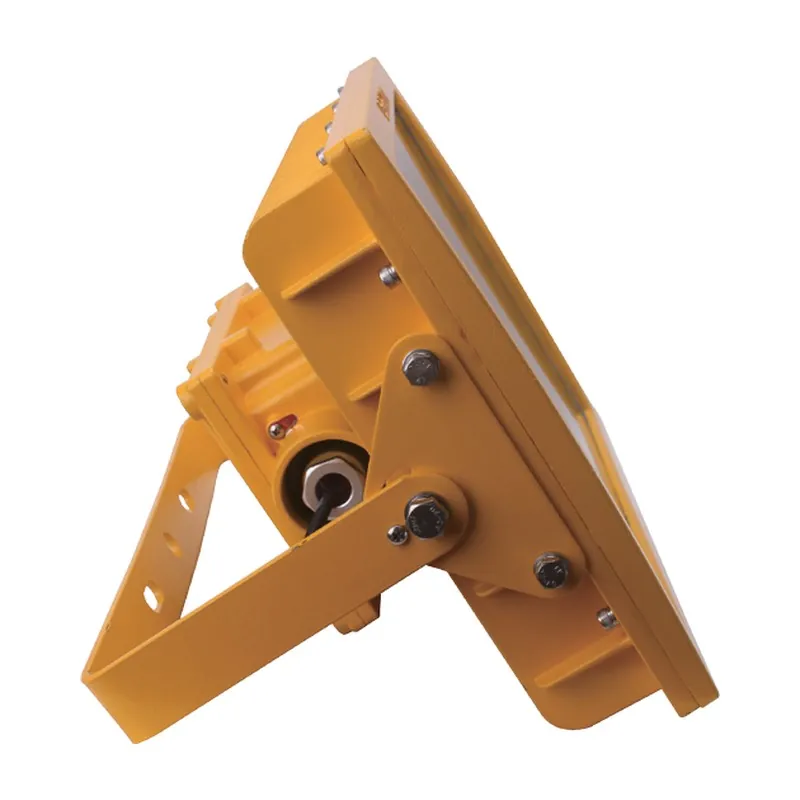
Petrol vapour is gas group IIA and temperature class T3. A fitting marked IIA, IIB or IIC with T3 or a better temperature class covers it. Our ExF explosion-proof flood light is marked Ex d IIB T6 Gb and adds the features a marine site needs:
| Feature | ExF |
|---|---|
| Ex marking | Ex d IIB T6 Gb |
| Power | 50–150 W |
| Efficacy | 110 lm/W |
| Ingress protection | IP67 |
| Corrosion grade | WF2 |
| Bracket | Galvanised steel |
| Ambient | −30 °C to +50 °C |
The certificate for the ExF is provided with the quotation. Our own explosion-proof certificate covers the BED series, which is better suited to indoor plant rooms than to open docks. For the general method of matching a fitting to a zone, see Zone 1 vs Zone 2.
Lighting the pier
Take a fuel pier 4 m wide, lit from poles 5 m high along one side, with a target of 50 lux on the deck. Using 60 W fittings at 110 lm/W, our pole height and spacing calculator gives:
| Result | Value |
|---|---|
| Arrangement | Single side |
| Utilisation factor | 0.46 |
| Recommended spacing | 12 m |
| Average illuminance at that spacing | about 51 lux |
A 36 m fuel pier would therefore take four poles, one at each end and two between. Where a pole falls inside a classified area near a dispenser, either move it out of the zone or use an Ex-rated fitting there. Add a dedicated light at each dispenser so the attendant can read the display and see the nozzle.
The calculator treats the pier like a narrow road, which is a reasonable estimate for an open deck. Water reflects very little light, so do not count on any help from the surroundings.
Glare on the water
Boaters approach the fuel dock from the water, often at night. Fittings aimed outward or tilted up throw glare directly into the helmsman’s eyes and can be confused with navigation lights. Aim floods down onto the deck, use shielded optics, and keep the colour of the lighting neutral white so it does not resemble red or green navigation lights. Our flood light mounting guide covers aiming and bracket choices.
Corrosion and mechanical protection
Salt spray attacks aluminium housings, fixings and cable glands. Over water, a failed gland can let in moisture and salt, which damages the driver and, in an Ex fitting, can compromise the protection.
- Specify IP66 or IP67, and a corrosion rating suited to marine exposure.
- Use stainless steel fixings, and isolate dissimilar metals.
- Choose cable glands rated for the environment and, in classified areas, certified for the protection type.
- Plan inspections more often than for an inland site.
Our comparison of IP65, IP66 and IP67 explains what each rating tests.
Wiring and shore power
Lighting circuits on docks should be protected by residual current devices where codes require them, and run in a way that copes with the movement of floating sections. Keep junction boxes out of classified areas and out of the voids under the deck.
Emergency lighting and controls
Fuel docks need emergency lighting at the emergency fuel shut-off and at the escape route to shore. Put the main lighting on a photocell or timer so it is on whenever the dock is open after dark. If the fuel dock is shared with general berths, consider separate circuits so the fuelling area can stay brightly lit while berths are dimmed.
What to send us
- Dock layout with dispensers, vents and fill points marked
- The area classification, or the code the marina follows
- Pole positions available and mounting heights
- Supply voltage
We return a fitting choice and spacing, with Ex fittings only where the classification needs them. The same approach applies to roadside forecourts, covered in our gas station canopy lighting guide.
Sources
Frequently asked questions
Do marina fuel docks need explosion-proof lights?
Only within the classified areas around dispensers, vents, fill points and enclosed spaces below the deck. Fittings outside those areas can be ordinary marine-grade outdoor fittings. NFPA 30A and NFPA 303 in the US, or the area classification under IEC 60079-10-1 elsewhere, set the extent.
What gas group and temperature class covers petrol?
Petrol (gasoline) vapour is gas group IIA. Its auto-ignition temperature puts it in temperature class T3. Fittings marked IIA, IIB or IIC with T3 or better cover it. Diesel is far less volatile and seldom creates a classified area on its own at normal temperatures.
How much light does a fuel dock need?
Enough to see mooring lines, the edge of the dock and the dispenser display clearly at night. Around 50 lux on the fuelling area, with more at the dispenser, is a reasonable design target; check local marina and fire regulations.
What IP rating should marina lights have?
IP66 or IP67 for fittings exposed to spray and washdown, with corrosion protection suited to salt air and stainless steel fixings.