
KCs Explosion-Proof Certification: What Korea Requires and How It Relates to IECEx
Explosion-proof equipment used at Korean workplaces needs KCs safety certification, which is not the same as the KC mark. What KCs covers, how IECEx reports help, and what to ask a supplier.
Key points
- KCs is Korea's safety certification under the Occupational Safety and Health Act, and explosion-proof electrical equipment for hazardous locations is one of the items that need it. KCs is administered by KOSHA.
- KC is a different mark: it covers general electrical product safety and electromagnetic compatibility. A light can carry KC and still lack the KCs certification needed in a hazardous area.
- Korea's explosion-proof requirements follow the IEC 60079 series, and Korea takes part in IECEx, so an IECEx test report can serve as the technical basis for a KCs application. Confirm the current route with KOSHA.
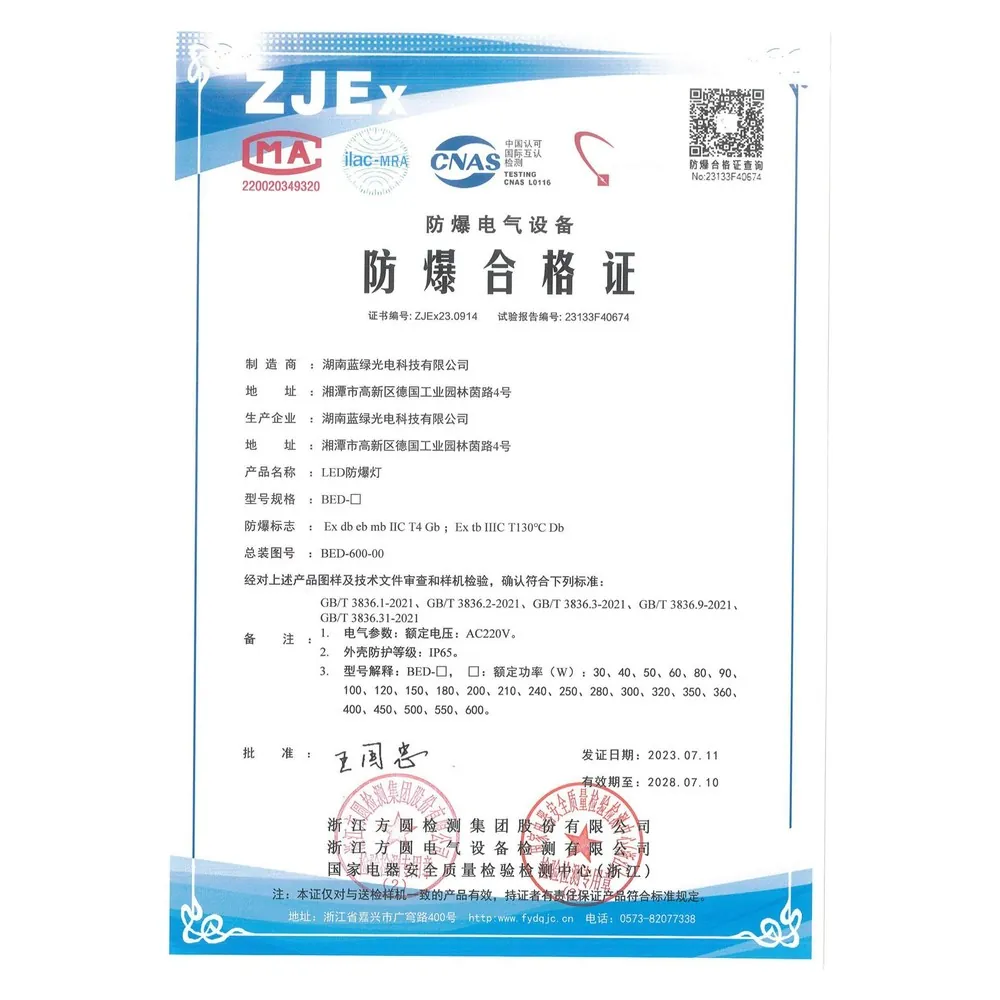
- Our BED series is certified under China's GB 3836 (ZJEx23.0914). That is not KCs or IECEx; for a Korean hazardous area, the fitting must hold KCs, and we confirm what is available before quoting.
Korean projects sometimes arrive with a short line in the specification: “explosion-proof lighting, KCs certified”. Overseas suppliers often read it as KC, the general Korean product mark, or assume their ATEX or IECEx certificate will do. Neither is quite right. This guide explains what KCs is, how it relates to the international schemes, and what a buyer should check.
KCs in one paragraph
Under Korea’s Occupational Safety and Health Act, certain machinery and protective equipment must have safety certification before use at a workplace. Explosion-proof electrical equipment for hazardous locations is included. The certification is administered by KOSHA, the Korea Occupational Safety and Health Agency, and certified equipment carries the KCs mark. The “s” stands for safety in the occupational sense; it is not a variant of the consumer product mark.
KC vs KCs
| KC | KCs | |
|---|---|---|
| Legal basis | Product safety and radio wave laws | Occupational Safety and Health Act |
| Covers | General electrical safety, EMC | Hazardous machinery and protective equipment, including Ex equipment |
| Typical products | Household and commercial electrical goods, LED lamps | Explosion-proof motors, lights, enclosures, and other listed items |
| Proves explosion protection? | No | Yes, for the certified Ex concept |
An industrial LED light can need both: KC for its general electrical and EMC conformity where applicable, and KCs for its explosion protection if it goes into a hazardous area. Ask your Korean importer or consultant which marks the project requires.
The technical basis: IEC 60079
Korea’s explosion-proof requirements are based on the IEC 60079 series, the same family behind IECEx, ATEX harmonised standards and China’s GB 3836. That shared base means the marking on a KCs-certified fitting reads like any other IEC-style marking: protection types (db, eb, mb, tb), gas or dust group, temperature class and equipment protection level.
Our explosion-proof light ratings guide decodes each part. Our article on the IEC 60079 standards explains which part covers which protection concept.
How IECEx fits in
Korea takes part in the IECEx scheme. In practice this means that an IECEx test report (ExTR) and quality assessment report can be used as the technical evidence for a KCs application, which usually avoids repeating the full test programme. The KCs certificate itself is still issued in Korea. Procedures change, so confirm the current route, documents and any local testing with KOSHA or an authorised agent before you plan a schedule.
ATEX test reports may help as background, but they are built on the EU’s conformity procedure rather than the IECEx scheme, so they are less directly usable. Our comparison of FM and ATEX and our guide to who certifies explosion-proof lights cover the other main schemes.
What a buyer should check
- The KCs certificate number and holder. The certificate names the manufacturer and the models it covers.
- The model and power. Certificates list specific models and ratings. A 150 W version may not be covered if only 100 W was certified.
- The marking against the area classification. Gas group, temperature class and EPL must suit the zone. A IIB T4 fitting cannot go where the classification requires IIC or T6.
- The KC mark, if required. Separate from KCs; check with the importer.
- Installation to the Korean code. Certified glands and cable systems are part of the protection.
Where our certificates stand
We are clear about what we hold. Our BED explosion-proof LED light is certified under GB 3836 with certificate ZJEx23.0914:
| Item | BED series |
|---|---|
| Gas marking | Ex db eb mb IIC T4 Gb |
| Dust marking | Ex tb IIIC T130 °C Db |
| Power range | 30–600 W in 24 certified steps |
| Ingress protection | IP65 |
| Valid | 11 July 2023 – 10 July 2028 |
| KCs | Not held |
| IECEx / ATEX | Not held |
That certificate is accepted in China and used as technical evidence in some markets without their own scheme. It does not replace KCs in Korea. For our other explosion-proof series, the certificates are supplied with the quotation. If your project is in Korea and needs KCs, tell us at the inquiry, and we will confirm which fittings can be supplied with it before quoting anything.
Sizing the lighting
The certificate decides whether a fitting may be installed; the photometry decides how many you need. Explosion-proof fittings are usually assumed at a lower efficacy than ordinary high bays, so counts are higher. For a quick estimate, use our high bay lighting calculator with a conservative efficacy, or follow how many explosion-proof lights do I need.
As an example, a 20 × 12 m process room at 6 m needing 200 lux, with 100 W Ex fittings at 110 lm/W, comes out at about 12 fittings in our calculator. Whichever scheme applies, the count should be checked against the certified power steps of the fitting you can actually buy.
Common misunderstandings
- “We have KC, so we are fine.” KC does not cover explosion protection.
- “IECEx is international, so Korea accepts it directly.” It helps, but the Korean certificate is still needed.
- “The supplier will handle it after the order.” Certification can take time; settle it before the order is placed.
- “One certificate covers the whole range.” Only the listed models and ratings are covered.
What to send us
- Project location and the certification required (KCs, KC, IECEx)
- Area classification: zones, gas group, temperature class
- Room or plant layout with mounting heights
- Quantities and the required delivery date
We reply with what can be supplied under the certification your project needs, and say so plainly if we cannot.
Sources
Frequently asked questions
What is KCs certification?
KCs is the safety certification required under Korea's Occupational Safety and Health Act for certain hazardous machinery and protective equipment. Explosion-proof electrical equipment intended for hazardous locations is one of those categories. KOSHA administers it.
What is the difference between KC and KCs?
The KC mark covers general product safety and electromagnetic compatibility for electrical products sold in Korea. KCs is a separate occupational safety certification. Explosion-proof equipment for a hazardous workplace needs KCs; a KC mark alone does not show explosion protection.
Is IECEx accepted in Korea?
Korea participates in IECEx, and IECEx test and assessment reports can be used as the technical basis for a KCs application, which can reduce repeat testing. The KCs certificate is still issued in Korea; an IECEx certificate alone is not the end document.
Do I need KCs if the equipment has ATEX?
Yes, for use in a Korean hazardous workplace. ATEX is a European requirement. Its test reports may help, but the equipment still needs KCs.
