
FM vs ATEX: Two Hazardous-Area Approvals, Different Laws, Different Markings
FM Approvals and ATEX both cover equipment for explosive atmospheres, but one is a US approval and the other an EU law. How they differ, how markings compare, and what to ask for.
Key points
- ATEX is EU law (Directive 2014/34/EU): equipment placed on the EU market for explosive atmospheres must comply. FM Approval is a certification by a US testing laboratory that satisfies OSHA's requirement for approved equipment and many insurers.
- ATEX uses equipment groups, categories and zones only; FM approves to both the North American Class/Division system and the Zone system.
- Neither is automatically accepted in the other's market. A project in Texas asks for an NRTL mark such as FM; a project in Germany asks for ATEX; many international projects ask for IECEx.
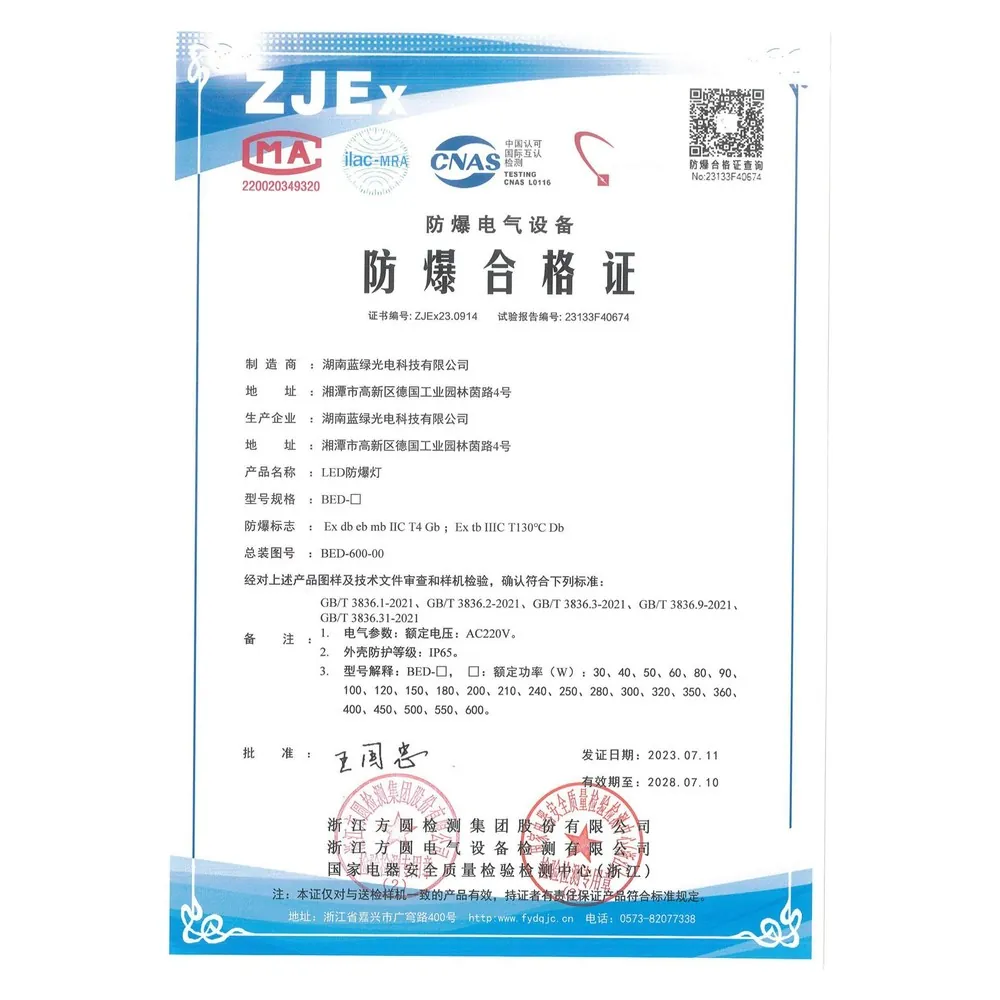
- Our BED series is certified under China's GB 3836 (certificate ZJEx23.0914, Ex db eb mb IIC T4 Gb). It is not an FM or ATEX certificate, and we say so before quoting.
Specifications for hazardous-area lighting often say “FM or ATEX approved”, as though the two were interchangeable. They are not. One is a European law, the other a US laboratory’s approval. They test to similar principles, but they answer different legal questions, use different area systems on the label, and are accepted in different places. If a fitting has the wrong one, it can be rejected on site regardless of how well it is built.
The short answer
| ATEX | FM Approval | |
|---|---|---|
| What it is | EU directive 2014/34/EU, a legal requirement | Certification by FM Approvals, a US testing laboratory |
| Who issues certificates | Notified Bodies designated by EU member states | FM Approvals (part of FM Global) |
| Where it is required | Equipment placed on the EU / EEA market | Accepted in the US as an NRTL approval under OSHA; often required by insurers |
| Area system on the label | Groups, categories, zones (gas and dust) | Class/Division and Zone (US versions of IEC 60079) |
| Self-declaration allowed? | Yes, for Category 3 (Zone 2 / 22) equipment | No; every approved product is tested and audited |
| Mark | CE plus the Ex hexagon | FM Approved diamond |
What ATEX actually requires
ATEX is not a test laboratory or a brand. It is Directive 2014/34/EU, which sets the essential health and safety requirements for equipment and protective systems intended for potentially explosive atmospheres. Equipment that meets it carries the CE mark, the Ex hexagon and a marking such as II 2 G Ex db IIC T4 Gb.
How a product proves conformity depends on its category:
- Category 1 and 2 electrical equipment (for Zones 0/1 and 20/21): an EU-type examination certificate from a Notified Body, plus a quality assurance notification for the factory, also from a Notified Body.
- Category 3 equipment (for Zones 2 and 22): the manufacturer may assess conformity internally and issue the declaration itself.
That second point surprises buyers: an ATEX Category 3 light can be legitimately “ATEX” without any third-party certificate. If your specification wants third-party proof for Zone 2, say so.
What FM Approval actually means
In the US, OSHA’s rule for hazardous locations (29 CFR 1910.307) requires equipment that is approved for the location. In practice that means listed, labelled or certified by a Nationally Recognized Testing Laboratory. FM Approvals is one; UL, CSA and Intertek are others.
An FM-approved light has been tested to FM’s approval standards, such as FM 3600 (general requirements) and FM 3615 (explosion-proof), or to the US editions of the IEC 60079 series for Zone markings. The factory is audited, and the product appears in FM’s online Approval Guide. Many insurers, especially FM Global clients, require FM-approved equipment, which is the main reason FM appears in specifications rather than UL.
An FM label can show either system:
- Division: Class I, Division 1, Groups C, D, T4
- Zone: Class I, Zone 1, AEx db IIB T4 Gb
The “AEx” prefix marks the US Zone certification; ATEX and IECEx use plain “Ex”. Our guide to the Class/Division and Zone systems explains how the two map onto each other.
The same fitting, three labels
The marking tells you which scheme a fitting was certified under. Here is our BED explosion-proof LED light as it is actually certified, and, for comparison, the form an ATEX or FM marking for a fitting with the same protection concepts would take. Only the first row is a certificate we hold.
| Scheme | Marking form | Status for BED |
|---|---|---|
| China, GB 3836 | Ex db eb mb IIC T4 Gb / Ex tb IIIC T130 °C Db | Certified, ZJEx23.0914, valid to 10 July 2028 |
| ATEX | CE, Ex hexagon, II 2 G Ex db eb mb IIC T4 Gb | Not held |
| FM (Zone) | Class I, Zone 1, AEx db eb mb IIC T4 Gb | Not held |
The protection-type letters (db, eb, mb), the gas group (IIC), the temperature class (T4) and the equipment protection level (Gb) are common to all three, because GB 3836, the ATEX harmonised standards and the US Zone standards all derive from IEC 60079. That shared language is why a technician can read any of them. It does not make one certificate valid in another market. Our explosion-proof light ratings guide decodes each part of the string.
How the areas line up
| North America (Division) | Zone | ATEX category | Equipment protection level |
|---|---|---|---|
| Division 1 | Zone 0 | Category 1 | Ga |
| Division 1 | Zone 1 | Category 2 | Gb |
| Division 2 | Zone 2 | Category 3 | Gc |
Division 1 covers both Zone 0 and Zone 1, so a “Div 1” fitting is not automatically suitable for Zone 0, and a Zone 1 fitting is not automatically listed for Division 1. For lighting, Zone 0 is rare; most fittings go in Zone 1 or Zone 2. See Zone 1 vs Zone 2 for what each allows.
Where IECEx fits
IECEx is the international certification scheme run under the IEC. An IECEx certificate of conformity, with its test and quality reports, is accepted directly in some countries and used as the technical basis for national certificates in many others, including ATEX in Europe. When a project spans several countries, IECEx is often the most useful single document to ask for. Our article on who certifies explosion-proof lights lists the main schemes country by country.
Which one does your project need?
Answer three questions:
- Where will the fitting be installed? EU or EEA: ATEX. US: an NRTL mark such as FM or UL. Canada: CSA or a “c” NRTL mark. Elsewhere: the national scheme, often with IECEx accepted.
- What does the specification or insurer say? If an FM Global-insured site requires FM approval, UL may not satisfy the insurer even though OSHA accepts both.
- Which area system is the site classified in? A US plant classified in Divisions needs Division markings or a Zone marking accepted by the authority having jurisdiction.
Common mistakes
- Accepting “ATEX compliant” without a certificate number. Ask for the EU-type examination certificate for Category 2 equipment, and the declaration of conformity.
- Treating FM and ATEX as alternatives in the same tender. Write the requirement per site. A refinery in Rotterdam and one in Louisiana need different documents.
- Ignoring the temperature class. A fitting with the right certificate but T4 cannot go where the classification requires T6. See T3 vs T4.
- Checking the certificate but not the model. Certificates cover listed models and power ranges. Check that the exact model and wattage you are buying is on it.
What we can supply
We are open about what our certificates cover. The BED series carries our own explosion-proof certificate under GB 3836, which is accepted in China and used as technical evidence in some export markets that do not require ATEX, IECEx or an NRTL mark. It is not an FM or ATEX approval. For our other explosion-proof series, certificates are provided with the quotation. If your project needs ATEX, IECEx or FM, tell us at the inquiry stage, and we will confirm what can be offered with that certificate before we quote.
To size the lighting itself once the certificate question is settled, use our high bay lighting calculator or the method in how many explosion-proof lights do I need.
Sources
Frequently asked questions
Is FM approval the same as ATEX?
No. ATEX is a European legal requirement for equipment sold into the EU for use in explosive atmospheres. FM Approval is a certification by FM Approvals, a US Nationally Recognized Testing Laboratory. The test standards overlap, but each is accepted in its own market.
Can an ATEX-certified light be used in the United States?
Not on the ATEX certificate alone. US hazardous locations need equipment listed or approved by an NRTL, such as FM, UL, CSA or Intertek, to a US standard, with US markings. Some manufacturers hold both certifications for the same fitting.
Is FM approval accepted in Europe?
Not as a substitute for ATEX. Equipment placed on the EU market must meet the ATEX directive, carry the CE and Ex marks, and, for Category 1 and 2 electrical equipment, have an EU-type examination certificate from a Notified Body.
What is the difference between FM and UL for hazardous locations?
Both are NRTLs that test to US hazardous-location standards and both are accepted under OSHA rules. The choice is usually set by the specification, the insurer or the local authority, not by a technical difference.
Which certificate should I ask a supplier for?
The one your site's market and specification require: ATEX for the EU, an NRTL mark such as FM or UL for the US, CSA or cUL for Canada, and IECEx where the project accepts the international scheme. Ask for the certificate number and check it with the issuing body.
