
Explosion Proof Lighting Explained: Zones vs Class I Division 1, Gas Groups, T-Codes and Ex Markings
How to choose explosion proof lighting: hazardous zones and the North American Class I Division 1/2 system, gas groups, temperature classes, dust markings and Ex protection types, with a marking decoded and a selection checklist.
Key points
- Zone (0/1/2 for gas, 20/21/22 for dust) says how often an explosive atmosphere is present.
- Gas group IIC covers hydrogen and acetylene and also includes IIA and IIB.
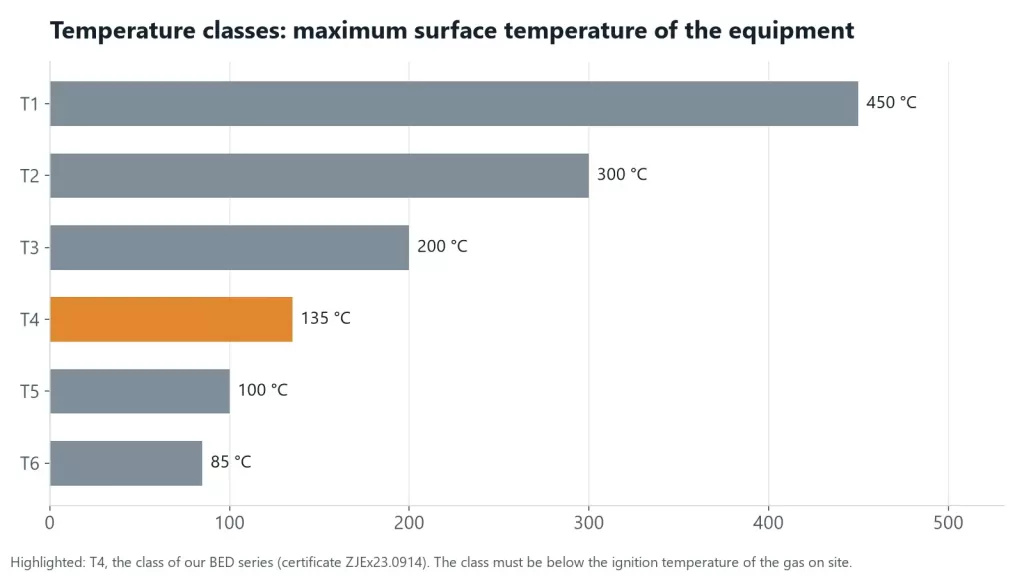
- The temperature class must stay below the ignition temperature of every gas on site: T4 means 135 °C.
- North America uses Class I Division 1/2 and needs UL or CSA listings; a GB 3836 or ATEX certificate is not a substitute.
An explosion-proof light carries a marking such as Ex db eb mb IIC T4 Gb / Ex tb IIIC T130°C Db. In North America, buyers may instead ask for “Class I Division 1”. Every part of these markings has a meaning, and every part has to match the site. This guide decodes them.
1. Hazardous areas: zones
Hazardous areas are classified by how often an explosive atmosphere is present:
| Gas / vapour | Dust | Explosive atmosphere present | Required protection level |
|---|---|---|---|
| Zone 0 | Zone 20 | Continuously or for long periods | Ga / Da |
| Zone 1 | Zone 21 | Likely in normal operation | Gb / Db (or Ga / Da) |
| Zone 2 | Zone 22 | Not likely; only briefly if it occurs | Gc / Dc (or higher) |
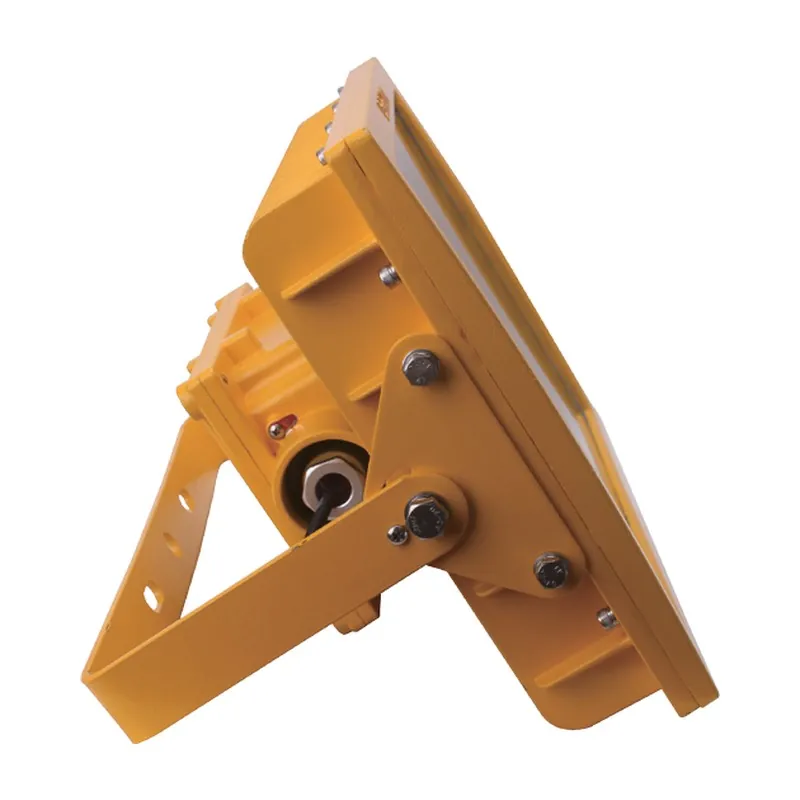
Lighting in Zone 0 is rare. Most explosion-proof luminaires are designed for Zones 1 and 2, and many also for dust Zones 21 and 22.
2. Equipment protection level (EPL)
The last letters of each marking (Gb, Db) are the equipment protection level. “G” is for gas, “D” for dust; “a” is very high protection, “b” high, “c” enhanced. Gb equipment may be used in Zone 1 and Zone 2.
3. Gas groups
| Group | Representative gas | Notes |
|---|---|---|
| IIA | Propane | Most common hydrocarbons |
| IIB | Ethylene | Includes IIA gases |
| IIC | Hydrogen, acetylene | Most demanding; covers IIA and IIB as well |
Group I is reserved for underground mines with firedamp (methane). Dust groups are IIIA (combustible flyings), IIIB (non-conductive dust) and IIIC (conductive dust, the most demanding).
4. Temperature classes
| Class | Maximum surface temperature |
|---|---|
| T1 | 450 °C |
| T2 | 300 °C |
| T3 | 200 °C |
| T4 | 135 °C |
| T5 | 100 °C |
| T6 | 85 °C |
The luminaire’s class must be below the ignition temperature of every gas that may be present. For dust, the marking states the maximum surface temperature directly, for example T130°C, which must be well below the ignition temperature of the dust layer.
Common substances and what they demand
Approximate classifications for substances often found on industrial sites. Always confirm with the safety data sheets and IEC 60079-20-1 for your exact substances:
| Substance | Gas group | Temperature class needed |
|---|---|---|
| Methane (natural gas, above ground) | IIA | T1 |
| Propane, LPG | IIA | T1–T2 |
| Petrol (gasoline) | IIA | T3 |
| Diesel, kerosene, jet fuel | IIA | T3 |
| Ethylene | IIB | T2 |
| Hydrogen | IIC | T1 |
| Acetylene | IIC | T2 |
| Carbon disulphide | IIC | T6 |
Two lessons follow. First, a IIC luminaire covers almost everything, which is why many buyers specify it even where IIA would do. Second, the temperature class depends on the substance, not the group: fuels such as petrol and diesel need T3 even though they are only IIA, and carbon disulphide needs T6. A T4 luminaire covers the first seven substances in the table, but not the last.
Where you meet each zone
Typical examples (the actual classification always comes from the site’s area classification drawing):
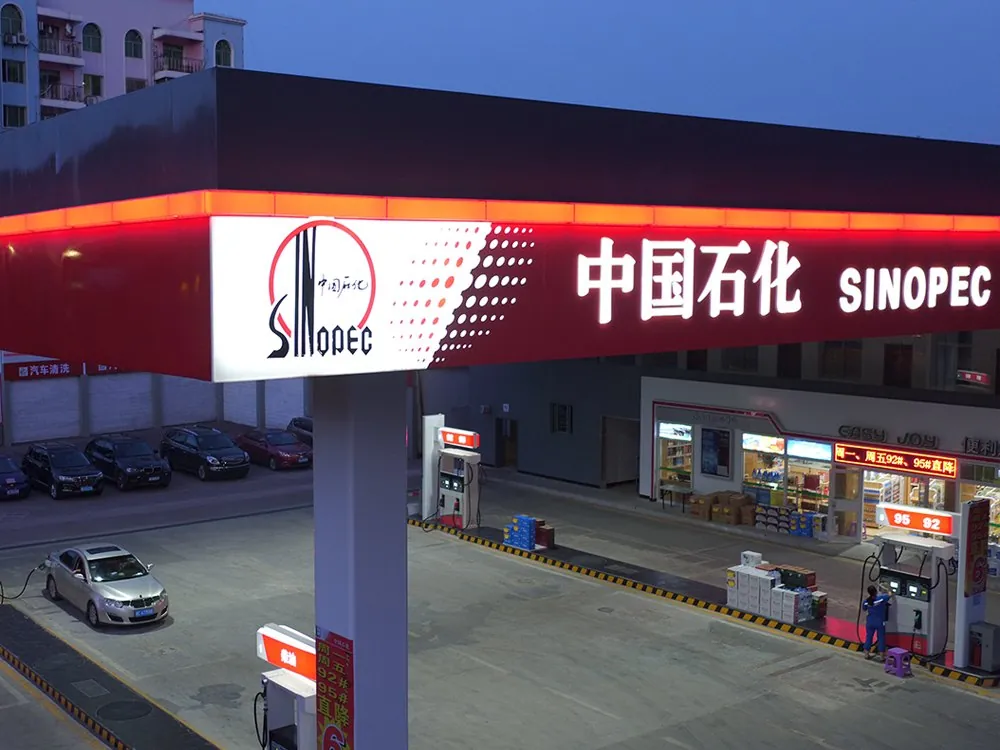
- Fuel stations: inside dispenser housings and around fill points often Zone 1; a surrounding band Zone 2. Canopy lights are normally outside the hazardous area, but check the drawing.
- Refineries and chemical plants: process areas commonly Zone 1 and Zone 2 around pumps, valves, flanges and vents.
- Spray painting: inside booths during spraying typically Zone 1, with Zone 2 around openings.
- Battery charging rooms: hydrogen released during charging can create a IIC hazard near the batteries if ventilation is poor.
- Grain silos, flour mills, sugar and wood processing: combustible dust, Zones 21 and 22.
- Coal handling and power plants: coal dust, Zones 21 and 22; underground coal mines use Group I equipment.
- Pharmaceutical plants: solvent vapours and fine powders, often both gas and dust zones in one building.
5. North America: Class, Division and Group
The United States (NEC Articles 500–503) and Canada traditionally classify hazardous locations differently, and buyers often search for “Class I Division 1” rather than “Zone 1”.
| North American system | Meaning | Rough Zone equivalent |
|---|---|---|
| Class I | Flammable gases and vapours | Gas zones |
| Class II | Combustible dusts | Dust zones (20/21/22) |
| Class III | Ignitable fibres and flyings | — |
| Division 1 | Hazard present in normal operation | Zone 0 + Zone 1 |
| Division 2 | Hazard present only in abnormal conditions | Zone 2 |
Gas groups are also named differently:
| Class I group | Representative gas | IEC group |
|---|---|---|
| A | Acetylene | IIC |
| B | Hydrogen | IIC |
| C | Ethylene | IIB |
| D | Propane | IIA |
The US NEC also allows the Zone system (Article 505), but the key difference is certification. Luminaires for Class I Division 1 in North America are normally listed by a recognised testing laboratory to UL 844 or the CSA equivalent. An IEC, ATEX or GB 3836 certificate is not a substitute. Our explosion proof lights are certified under GB 3836, so for US or Canadian projects that require Class/Division listings, tell us at the inquiry stage rather than assuming equivalence.
6. Protection types
The letters after “Ex” describe how the equipment avoids igniting the atmosphere:
- d / db (flameproof): the enclosure withstands an internal explosion and prevents flame from escaping. The classic choice for luminaires.
- e / eb (increased safety): extra measures prevent arcs, sparks and hot spots; typical for terminal boxes.
- m / mb (encapsulation): components potted in resin, often used for LED drivers.
- i (intrinsic safety): energy is limited so a spark cannot ignite; used for low-power instruments rather than lighting.
- t / tb (protection by enclosure, dust): the enclosure keeps dust out and limits surface temperature.
A luminaire can combine several types, one for each part, which is what “Ex db eb mb” means.
Reading a real marking
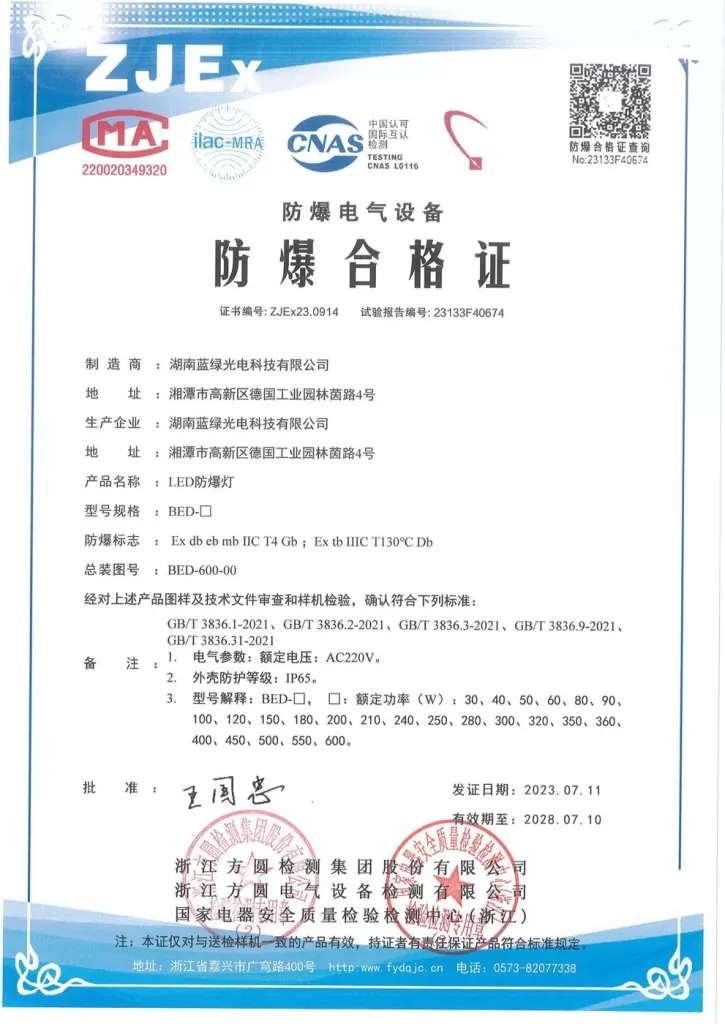
Our BED series explosion-proof LED light is certified (certificate ZJEx23.0914, under the GB 3836 standards) as:
Ex db eb mb IIC T4 Gb / Ex tb IIIC T130°C Db, IP65
- db eb mb: flameproof light chamber, increased-safety terminal compartment, encapsulated driver
- IIC: suitable for all gas groups, including hydrogen and acetylene
- T4: surface below 135 °C
- Gb: Zone 1 and Zone 2
- tb IIIC T130°C Db: dust Zones 21 and 22, including conductive dust, surface below 130 °C
You can see the certificate on our certificates page.
Installation and inspection
A certified luminaire is only safe if it is installed and maintained as certified. The relevant international standards are IEC 60079-14 (design and installation) and IEC 60079-17 (inspection and maintenance); national rules may add to them. Practical points:
- Cable glands and plugs must themselves be certified for the protection type and fitted correctly. An ordinary gland in a flameproof enclosure voids the protection.
- Unused entries must be closed with certified stopping plugs.
- Flamepaths (the precisely machined joints of a flameproof enclosure) must not be painted, damaged or filled with ordinary sealant. Light grease specified by the manufacturer is usually allowed.
- All cover bolts must be present and tight; replacements must be of the specified grade.
- Do not open a live enclosure in a hazardous area unless the certificate and site permit system allow it.
- Keep the certificate and instructions with the equipment register, so inspectors can check the marking against the zone.
Periodic inspection, typically visual every year and closer inspections at longer intervals, catches the common faults: missing bolts, damaged glass, corroded glands and dust layers on hot surfaces.
Emergency lighting
Escape routes in hazardous areas still need emergency lighting. Explosion-proof emergency luminaires include their own battery and switch to battery power when the supply fails, typically for 90 minutes or more. Check that the battery and charging circuit are covered by the certificate and that the duration meets your local emergency lighting rules.
Selection checklist
- Zone (0/1/2, 20/21/22) from the site’s hazardous area classification drawing
- Gas group and temperature class of the substances present, or the dust group and ignition temperature
- Certification scheme required: ATEX (EU), IECEx, UL/CSA listing for Class/Division in North America, national (for example GB 3836 in China) or a combination
- Ingress protection (IP65 or IP66 is typical outdoors) and corrosion protection (WF1/WF2 for chemical and coastal sites)
- Input voltage, including 24 V or 36 V for confined spaces and mines
- Mounting (ceiling, pendant, wall, pole or bracket), cable entry size and gland type
- Ambient temperature range, especially for hot process areas
Our explosion-proof LED lights range from 10 W emergency lights to 600 W floodlights. Send us the zone, gas group and temperature class from your area classification, and we will propose a model and send its certificate with the quotation.
Sources
Frequently asked questions
What is the difference between T4 and T6?
The temperature class is the maximum surface temperature of the luminaire: T4 is 135 °C and T6 is 85 °C. The class must be lower than the ignition temperature of the gas on site. T4 covers most hydrocarbons, including methane, propane, petrol vapour and hydrogen; T6 is needed for gases with very low ignition temperatures, such as carbon disulphide.
Can a IIB light be used where hydrogen is present?
No. Hydrogen and acetylene belong to group IIC, the most demanding group. A IIC luminaire may be used for IIA and IIB gases, but not the other way round.
Is Zone 1 more dangerous than Zone 2?
Yes. In Zone 1 an explosive gas atmosphere is likely to occur in normal operation; in Zone 2 it is not likely and, if it occurs, lasts only a short time. Zone 1 needs equipment protection level Gb or Ga; Zone 2 accepts Gc, Gb or Ga.
Is Zone 1 the same as Class I Division 1?
Not exactly. Class I Division 1 (used under the US National Electrical Code and in Canada) covers locations where flammable gas is present in normal operation, which corresponds roughly to Zone 0 plus Zone 1. Class I Division 2 corresponds roughly to Zone 2. The certification is different too: North American projects usually require a listing by a recognised testing laboratory to UL 844 or the equivalent CSA standard.
Are Chinese GB 3836 certificates accepted abroad?
GB 3836 is technically aligned with the IEC 60079 series, but a Chinese certificate is not automatically accepted under ATEX in the EU or in IECEx countries. If your project requires ATEX or IECEx, state it in the inquiry so the supplier can confirm which models are certified accordingly.