
Intrinsically Safe vs Explosion-Proof: Protection Types for Lights and Equipment
Intrinsically safe (Ex i) vs explosion-proof or flameproof (Ex d) equipment, other protection types (Ex e, m, t), and which suits fixed lights, portable lights and sensors.
Key points
- Explosion-proof (flameproof, Ex d) equipment contains any internal explosion and stops flames escaping; intrinsically safe (Ex i) equipment limits energy so it cannot cause ignition at all.
- Fixed LED lights use mainly Ex d, Ex e and Ex m, often combined; intrinsic safety suits low-power devices such as sensors, radios and small torches.
- Ex ia is suitable for Zone 0; Ex d and Ex e are used in Zones 1 and 2.
- Portable lights for hazardous areas are certified as a whole, usually with Ex ib, Ex d or Ex e protection and a sealed battery.
“Explosion-proof” is used loosely to mean any equipment safe for hazardous areas. Engineers use it more precisely, for one of several protection methods. Knowing the difference between flameproof, intrinsically safe and the other types helps when reading fixture markings and choosing equipment.
Two different ideas
| Explosion-proof / flameproof (Ex d) | Intrinsically safe (Ex i) | |
|---|---|---|
| Principle | Let it happen inside, contain it | Never let it happen |
| How | Strong enclosure, flamepaths that cool escaping gas | Energy limited by design, even with faults |
| Power | Any, including high power | Very low power only |
| Typical equipment | Lights, motors, switches, junction boxes | Sensors, transmitters, radios, small torches |
| Weight | Heavy enclosures | Light |
| Maintenance | Must not open live; check flamepaths | Can often be worked on live |
| System | Device on its own | Device plus barriers or isolators in the safe area |
Flameproof (Ex d)
A flameproof enclosure lets the explosive gas enter, and if it ignites inside, the enclosure holds the pressure and the joints (flamepaths) cool the escaping gases. Key points:
- Thick die-cast or steel housings
- Flamepath gaps and lengths set by the standard
- Certified cable glands or conduit seals
- No modifications or extra holes
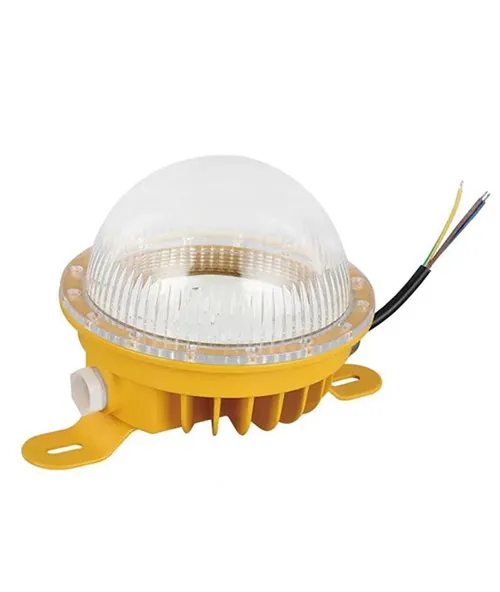
Most explosion-proof LED lights use Ex d for the driver and LED compartment, for example the BAD8501B ceiling light (Ex d IIC T6 Gb) and the BDE507 round light.
Intrinsic safety (Ex i)
An intrinsically safe circuit limits voltage, current and stored energy so any spark or hot surface is too weak to ignite the gas. It usually needs:
- The field device certified Ex i
- A barrier or isolator in the safe area
- Cable with limited capacitance and inductance
- A loop calculation for the system
Levels:
| Level | Faults tolerated | Zones |
|---|---|---|
| Ex ia | Two faults | Zone 0, 1, 2 |
| Ex ib | One fault | Zone 1, 2 |
| Ex ic | Normal operation | Zone 2 |
Other protection types
| Code | Name | How | Used for |
|---|---|---|---|
| Ex e | Increased safety | No sparking parts, extra insulation and creepage | Terminal boxes, LED lights’ connection chambers |
| Ex m | Encapsulation | Parts potted in resin | Drivers, small electronics |
| Ex n / ec | Non-sparking (Zone 2) | Simplified protection | Zone 2 lighting |
| Ex p | Pressurisation | Clean air or inert gas inside | Control panels, analysers |
| Ex q | Powder filling | Sand around parts | Capacitors, some components |
| Ex o | Oil immersion | Parts in oil | Transformers |
| Ex t | Dust protection by enclosure | Dust-tight, temperature limited | Lights and boxes in dust zones |
Many luminaires combine types. A marking such as Ex db eb mb IIC T4 Gb, used on our BED series, means a flameproof main compartment, increased-safety terminals and encapsulated electronics.
Which suits lights?
| Equipment | Usual protection |
|---|---|
| Fixed high bays and floodlights | Ex d, often with Ex e and Ex m |
| Linear and ceiling lights | Ex d, or Ex e/Ex m designs |
| Zone 2 lighting | Ex ec / Ex nA, or Zone 1 fixtures |
| Dust zones | Ex t (tb, tc) |
| Portable torches and headlamps | Ex ib or Ex ia, sometimes Ex e |
| Portable work lights | Ex d or Ex e with sealed batteries |
| Emergency lights | Ex d with sealed battery compartment |
Portable explosion-proof lights
Portable lights for tank cleaning, maintenance and inspection are certified as complete units:
- Low-power torches and headlamps: often intrinsically safe
- Larger work lights and floodlights: flameproof or increased safety housings, with sealed battery packs
- Charging must take place outside the hazardous area unless the charger is certified
- Batteries must be those specified by the certificate
Zone and protection
| Zone | Allowed (typical) |
|---|---|
| Zone 0 | Ex ia, special Ga equipment |
| Zone 1 | Ex d, Ex e, Ex ib, Ex m, Ex p and combinations (Gb) |
| Zone 2 | All Zone 1 types plus Ex ec / Ex n, Ex ic (Gc) |
For zones, gas groups and temperature classes in more detail, see explosion-proof light ratings explained.
Maintenance differences
- Ex d: isolate before opening; inspect flamepaths for damage and corrosion; never paint them; replace damaged glands
- Ex i: can often be worked on live with suitable instruments; keep loop documentation current; do not mix non-IS devices into IS circuits
- Ex e: check terminals and insulation; no extra components
Inspections follow IEC 60079-17 and site permits.
Explosion-proof electrical equipment beyond lights
Lights are only part of a hazardous area installation. Junction boxes, switches, plugs, control stations, motors and cable glands all need suitable protection and certificates. Mixing certified lights with uncertified boxes defeats the protection.
Choosing in practice
For a pump room in Zone 1, fixed lighting is usually flameproof LED fittings with Ex e terminal boxes, while gas detectors and level transmitters are intrinsically safe and wired through barriers. Maintenance staff carry intrinsically safe radios and torches. In Zone 2 areas next to them, the same Zone 1 fittings are often used for simplicity, because one spare stock covers both zones. In dusty areas such as grain handling, the dust marking (Ex t) matters as much as the gas marking. Fuel stations are a familiar example: canopy lights outside the classified zones can be standard, while lights near dispensers and vents must be certified.
Certificates
For the BED series we hold the certificate in our own name. For other explosion-proof models, the certificate is supplied with the quotation. Check the marking and certificate against the zone drawing before installation.
Ordering
Send the zone drawing, gas group, temperature class, and whether you need fixed or portable lights. We will propose fixtures with suitable protection types.
Sources
Frequently asked questions
What is the difference between intrinsically safe and explosion-proof?
Explosion-proof (flameproof) equipment is built strongly enough to contain an explosion inside it and cool escaping gases so they cannot ignite the outside atmosphere. Intrinsically safe equipment limits electrical and thermal energy so low that it cannot ignite the atmosphere in the first place, even with faults.
Are LED lights intrinsically safe?
Fixed LED luminaires generally need too much power to be intrinsically safe and use flameproof, increased-safety or encapsulation protection instead. Small battery torches and headlamps can be intrinsically safe.
Which is better, intrinsically safe or explosion-proof?
Neither is better in general. Intrinsic safety suits low-power devices and allows live work in hazardous areas. Flameproof protection suits higher-power equipment such as lights and motors. The right choice depends on the power needed, the zone and maintenance practice.