
Explosion-Proof High Bay Lighting: Ratings, Wattage and Layout for Hazardous Areas
How to choose explosion-proof LED high bays for chemical plants, fuel depots, paint shops and mines: Ex markings, wattage by height, a worked layout, heat, corrosion and installation.
Key points
- An explosion-proof high bay must be marked for the zone (gas Zone 1/2 or dust Zone 21/22), the gas group (IIA, IIB, IIC) and a temperature class below the ignition temperature of the substances present.
- Typical wattage: 60–100 W at 5–6 m, 100–200 W at 8–10 m and 200–400 W at 12–15 m, the same light levels as normal high bays.
- A 30 × 20 m hazardous store at 8 m needs about 20 fittings of 150 W at 120 lm/W for 200 lux, with a lower maintenance factor for dirty atmospheres.
- Cable glands, sealing and earthing are part of the protection; an Ex fixture installed with the wrong gland is no longer explosion-proof.
High bays in hazardous areas do the same job as high bays in any warehouse: light a large floor from a high ceiling. The difference is that a spark or a hot surface could ignite the atmosphere. That changes how the fixture is built and certified, how it is installed and how it is maintained, while the lighting design itself follows the same rules.
Where explosion-proof high bays are used
- Chemical and pharmaceutical plants
- Oil refineries, gas plants and fuel depots
- Paint shops and spray booths (see explosion-proof lighting for paint booths)
- Solvent and chemical stores
- Grain, flour, sugar and wood-dust facilities
- Coal handling and mines
- Battery rooms and hydrogen areas
Reading the marking
A typical gas marking looks like Ex db eb mb IIC T4 Gb:
| Part | Meaning |
|---|---|
| Ex db | Flameproof enclosure (contains an internal explosion) |
| eb, mb | Increased safety and encapsulation for parts of the fixture |
| IIC | Gas group: IIC covers the most easily ignited gases such as hydrogen and acetylene, and also IIA and IIB |
| T4 | Maximum surface temperature 135 °C |
| Gb | Equipment protection level for Zone 1 (and Zone 2) |
Dust markings, such as Ex tb IIIC T130 °C Db, cover Zone 21 and 22. For the full system of zones, groups and temperature classes, see explosion-proof light ratings explained.
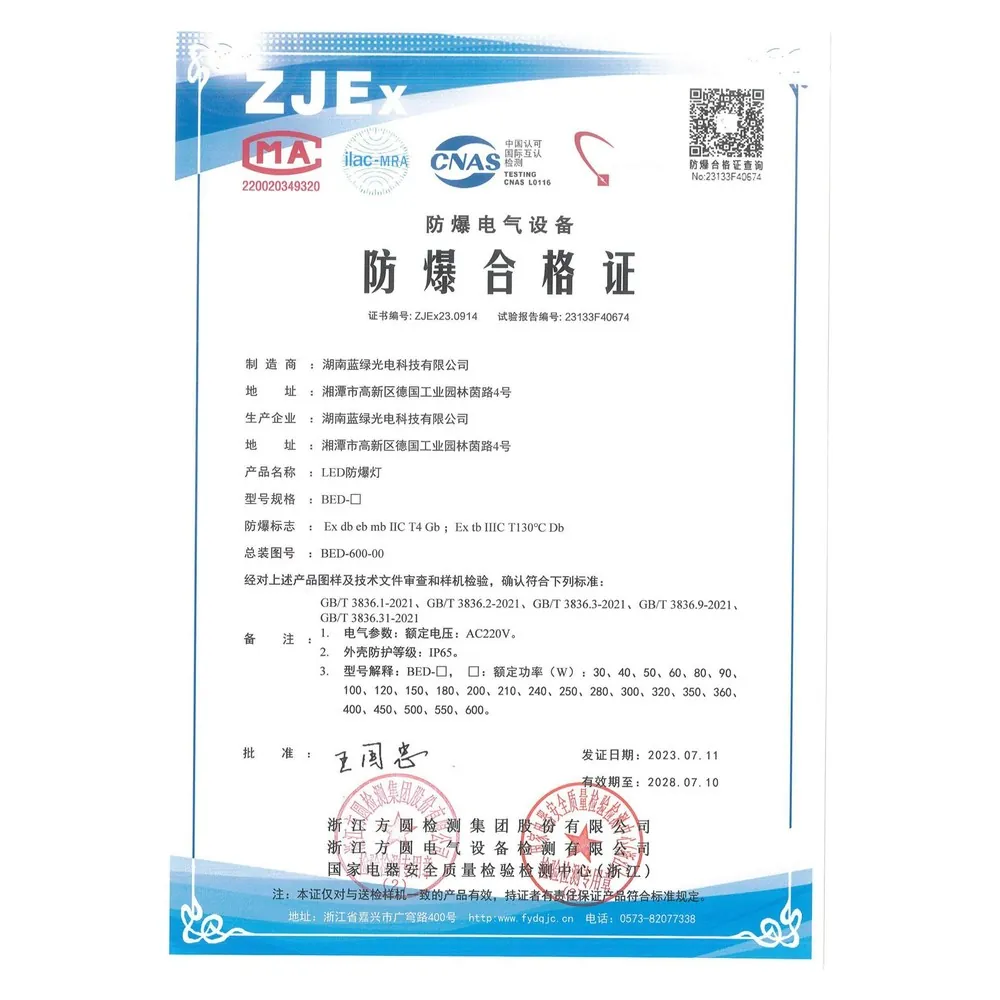
Our BED explosion-proof LED light is certified under GB 3836 (aligned with IEC 60079), certificate ZJEx23.0914 valid to July 2028, marked Ex db eb mb IIC T4 Gb and Ex tb IIIC T130 °C Db, in power steps from 30 to 600 W.
Choosing the rating
- Zone: from the site’s hazardous area classification drawing. Zone 1 needs Gb (or Ga) equipment; Zone 2 can use Gc or better.
- Gas group: the most demanding gas present. IIC fixtures can be used in IIB and IIA areas.
- Temperature class: below the auto-ignition temperature of every substance present. T4 (135 °C) suits most hydrocarbons; carbon disulphide needs T6.
- Dust: for combustible dust, a dust marking for Zone 21/22 and a surface temperature below the dust’s ignition limits.
- Market: the certificate type the authority accepts (IECEx, ATEX, national schemes, or Class/Division listings in North America).
Wattage by mounting height
| Mounting height | Typical LED high bay | Light level |
|---|---|---|
| 5–6 m | 60–100 W | 150–300 lux |
| 8–10 m | 100–200 W | 150–300 lux |
| 12–15 m | 200–400 W | 150–300 lux |
| 15 m and above | 400–600 W or floodlights | Depends on task |
Light levels follow the task: about 100–150 lux for stores, 200–300 lux for process areas, 500 lux for inspection and control.
A worked example
A solvent store of 30 × 20 m with 8 m mounting height, medium reflectances, target 200 lux. Dirty atmospheres call for a lower maintenance factor: 0.7 instead of 0.8. With 150 W fittings at 120 lm/W, our high bay calculator gives:
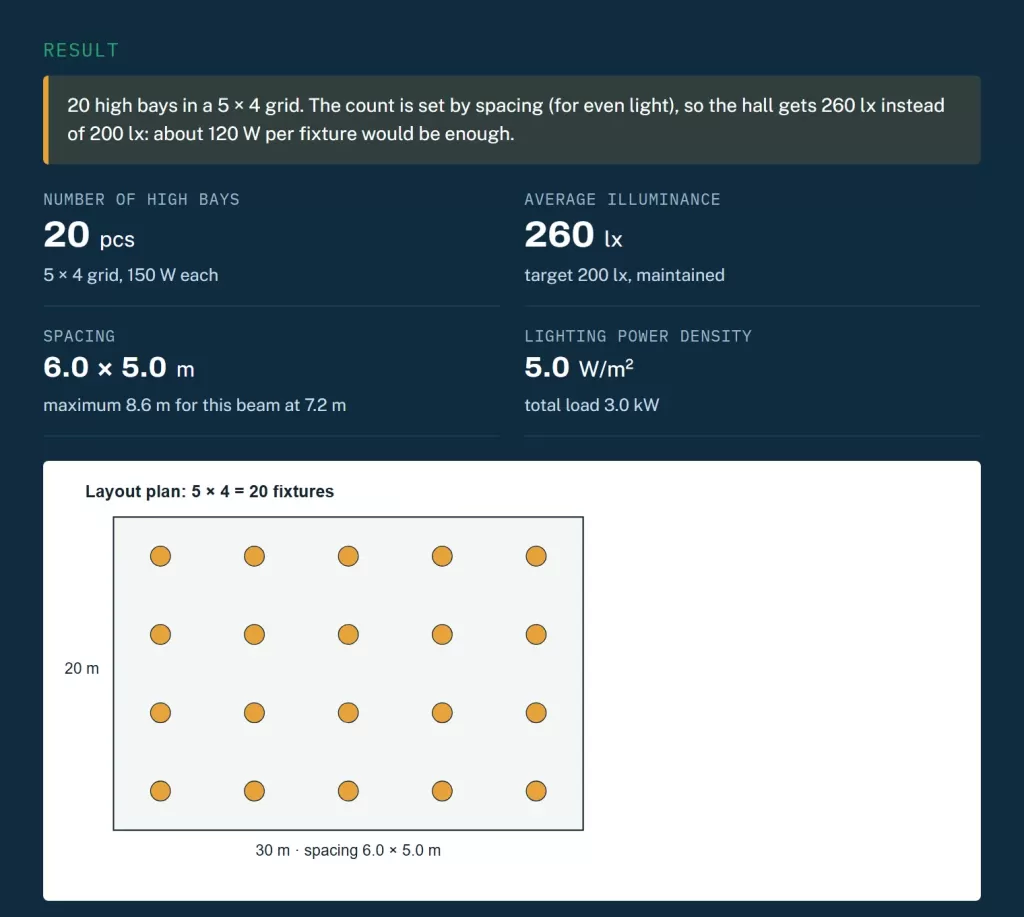
- 20 fittings in a 5 × 4 grid, about 260 lux average
- 5.0 W/m², total load 3 kW
- Spacing of 6 × 5 m keeps light even between racks
Open the example. Here the layout is set by spacing rather than lumens: fewer fittings would leave dark patches between them, so the result is above target; the calculator notes that about 120 W per fitting would be enough in the same grid. For process areas at 300 lux, 200 W fittings in the same grid give about 350 lux.
Heat and ambient temperature
The temperature class is only valid within the rated ambient range, often −30 °C to +40 °C or +50 °C. In hot roofs, furnaces and tropical plants:
- Check the rated ambient on the certificate
- Avoid mounting directly above heat sources
- In high-heat areas, choose fittings rated for the temperature or move them
Corrosion
Chemical plants, coastal refineries and fertiliser plants attack aluminium and coatings. Look for:
- Corrosion grade WF1 or WF2 for outdoor and chemical environments
- Powder-coated die-cast aluminium, or stainless steel for severe cases
- Stainless steel fasteners
- Tempered glass rather than plastic lenses
Installation is part of the protection
- Cable glands certified for the protection type and the cable diameter
- Unused entries closed with certified stopping plugs
- Flamepath joints clean and undamaged; do not paint or grease them unless allowed
- Earthing of the fixture and bracket
- Secondary safety chain or wire for suspended fixtures
- Installation and inspection by competent people under IEC 60079-14 and 60079-17
Mounting options
| Mounting | Use |
|---|---|
| Hook or pendant | Open high ceilings |
| Ceiling bracket | Low ceilings and beams |
| Wall bracket | Along walls and racks |
| Pole or U-bracket | Outdoor process areas, tank farms |
For outdoor tank farms and loading bays, explosion-proof floodlights on poles or structures are more common than high bays.
Converting from HID or fluorescent
Many plants still use 250–400 W metal halide or sodium explosion-proof fittings. LED replacements of 100–200 W give the same or more light, start instantly, and need far fewer lamp changes, which matters because every opening of an Ex fixture in a hazardous area needs a permit. See the HPS to LED conversion chart for equivalents.
Emergency lighting
Escape routes in hazardous areas need certified emergency lights. Our explosion-proof emergency light gives two hours of emergency operation with twin heads.
Certificates and documents
For the BED series we hold the certificate in our own name. For other explosion-proof models, the certificate is supplied with the quotation. Always check that the marking on the label matches the certificate and the zone drawing.
What to send for a quotation
The hazardous area classification (zone, gas group, temperature class), the room or area size and mounting heights, target lux, ambient temperature and the certificate type your authority accepts. We will propose fittings and a layout.
Sources
Frequently asked questions
What is an explosion-proof high bay light?
A high-ceiling LED light built and certified so that it cannot ignite flammable gas, vapour or dust around it, for example by containing any internal explosion in a flameproof housing (Ex d) or by keeping surfaces below the ignition temperature. It is used in chemical plants, refineries, fuel stores, paint shops, grain stores and mines.
How many watts should an explosion-proof high bay be?
Choose by mounting height and target light level, as for normal high bays: about 60–100 W at 5–6 m, 100–200 W at 8–10 m and 200–400 W at 12–15 m for 150–300 lux. Run a lumen-method calculation with the fixture's real lumens.
Is explosion-proof the same as vapour-tight?
No. A vapour-tight (IP65/IP66) light keeps dust and water out, but it is not certified to prevent ignition of an explosive atmosphere. Only fixtures certified for the hazardous zone may be used there.