
HPS to LED Conversion: LED vs Sodium Street Lights, Wattage Chart and Payback
What LED wattage replaces a 70, 150, 250 or 400 W high-pressure sodium lamp? A conversion chart for street and area lighting, why ballast losses matter, how much energy you save, and how to calculate payback.
Key points
- A 250 W sodium street light draws about 290 W with its ballast; 100–120 W of LED usually replaces it.
- LED needs 40–50% of the watts: no ballast loss, higher efficacy and optics that keep light on the road.
- Typical savings are 50–65% of lighting energy, more with dimming after midnight.
- Use the chart for budgets, then confirm each road with a lighting calculation.
“What LED replaces my 250 W sodium lamp?” is the most common question we get from municipalities and contractors starting a retrofit. The short answer is 100–120 W. The useful answer explains why, because getting the equivalent wrong in either direction costs money: too high and you waste energy for 15 years, too low and the road fails its lighting class.
Conversion chart
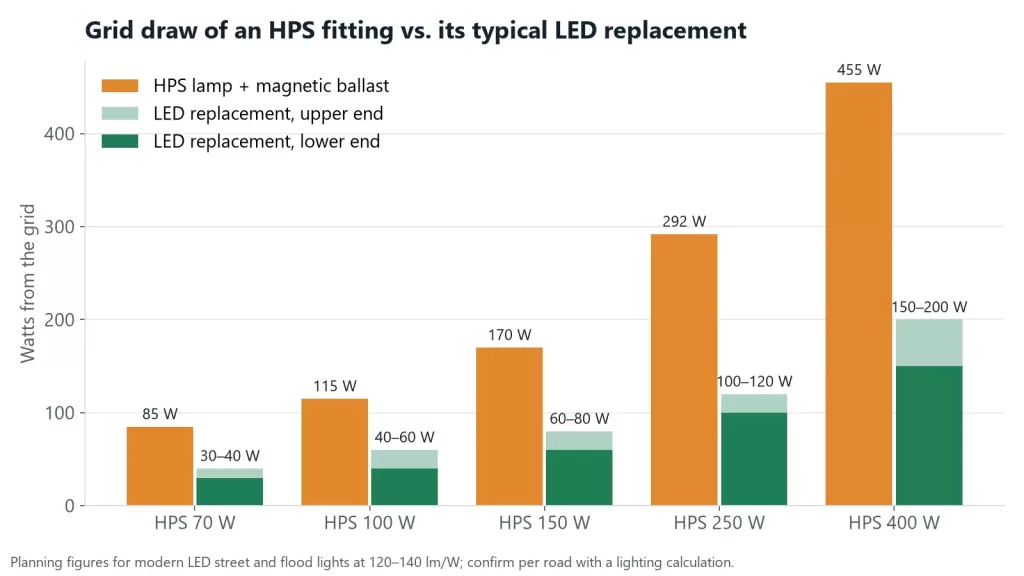
| Existing HPS lamp | Grid draw with magnetic ballast | Typical LED replacement | Typical use |
|---|---|---|---|
| 70 W | ~85 W | 30–40 W | Residential streets, paths |
| 100 W | ~115 W | 40–60 W | Residential and collector roads |
| 150 W | ~170 W | 60–80 W | Urban roads |
| 250 W | ~285–300 W | 100–120 W | Main roads, car parks |
| 400 W | ~450–460 W | 150–200 W | Main roads, floodlights, high masts |
| 1000 W (HPS or metal halide) | ~1,080–1,100 W | 300–400 W | High masts, ports, stadiums |
These are planning figures for modern LED street and flood lights at 120–140 lm/W. The right value for your road depends on width, pole height and spacing; check it with the pole spacing calculator or ask for a photometric layout.
LED vs sodium street lights at a glance
| High-pressure sodium (HPS) | LED street light | |
|---|---|---|
| Efficacy of the complete fitting | Typically 60–80 lm/W after ballast and reflector losses | 120–140 lm/W |
| Colour | Orange-yellow, about 2,000 K | 3,000–5,700 K, choose per site |
| Colour rendering (CRI) | About 20–25 | 70 or more |
| Start-up | 3–5 minutes to full output; minutes to restrike after a power dip | Instant, and can be dimmed |
| Lamp life | Lamp replaced every 3–4 years in street duty | 50,000–100,000 hours for the LED module |
| Light control | Omnidirectional lamp, light spills onto verges and sky | Road optics put light on the carriageway |
| Hazardous materials | Contains mercury and sodium | No mercury |
Sodium lamps still have one advantage: the lamps themselves are cheap. Over the life of an installation, energy and maintenance outweigh that many times over.
Why LED needs about 40–50% of the watts
1. Ballast losses disappear. The wattage printed on an HPS lamp is the lamp alone. A magnetic ballast adds 10–20%, so a “250 W” fitting draws close to 300 W. An LED driver loses only 5–10%, and that loss is already included in the luminaire wattage.
2. Efficacy. A 250 W HPS lamp produces about 25,000–28,000 lumens, roughly 100–110 lm/W for the bare lamp. Once the ballast and the reflector losses of the old luminaire are counted, the fitting delivers well under 80 lm/W. A good LED street light measures 120–140 lm/W for the complete luminaire.
3. Optics. An HPS lamp radiates in all directions, and the reflector has to redirect it. A lot of light ends up on house fronts, verges and the sky. LED road optics shape the beam to the road (Type II for narrow roads, Type III for wider ones), so more of the lumens land where the lighting class is measured.
4. Lumen maintenance. HPS lamps lose output over their life and are often running well below rated output when replaced. A retrofit designed to the new lamp’s lumens is already conservative.
How much will you save?
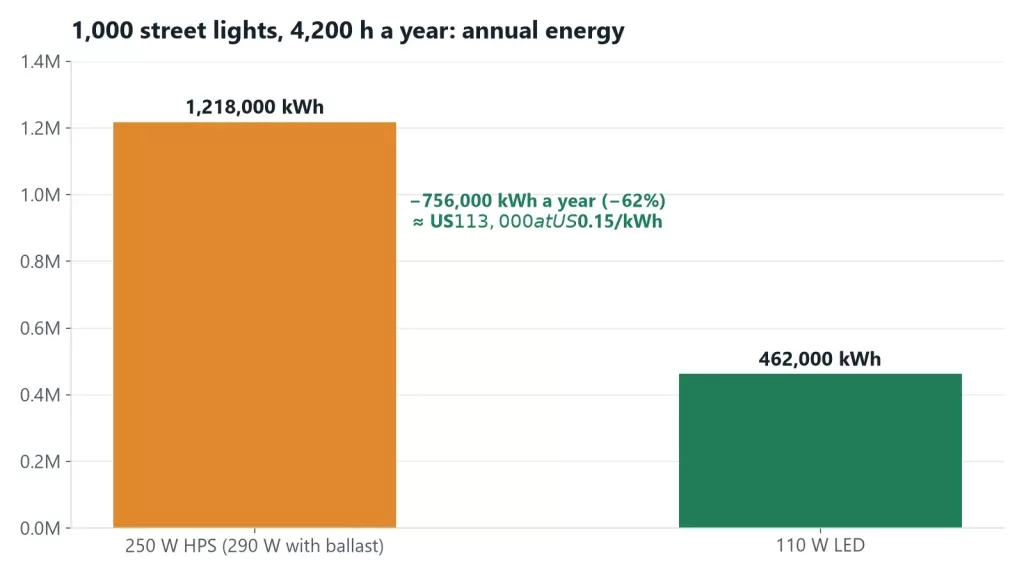
Take a city replacing 1,000 × 250 W HPS street lights with 110 W LED, running 4,200 hours a year (about 11.5 hours a night), electricity at US$0.15/kWh:
- Old: 1,000 × 290 W × 4,200 h = 1,218,000 kWh a year
- New: 1,000 × 110 W × 4,200 h = 462,000 kWh a year
- Saving: 756,000 kWh, or about US$113,000 a year in energy (62%)
Add relamping. HPS lamps are usually replaced every 3–4 years with a bucket truck and a crew; LED street lights need little more than an occasional clean. Even US$15 per light per year in avoided maintenance adds US$15,000.
With LED luminaires at around US$120 and installation at US$30 per light, the investment of US$150,000 pays back in about 14 months. Our LED retrofit savings calculator does this for your numbers and exports a PDF report you can attach to a budget request.
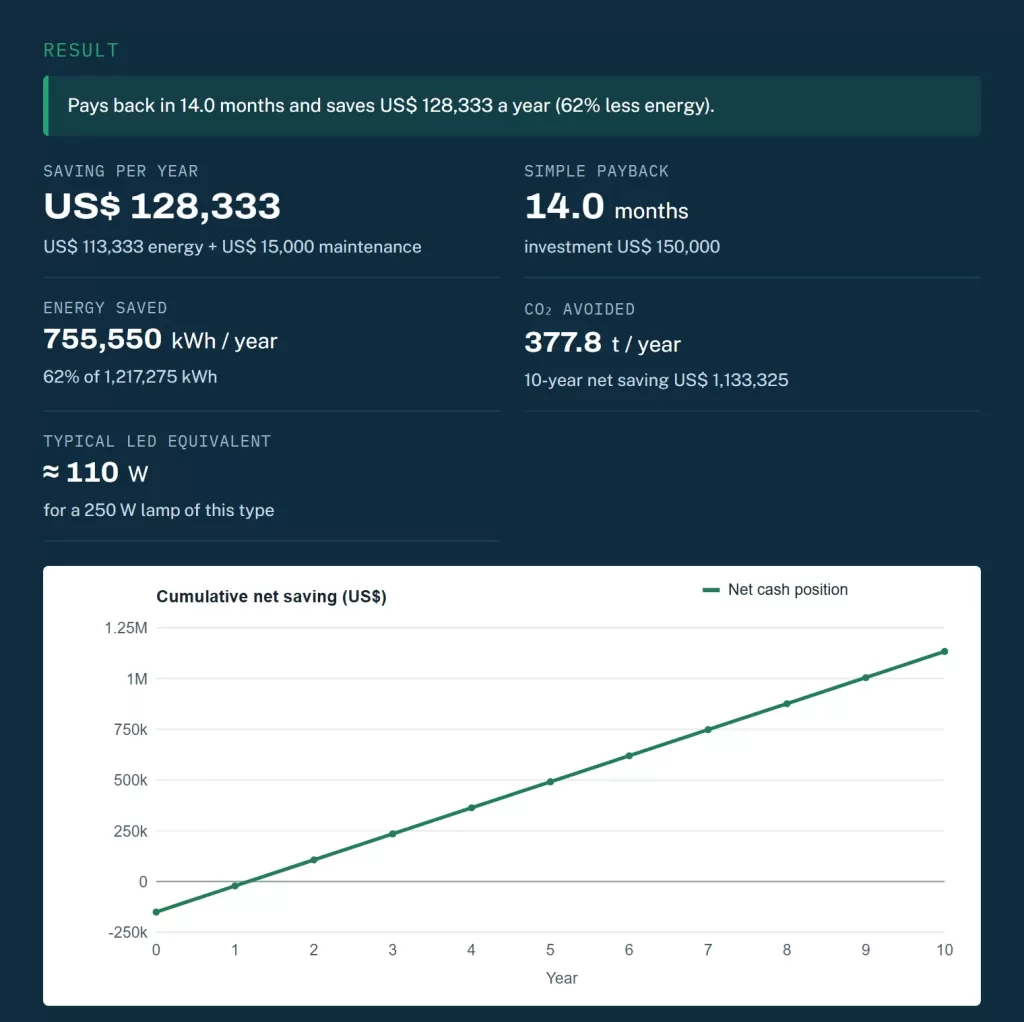
Open this example and replace the quantities, tariff and prices with your own.
Add dimming and the saving grows
Roads are busy in the evening and nearly empty after midnight. A programmable driver that runs at 100% until midnight and 50–60% until dawn cuts another 20–25% of the LED energy, with no new cabling. Ask for drivers with a built-in dimming profile, or 0–10 V / DALI dimming with a NEMA or Zhaga socket if you plan a smart-city control system later.
Mistakes to avoid in a retrofit
- Swapping by wattage ratio only. Use the ratio for budgets, then check the road with a calculation. Wide roads with short poles may need more than the chart suggests.
- Ignoring colour temperature. 3000 K or 4000 K is standard for roads. Some cities and dark-sky areas require 3000 K or lower.
- No surge protection. Street lights are exposed to lightning and grid switching. Specify at least 10 kV surge protection.
- Wrong spigot or bracket. Measure the existing arm (commonly 42–60 mm diameter) so the new heads fit without new arms.
- Forgetting the photocell. If the old fittings had photocells, the new ones need a socket or a built-in sensor.
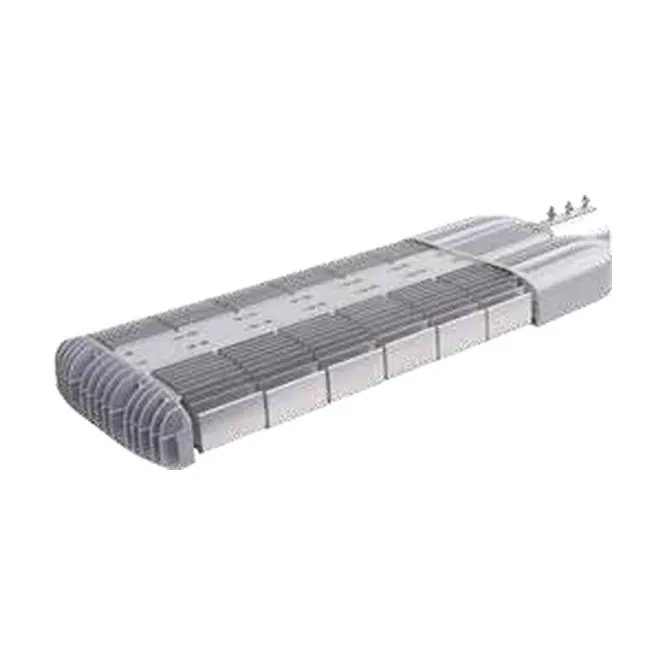
Our modular LED street lights cover 30–350 W in one platform, which makes it easy to match each road in a retrofit with the same fitting. Send us a list of existing lamp wattages and pole heights, and we will propose the LED wattage for each road.
Sources
Frequently asked questions
What LED wattage replaces a 250 W high-pressure sodium street light?
In most road lighting retrofits, 100–120 W of LED at 130 lm/W gives the same or better light on the road as a 250 W HPS lamp, which draws about 285–300 W from the grid with its magnetic ballast.
What LED replaces a 400 W HPS or metal halide floodlight?
Typically 150–200 W of LED. Floodlights and high masts lose more light outside the target area than street lights, so check with a photometric calculation if the aiming distance is long.
How much energy does an HPS to LED conversion save?
Usually 50–65% of the lighting energy, and more if the LEDs are dimmed after midnight. A 250 W HPS fitting running 4,200 hours a year uses about 1,220 kWh; a 110 W LED uses about 460 kWh.
Is LED better than sodium for street lights?
For almost all roads, yes: LED uses about half the energy for the same light on the road, starts instantly, can be dimmed, renders colours far better and lasts several times longer. Sodium's only remaining advantage is the low price of a replacement lamp.
Why does LED need fewer watts for the same job?
Three reasons: higher efficacy (130 lm/W for a modern LED street light against 80–100 lm/W for the HPS lamp alone, before ballast and reflector losses), better optics that put the light on the road instead of the sky and verges, and no ballast loss.