
Solar vs Grid Street Lights: Which Costs Less Over 10 Years?
A total-cost-of-ownership comparison of solar street lights and grid-powered LED street lights: trenching and cabling, grid connection, electricity, battery replacement and maintenance, with a worked 100-light example and the cases where each option wins.
Key points
- Trenching, cabling and grid connection often cost more than the lights on new roads.
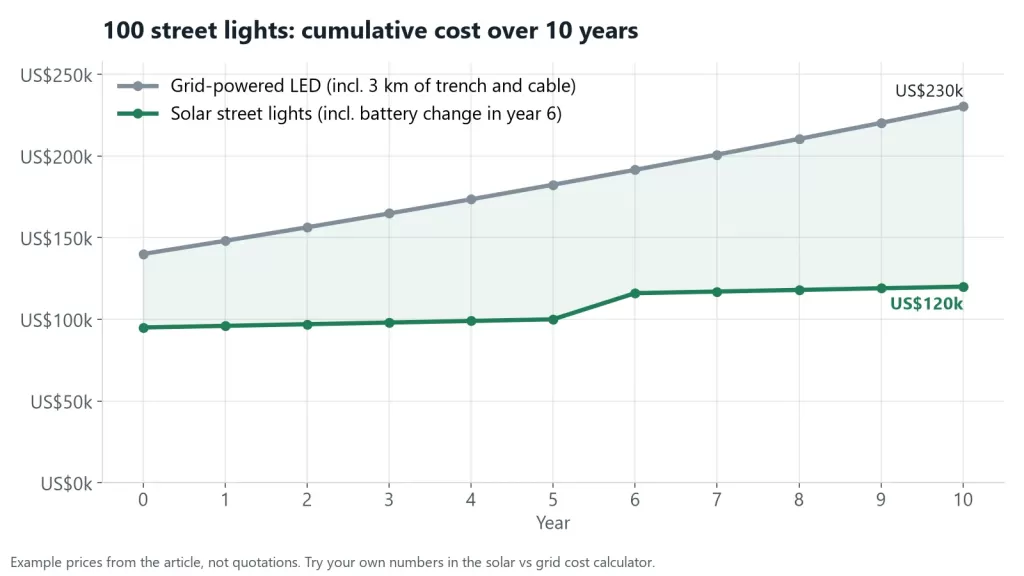
- In the 100-light example solar costs about US$120k over 10 years against about US$230k for grid lighting.
- Grid LED wins where the cable already exists, at high power, or with very little winter sun.
- Compare a correctly sized solar system with a grid design that meets the same lighting class.
When a road, an industrial park or a housing estate needs lighting, the question is rarely “which light is better?” It is “which option costs less over the life of the project, and which can we get approved?” This article sets out the cost items that decide the answer, with a worked example you can repeat for your own site in our free solar vs grid cost calculator.
The cost items
Grid-powered LED street lights
- Luminaire, pole and installation
- Trench and cable along the full run (number of poles × spacing), including conduit, backfill and surface repair
- Grid connection: feeder pillar, metering, sometimes a transformer
- Electricity every night, with tariffs that usually rise
- Maintenance: cable faults, photocells, occasional driver replacement
Solar street lights
- Complete solar light (panel, battery, controller, LED) and pole, installed
- Battery replacement every 5–8 years for LiFePO4
- Maintenance: panel cleaning in dusty areas, occasional controller checks
Two items are often left out of quick comparisons: the civil works on the grid side and the battery replacement on the solar side. Both are large, so leaving either out biases the answer.
Worked example: 100 lights on a new road
Assumptions (examples only; use local quotes for your project):
| Item | Grid-powered | Solar |
|---|---|---|
| Light + pole, installed | US$600 each | US$950 each |
| Trench + cable | US$25/m × 30 m spacing | — |
| Grid connection | US$5,000 | — |
| LED power / hours | 100 W, 12 h a night | — |
| Electricity | US$0.15/kWh, +3% a year | — |
| Battery replacement | — | US$150 every 6 years |
| Maintenance | US$15 per light per year | US$10 per light per year |
Results over 10 years:
- Grid: upfront US$140,000 (of which US$75,000 is trenching and cable), plus 43,800 kWh a year of electricity. Total about US$230,000.
- Solar: upfront US$95,000, plus maintenance and one battery replacement. Total about US$120,000.
- Solar is cheaper from day one in this example, because the trench and cable alone cost more than the price difference between the lights. It also avoids about 438 MWh of grid electricity and, at 0.5 kg CO₂/kWh, about 219 tonnes of CO₂.
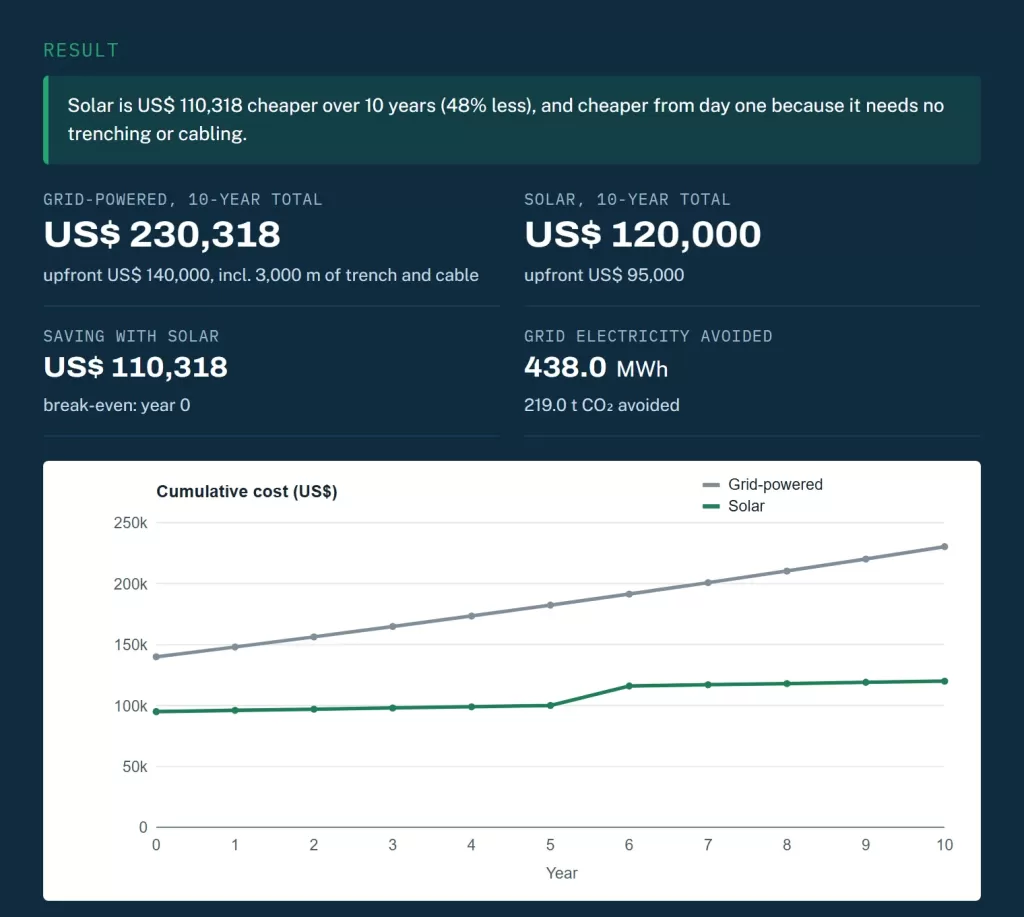
Open this example and enter your own prices. Set the trench cost to zero if powered poles already exist.
What changes the answer: a sensitivity check
A single worked example can mislead, so we re-ran the same 100-light road in the calculator, changing one input at a time and keeping everything else as above. The solar total stays at about US$120,000 in every row except the battery row.
| Change | Grid, 10-year total | Solar, 10-year total | Solar saves |
|---|---|---|---|
| Base case (trench US$25/m) | US$230,000 | US$120,000 | US$110,000 |
| Trench US$50/m (rock, paved surfaces, cities) | US$305,000 | US$120,000 | US$185,000 |
| Trench US$10/m (soft ground, low labour cost) | US$185,000 | US$120,000 | US$65,000 |
| No trench at all, but new poles and connection | US$155,000 | US$120,000 | US$35,000 |
| Electricity US$0.08/kWh | US$195,000 | US$120,000 | US$75,000 |
| Electricity US$0.25/kWh | US$281,000 | US$120,000 | US$161,000 |
| Battery lasts only 4 years (two replacements) | US$230,000 | US$135,000 | US$95,000 |
| Retrofit: existing powered poles, LED heads only (US$250 each) | US$115,000 | US$120,000 | −US$5,000 |
Three lessons stand out:
- Civil works dominate. The trench price moves the grid total by more than any other input. Get a real local quote per metre, including surface reinstatement, before deciding.
- Electricity price matters, but less than people expect at 100 W per light. Its effect grows with wattage and burning hours.
- Retrofits are different. Where powered poles already stand, replacing the heads with grid LED is about as cheap as solar over 10 years and has no battery to maintain. Solar only wins there if the grid is unreliable or the cable is being stolen.
The same comparison with discounting
Public budgets and lenders often compare options by net present value (NPV), because money spent in year 8 is worth less than money spent today. Discounting the base case at 8% a year:
- Grid: NPV of costs about US$200,000
- Solar: NPV of costs about US$111,000
Discounting narrows the gap slightly, because grid lighting’s electricity is spread over the years while most of its cost, the trench, is upfront anyway. The ranking does not change. If your funder needs NPV, use the year-by-year table in the calculator’s PDF report and apply your discount rate.
When grid lighting wins
Change one assumption and the answer can flip:
- The cable is already there. In a retrofit of existing powered poles, there is no trench to dig, and grid LED is cheaper.
- High power at high mounting heights. A 250 W light on a 12 m pole running all night needs a large panel and battery. For motorways and big junctions, grid power is usually more economical.
- Very little sun in winter. At high latitudes the panel and battery have to be sized for December, which makes solar expensive. Check your site’s worst-month sun hours in Global Solar Atlas or PVGIS, then size the system with our solar street light calculator.
- Cheap, reliable electricity and cheap civil works. Where trenching costs US$5–10 per metre and power is subsidised, grid lighting is hard to beat.
When solar wins
- New roads, rural roads and estates far from a substation
- Long runs with wide pole spacing, where cable cost per light is high
- Unreliable grids, where solar keeps the road lit during outages
- Areas with cable theft. Los Angeles cited copper wire theft when it announced plans in 2026 to convert up to 60,000 street lights to solar.
- Projects where grid connection approval takes months
Mixed and phased options
The choice does not have to be all one or the other:
- Grid on the main road, solar on the branches. Busy roads near existing cables stay on the grid; side streets, footpaths and car parks far from the cable go solar.
- Solar first, grid later. A new estate can open with solar lights while the network is built; the solar lights can move to a later phase of the site.
- Grid-solar hybrid controllers. Some systems charge from the panel and fall back to the grid on long cloudy spells. They cost more and still need a cable, so they mainly suit sites with an existing but unreliable supply.
A checklist for a fair tender comparison
When bids for both options arrive, check that they answer the same question:
- Same lighting class on the same road: average luminance or illuminance and uniformity, from a photometric calculation, not from wattage alone.
- Same working hours and dimming: the grid option should not be costed at full power all night while the solar option dims to 30%, or the reverse.
- Solar sized for the worst month and the longest rainy spell at the site, with the sun hours stated.
- All grid civil works priced: trench, duct, cable, backfill, surface repair, feeder pillar, metering and connection fees.
- Battery replacement included in the solar running cost, with chemistry and expected life.
- Same evaluation period and tariff assumptions, ideally 10–15 years with a stated tariff escalation.
- Warranty terms compared: luminaire, battery, panel and controller often carry different warranties.
Make the comparison fair
A solar light that is too small looks cheap in a spreadsheet and fails in the first rainy season. Before comparing costs, make sure the solar option is sized for the site: battery for the longest rainy spell (check it with the battery autonomy calculator), panel for the worst month, and a dimming profile that matches the road. Compare it with a grid design that meets the same lighting class.
Our calculator exports a PDF report with the year-by-year costs, the formulas and your assumptions, which you can attach to a budget request or a tender evaluation. If you send us the road length, pole spacing and site location, we will size the solar option and quote it, so the comparison uses real numbers.
Sources
Frequently asked questions
Are solar street lights cheaper than grid street lights?
On new roads, rural roads, estates and car parks without an existing cable network, usually yes over 10 years, because solar avoids trenching, cabling, grid connection and electricity. Where powered poles already exist, replacing the heads with grid LED is normally cheaper.
What is the main hidden cost of grid street lighting?
Civil works. Every pole needs a cable trench to the next pole, plus a connection to the network. Depending on the country and the ground, trenching and cabling cost from under US$10 to over US$100 per metre, which on a 30 m spacing can exceed the price of the light.
What is the main running cost of solar street lights?
Battery replacement. A good LiFePO4 battery lasts about 5–8 years in street lighting duty, so a 10-year comparison should include one replacement per light.
How long do solar street lights last?
The LED head, housing and pole should last 15 years or more. The battery is the wear part. The solar panel loses roughly 0.5% of output per year and usually outlasts the project.