
How Many Rainy Days Can a Solar Street Light Last? Autonomy Explained
What 'days of autonomy' really means for a solar street light, why datasheet figures are often optimistic, how to check a light against your rainy season, and what to change when the battery is too small.
Key points
- Datasheet "days of autonomy" often ignores depth of discharge, cold and recovery time.
- Rainy days covered = usable battery energy ÷ (night load − rainy-day charge).
- The panel matters as much as the battery: it decides how fast the battery refills after the rain.
- Dimming after midnight and low-battery dimming are the cheapest ways to add autonomy.
Every solar street light datasheet quotes a number of rainy days, often “3–5 days”. Buyers in rainy climates learn the hard way that this number can mean very different things. This article explains how autonomy should be calculated and how to check a light against the weather at your site.
What the datasheet number usually means
Most suppliers calculate autonomy as:
battery energy ÷ energy per night
That figure ignores three things:
- Depth of discharge. A 12.8 V, 100 Ah LiFePO4 battery stores 1,280 Wh, but only about 90% of it should be used, and only about 50% of a lead-acid or gel battery.
- Temperature. Cold nights reduce usable capacity, by roughly 10% near 0 °C and 25% below freezing.
- Recovery. After the rain stops, the panel has to refill the battery while still running the light every night. If the panel is only just big enough for a sunny day, recovery can take weeks, and the next storm finds the battery half empty.
A better way: a day-by-day energy balance
For each rainy day, the battery loses the night’s load minus the small charge the panel still collects under cloud. For each sunny day after the rain, it gains the panel’s surplus over the night’s load.
Rainy days covered = usable battery energy ÷ (night load − rainy-day charge)
Example
A 40 W light, 5 hours at 100% and 7 hours dimmed to 30%, with a 0.9-efficient driver:
- Night load = 40 × (5 + 7 × 0.3) ÷ 0.9 ≈ 316 Wh
- 150 Wp panel, 4.5 sun hours, MPPT controller (overall efficiency about 0.72): sunny day ≈ 486 Wh, rainy day at 15% ≈ 73 Wh
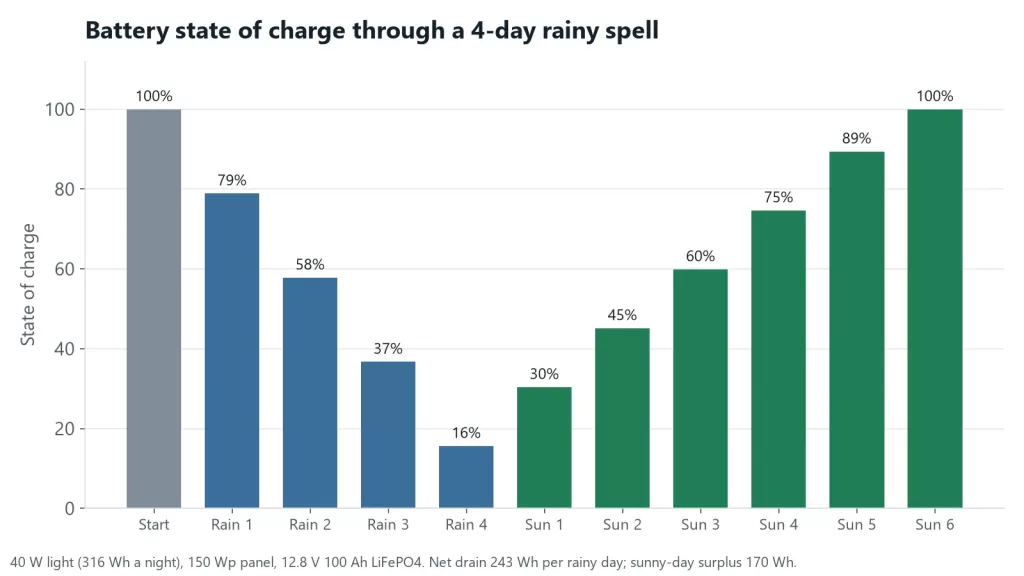
- Net drain per rainy day ≈ 243 Wh
- Battery 12.8 V, 100 Ah LiFePO4: usable ≈ 1,152 Wh
- Rainy days covered ≈ 4.7
- After a 4-day spell the battery has lost about 970 Wh. The sunny-day surplus of about 170 Wh refills it in about six days.
The same light with a 100 Wp panel covers about 4.3 rainy days, almost the same. But its sunny-day surplus is only about 8 Wh, so after the storm it would take months to refill. The panel matters as much as the battery.
Run your own numbers in our free battery autonomy calculator, which also draws the battery’s state of charge day by day. This is the same example in the calculator:
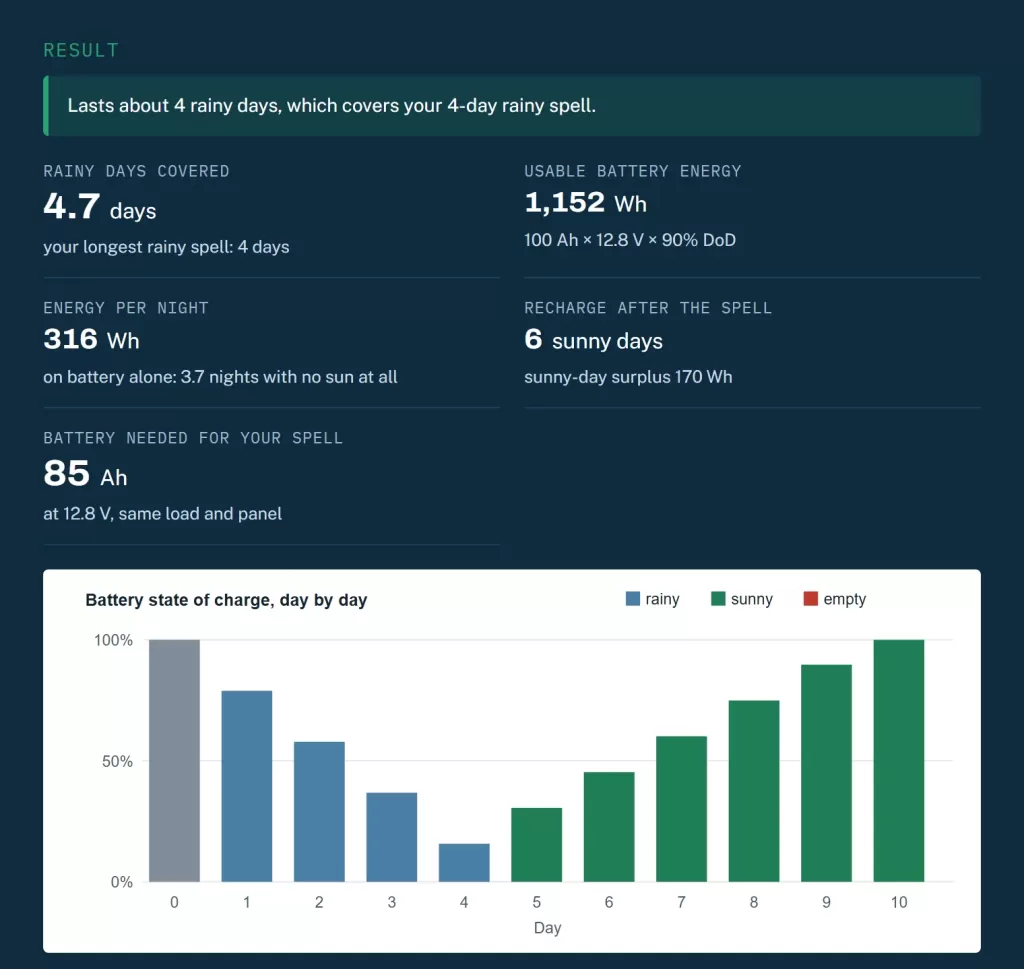
Open this example, then change the panel to 100 Wp to see the recovery time explode.
Find your longest rainy spell
- Local weather records (national meteorological service or airport data): count the longest run of days with heavy cloud in the wettest month of recent years.
- Solar databases: Global Solar Atlas and PVGIS give monthly irradiation. Use the worst month to size the panel, not the annual average.
- Local experience: ask installers which month lights fail in, if they fail. That month sets the design.
How much does the worst month differ from the average? Monthly data from PVGIS (2015–2020, horizontal surface) for six cities where we size lights:
| City | Annual average (sun hours/day) | Worst month | Worst month as % of average |
|---|---|---|---|
| Lagos | 5.1 | June: 4.0 | 80% |
| Port Harcourt | 4.7 | July: 3.4 | 73% |
| Manila | 4.9 | December: 3.7 | 76% |
| Cebu | 5.2 | December: 4.2 | 82% |
| Johannesburg | 5.7 | June: 4.1 | 72% |
| Cape Town | 5.3 | June: 2.4 | 45% |
A system sized on the annual average is short of energy every day of its worst month, which is also the month with the longest rainy spells. That combination, not bad luck, is why so many solar lights go dark in the same few weeks each year.
Three designs for a wet-season site
Take the 40 W light from the example and move it to a site like Port Harcourt in July: 3.4 sun hours, 15% yield on rainy days, and a 5-day rainy spell to survive. The battery autonomy calculator gives:
| Battery | Panel | Rainy days covered | Sunny days to refill | Meets the 5-day spell? |
|---|---|---|---|---|
| 100 Ah | 150 Wp | 4.4 | 22 | No |
| 150 Ah | 150 Wp | 6.6 | 25 | Yes, but slow to refill |
| 100 Ah | 200 Wp | 4.8 | 7 | No |
| 150 Ah | 200 Wp | 7.1 | 7 | Yes |
The second row is the trap. A bigger battery gets through the storm, but with the same panel it takes nearly a month of sunny days to refill, and in a wet season the next storm usually arrives first. Only the last design survives the spell and recovers in a week. Battery and panel have to grow together.
Changing the schedule helps too: starting the 30% dimming an hour earlier (4 hours at 100%, then 8 at 30%) cuts the night load from 316 to 284 Wh and adds about half a rainy day with the same hardware.
Five ways to add autonomy
- Dim after midnight. Running at 30% from midnight to dawn cuts the night load by a third or more, and therefore adds a third to the rainy days covered.
- Low-battery dimming. Controllers that step down brightness as the battery falls keep the road lit, at a lower level, through long storms.
- Bigger battery. The direct fix. Prefer LiFePO4: you can use 90% of it, against 50% for gel.
- Bigger panel. Faster recovery after a spell, and more charge on cloudy days.
- Lower wattage with better optics. A well-designed 30 W light with a good road optic can replace a poorly designed 50 W one.
For sizing the battery and panel from scratch, see how to calculate solar street light battery capacity and compare LiFePO4 and gel batteries.
Low-battery dimming in practice
A good controller does not simply run the light until the battery is empty. It watches the battery voltage and steps the brightness down as the charge falls, for example:
| Battery state | Light output |
|---|---|
| Above 60% | Normal schedule (for example 100% to midnight, 30% after) |
| 30–60% | Whole night reduced, for example to 50% and 20% |
| 15–30% | Minimum level, for example 20% all night |
| Below 15% | Off, to protect the battery; restart after charging |
With a profile like this, a long storm makes the road dimmer rather than dark, and the battery is never driven into damaging deep discharge. Ask the supplier for the exact thresholds and check that they can be changed on site, by remote control or app, because the right settings depend on your climate.
Common myths about rainy days
“Our light works 7 rainy days.” Usually calculated as battery Wh ÷ night load, with the full battery counted and no charge from the panel. Ask for the depth of discharge used and the recovery time.
“Solar panels produce nothing on cloudy days.” Not quite: under heavy overcast a panel typically produces 10–25% of a clear day, and under light cloud much more. That small charge is why the day-by-day balance above covers more days than battery-only arithmetic, provided the panel is large enough.
“A larger battery always helps.” Only if the panel can refill it. See the table above.
“Lithium batteries do not mind the cold.” LiFePO4 handles heat well, but loses capacity in the cold and must not be charged below 0 °C without protection. In cold climates, include a temperature derating and choose a controller with low-temperature charge protection.
Testing autonomy before you buy
For larger projects, a sample test is cheap insurance:
- Charge the sample light fully.
- Cover the panel completely, or disconnect it, and run the light on the project schedule night after night.
- Count the nights until the light shuts off or reaches its minimum dimming level.
- Compare with the claimed rainy days. A pure battery test with no charge at all should give roughly the “nights on battery alone” figure from the calculator.
A sample that falls well short of the claim tells you more about the supplier than any datasheet.
What to ask a supplier
- Usable battery energy in Wh (not only Ah), and the depth of discharge assumed
- Night load in Wh with the dimming profile you will actually use
- Panel output in Wh per day for your site’s worst month
- How many sunny days the battery needs to recover after the stated rainy days
- Whether the controller dims automatically when the battery is low
Our solar street lights are sized per project. Tell us the site location and the road, and we will check the autonomy against local solar data before quoting.
Sources
Frequently asked questions
How many days of autonomy should a solar street light have?
At least the longest run of heavily overcast days you expect in a normal year. Two to three days is enough in dry climates; four to five days is common in monsoon and rainy-season climates such as Southeast Asia, coastal West Africa and parts of Latin America.
Do solar panels charge when it rains?
Yes, a little. Under heavy overcast a panel typically produces 10–25% of a clear-day output. That small charge slows the battery drain, but on its own it cannot keep a street light running.
What happens when the battery runs out?
A good controller switches the light off before the battery is damaged and restarts it when the panel has recharged it enough. Many controllers also reduce brightness automatically when the battery is low, so the light runs dimmer for longer instead of going dark.
How do I make a solar street light last longer in the rainy season?
Use a lower-power LED or dim it after midnight, choose a bigger battery, choose a bigger panel so the battery recovers faster after the rain, and make sure the controller has a low-battery dimming mode.