
How to Calculate Solar Street Light Battery Capacity (with Worked Examples)
A step-by-step method to size the battery of a solar street light in Wh and Ah, from LED power, lighting schedule, nights of autonomy and depth of discharge, with three worked examples and the mistakes that make lights fail in the rainy season.
Key points
- Energy per night = LED watts × equivalent full-power hours ÷ driver efficiency.
- Multiply by nights of autonomy, divide by usable depth of discharge, then by voltage for Ah.
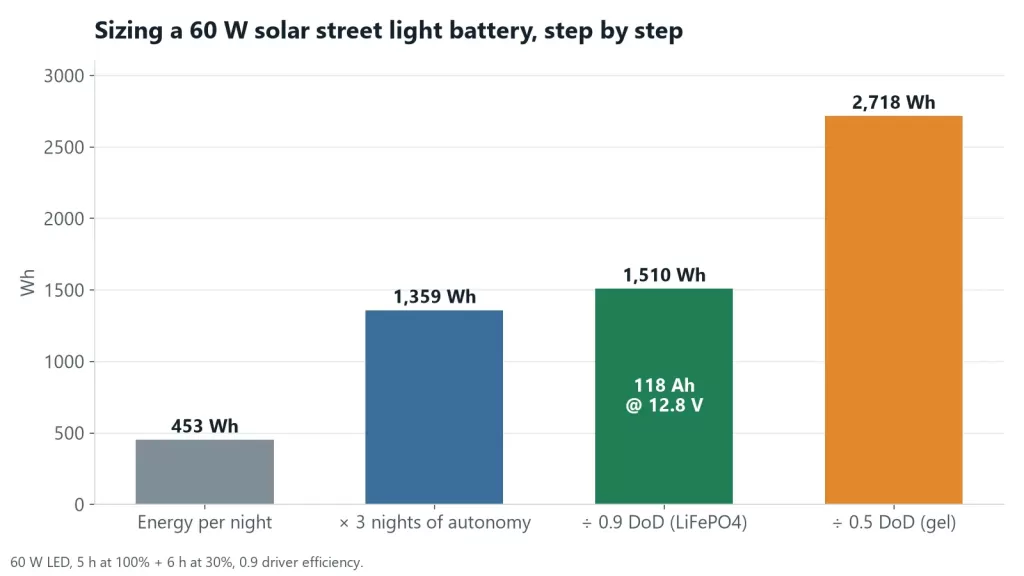
- The 60 W example needs about 1,510 Wh (118 Ah at 12.8 V) with LiFePO4, or 2,718 Wh with gel.
- Dimming after midnight is the biggest single lever on battery size.
Most solar street lights that “stop working” have not broken. Their battery is simply too small for the site. The light works in the dry season, and then fails after the third cloudy day of the rains. Battery sizing is not difficult, but every step needs to be done honestly. This guide walks through the method we use, with the formula, three worked examples, and the corrections that catalogue datasheets often leave out.
If you just want the numbers, use our solar street light calculator. It applies exactly this method and shows its working.
Step 1: Energy used per night
Start with the lighting schedule, not the wattage alone. A modern solar street light rarely runs at full power all night. A typical profile is full output from dusk until people go home, then dimmed output until dawn, with a motion sensor boosting it back to full when someone passes.
Convert the schedule into equivalent full-power hours:
Equivalent hours = hours at 100% + (hours dimmed × dimmed level)
Then account for the LED driver, which loses some energy as heat:
Energy per night (Wh) = LED power (W) × equivalent hours ÷ driver efficiency
Example: a 60 W LED, 5 h at 100% and 6 h at 30%:
- Equivalent hours = 5 + 6 × 0.3 = 6.8 h
- Energy = 60 × 6.8 ÷ 0.9 = 453 Wh per night
Running the same light at 100% for 11 hours would use 60 × 11 ÷ 0.9 = 733 Wh, which is 62% more. Dimming is the single biggest lever on battery size.
Step 2: Nights of autonomy
Autonomy is the number of nights the light must run with little or no charging, for example during a stretch of overcast days.
| Climate | Typical autonomy |
|---|---|
| Desert and semi-arid (Middle East, Sahel, northern Nigeria) | 2 nights |
| Tropical with distinct dry and rainy seasons | 3 nights |
| Monsoon, equatorial or long rainy season (coastal West Africa, Southeast Asia) | 4–5 nights |
Stored energy needed (Wh) = energy per night × nights of autonomy
For our example with 3 nights: 453 × 3 = 1,359 Wh.
Step 3: Usable depth of discharge
You cannot use 100% of a battery’s nameplate capacity without shortening its life. Divide by the usable depth of discharge (DoD):
| Battery type | Usable DoD for long life |
|---|---|
| LiFePO4 (lithium iron phosphate) | 80–90% |
| Gel / AGM lead-acid | 50% |
Battery capacity (Wh) = stored energy needed ÷ DoD
LiFePO4 at 90%: 1,359 ÷ 0.9 = 1,510 Wh.
Gel at 50%: 1,359 ÷ 0.5 = 2,718 Wh. That is 80% more capacity for the same job, which is one reason LiFePO4 has become the standard. See our comparison of LiFePO4 and gel batteries for solar street lights.
Step 4: Convert to amp-hours
Battery datasheets usually quote Ah, so divide by the nominal voltage:
Capacity (Ah) = capacity (Wh) ÷ battery voltage (V)
1,510 Wh ÷ 12.8 V = 118 Ah (a 12.8 V LiFePO4 pack is four cells in series). Round up to the next standard pack size.
The solar street light calculator gives the same answer and adds the panel size for your worst-month sun hours:
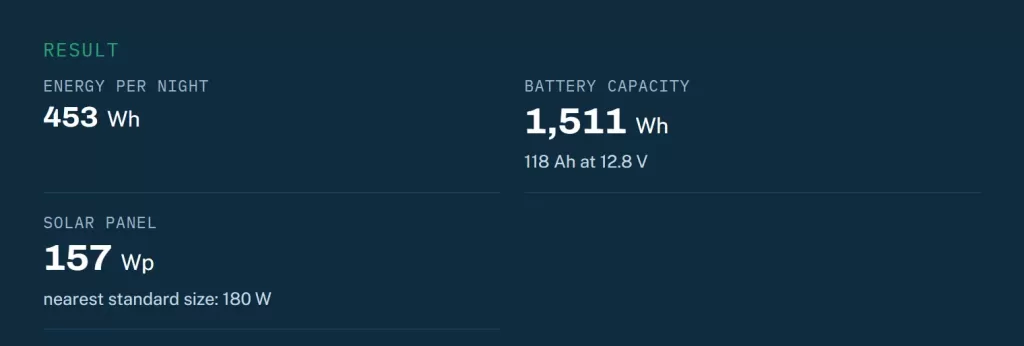
Open this example and change the battery to gel to see the 80% jump in capacity.
Step 5: The corrections that are often skipped
Battery ageing. If the design must still meet its autonomy target in year five, size for the end-of-life capacity. For LiFePO4 that is usually 80% of the original capacity, so divide by 0.8: 1,510 ÷ 0.8 = 1,888 Wh.
Cold climates. Battery capacity drops in the cold, and LiFePO4 must not be charged below 0 °C unless the battery has a heater or a controller with low-temperature charge protection. For sites with winter frosts, ask for a cold-weather configuration.
The panel has to refill the battery. A large battery is useless if the panel cannot recharge it in the worst month. As a rule, the panel must replace one night’s energy on a poor day and recover the reserve over the following sunny days. Our calculator sizes the panel from the peak sun hours of your worst month.
Three worked examples
| Village road | Urban residential street | Main road, long rainy season | |
|---|---|---|---|
| LED power | 30 W | 60 W | 100 W |
| Schedule | 4 h 100% + 7 h 30% | 5 h 100% + 6 h 30% | 6 h 100% + 6 h 50% |
| Equivalent hours | 6.1 h | 6.8 h | 9 h |
| Energy per night (÷ 0.9) | 203 Wh | 453 Wh | 1,000 Wh |
| Autonomy | 2 nights | 3 nights | 5 nights |
| LiFePO4 at 90% DoD | 451 Wh (35 Ah @ 12.8 V) | 1,510 Wh (118 Ah @ 12.8 V) | 5,556 Wh (217 Ah @ 25.6 V) |
| Suggested type | All-in-one | All-in-one or split | Split system |
The third column shows why heavy-duty projects move to split solar street lights: a 5.5 kWh battery does not fit inside an integrated lamp housing.
How to check a supplier’s datasheet
When you compare quotations, ask each supplier for:
- The lighting schedule their autonomy claim is based on. “3 nights” at 30% output is a different product from “3 nights” at 100%.
- The battery chemistry, voltage and Ah, so that you can compute Wh yourself.
- The depth of discharge the controller allows.
- The peak sun hours they assumed for charging.
If a 60 W “all-in-one” light claims three nights at full power with a 30 Ah battery, the numbers do not add up: 30 Ah × 12.8 V is only 384 Wh, which is less than one night at full power.
Get your project sized
Send us the site location, LED power or road dimensions, and the number of nights you need. We will check them against satellite solar data for your coordinates and return a configuration. You can also browse our solar street lights.
Frequently asked questions
What is the formula for solar street light battery capacity?
Battery capacity (Wh) = LED power (W) × equivalent full-power hours per night ÷ driver efficiency × nights of autonomy ÷ usable depth of discharge. Divide the result by the battery voltage to get Ah.
How many Ah battery do I need for a 60 W solar street light?
With a typical schedule of 5 hours at full power and 6 hours at 30%, a 0.9 efficient driver, 3 nights of autonomy and a LiFePO4 battery at 90% depth of discharge, you need about 1,510 Wh, which is roughly 118 Ah at 12.8 V. Running the light at full power all night would need about 2,400 Wh.
How many nights of autonomy should a solar street light have?
Two to three nights is common for sunny climates with short cloudy spells. Regions with long monsoon or rainy seasons usually need four to five nights. More autonomy means a bigger battery and a bigger panel to recharge it.
Should the battery be oversized to allow for ageing?
Yes, if you want the light to meet its autonomy target for its whole life. A LiFePO4 battery is usually considered at end of life when it reaches 80% of its original capacity, so dividing the calculated capacity by 0.8 keeps the design valid until then.