
All-in-One vs Split Solar Street Lights: Which Should You Buy?
An engineer's comparison of integrated (all-in-one) and split solar street lights covering battery capacity, panel size, installation cost, theft, maintenance and climate, with a decision table for your project.
Key points
- All-in-one lights are fastest to install and cheapest for small and medium wattages.
- Split systems carry bigger panels and batteries, angled and shaded, for high power and cloudy climates.
- The deciding question is how much energy the light needs per night and for how many nights.
- Ask for both quotes for the same lighting result and compare.
“All-in-one or split?” is usually the first question in a solar street light project, and the answer depends less on preference than on how much energy your site needs. This guide compares the two designs honestly. We manufacture both, so we have no reason to push one over the other.
The two designs in one paragraph each
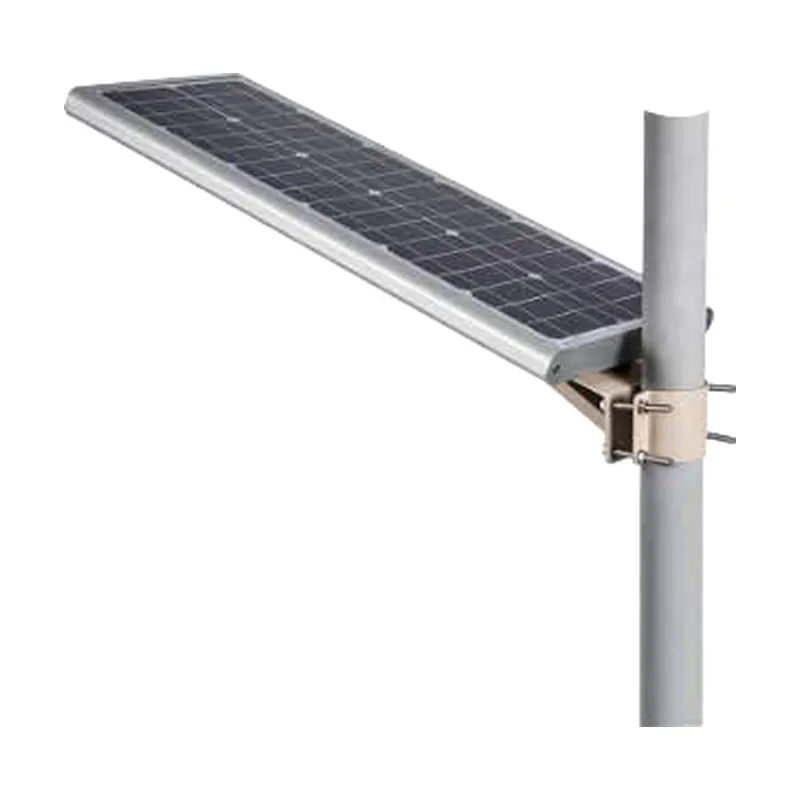
All-in-one (integrated). The solar panel forms the top of the luminaire. The LiFePO4 battery, the MPPT controller, the LED module and usually a motion sensor sit inside the same housing. You bolt it to a pole, and that is the installation.
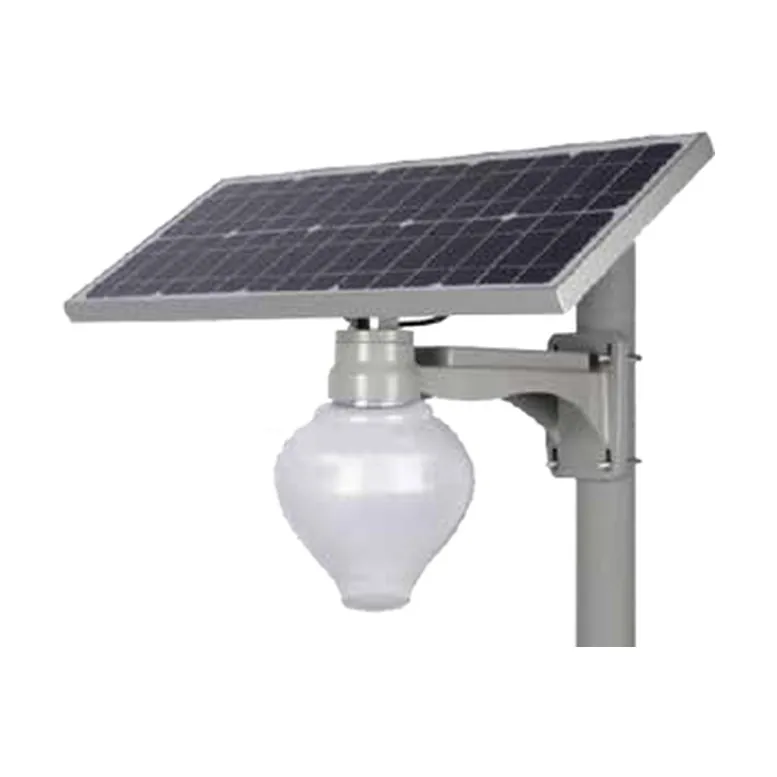
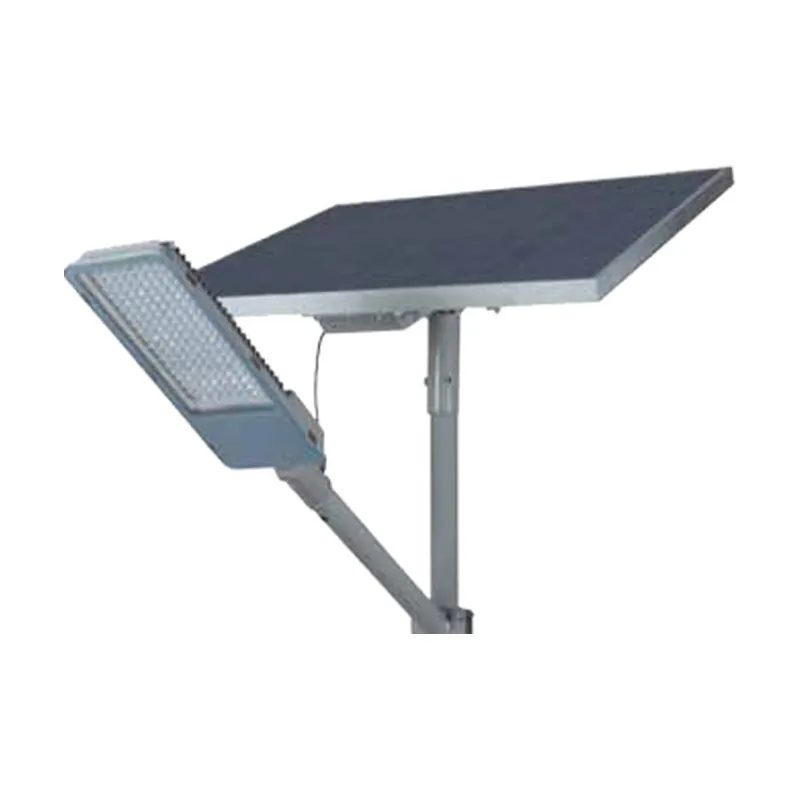
Split. A separate solar panel is mounted on top of the pole, angled towards the sun. The battery sits in a box on the pole or in a buried enclosure at its base. The LED luminaire hangs on an arm. Cables connect everything through the controller.
Side-by-side comparison
| Factor | All-in-one | Split |
|---|---|---|
| Typical LED power | 20–120 W | 30–200 W |
| Battery size | Limited by the housing | Sized freely, from a few hundred Wh to several kWh |
| Panel size and angle | Fixed by the housing, often at a shallow angle | Any size, tilted to suit the latitude |
| Installation | Fastest, no on-site wiring | Wiring and battery box take more time |
| Shipping volume | Compact | Larger: separate panel, battery box and bracket |
| Theft risk | Whole unit at the top of the pole | Panel and battery are bigger targets, so mount high or bury the battery |
| Battery temperature | Battery sits under the panel in direct sun | Battery can be shaded or buried, so it runs cooler |
| Repairs | Usually replace the whole head | Replace the battery, controller or LED separately |
| Wind load | Lower | Higher (panel area), so the pole must be designed for it |
| Upfront cost | Lower per point for small and medium wattages | Higher per point, but more capacity per dollar at high wattages |
When to choose all-in-one
- Village roads, residential streets, car parks, campuses and paths
- Mounting heights up to about 8 m
- Sites with good sun, at least 4 peak sun hours in the worst month
- Projects where installation speed and logistics matter most, such as remote areas, large rural electrification programmes, or crews without electricians
When to choose split
- Main roads and wide roads with poles of 9 m and above
- LED power above about 100 W
- Long rainy seasons that need 4–5 nights of autonomy
- High latitudes, where the panel must be tilted steeply to catch the winter sun
- Very hot sites, where a shaded or buried battery will last noticeably longer
- Projects where a local team will maintain the lights and wants to replace parts rather than whole units
The question that decides it: how much energy?
Work out the battery capacity your site really needs. Our guide to calculating solar street light battery capacity walks through the steps, and the calculator does it for you. Then compare the result with what fits in an integrated housing:
- Under about 1.5 kWh: an all-in-one will usually do the job.
- About 1.5–2.5 kWh: large all-in-one units exist, but check that the panel can recharge that much in your worst month.
- Above about 2.5 kWh: go split.
A third option: semi-integrated
Some designs combine an integrated LED and battery head with a separate, larger panel. You get a bigger panel at a better angle while keeping installation simple. It is a good fit for sites where the sun is the limit but the battery fits in the head.
Which design for which climate
| Climate | Usually better | Why |
|---|---|---|
| Hot desert (Middle East, Sahel) | Split, with a shaded or buried battery | Heat under the panel shortens battery life; plenty of sun means the panel can be modest |
| Tropical monsoon (Southeast Asia, West Africa) | Split for main roads; all-in-one with large battery for paths | Long rainy spells need more battery and panel than a housing holds |
| Temperate, mild winters | All-in-one up to medium power | Moderate needs fit inside the housing |
| High latitude, short winter days | Split with a steeply tilted panel | Winter sun is low, so tilt matters more than in the tropics |
| Coastal and windy sites | Either, with stainless fixings | Panel area adds wind load; check the pole design |
Check the numbers for your own site with the battery autonomy calculator.
Ask for both quotes
If you are unsure, send us the site location, road width and the schedule you need. We will size both options and show you the cost and performance difference, so that you can decide on facts. See our solar street light range.
Frequently asked questions
What is an all-in-one solar street light?
An all-in-one (integrated) solar street light combines the solar panel, battery, charge controller, LED module and sensor in one housing that mounts on top of a pole. It is the fastest type to install because no wiring is needed on site.
What is a split solar street light?
In a split solar street light the solar panel is mounted on its own bracket at the top of the pole, the battery sits in a box on the pole or buried in the ground, and the LED luminaire is mounted on an arm. The parts are connected by cables, so each can be sized independently.
Which lasts longer, all-in-one or split?
With the same battery chemistry and good components, both can last a similar time. Split systems are easier to repair, because the battery, controller or LED can be replaced separately. In very hot climates, a split system with the battery in a shaded or buried box keeps the battery cooler than an integrated housing in direct sun.
Are all-in-one solar street lights good for main roads?
They work on many secondary roads, but main roads with tall poles, high output and long rainy seasons usually need more battery and panel than fits in an integrated housing. A split system is the safer choice there.