
Road Lighting Classes Explained: EN 13201 M, C and P Classes (with Lux Values)
What the EN 13201 road lighting classes mean, the luminance and illuminance each class requires, how to choose the class for a road, and what it means for street light wattage, pole height and spacing.
Key points
- EN 13201 has three families: M for traffic roads, C for conflict areas, P for pedestrian and residential areas.
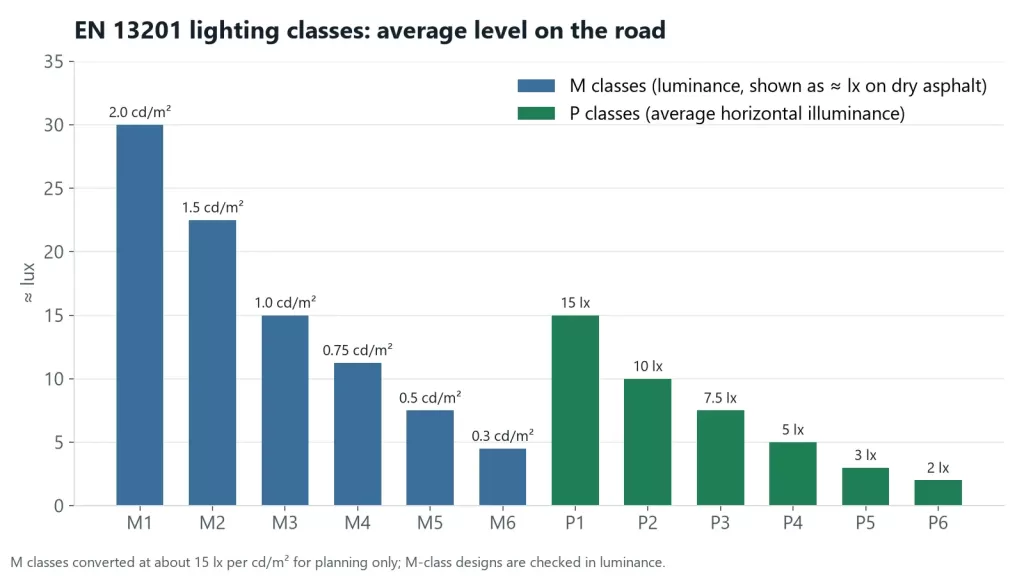
- M classes are specified in road luminance; as a rough planning figure 1 cd/m² ≈ 15 lx on dry asphalt.
- The road owner sets the class; two classes apart can mean double the wattage.
- Solar street lights can meet P classes easily, but M classes need careful design.
Street lighting tenders often say something like “lighting to EN 13201, class M3”. If you are not a lighting designer, that line is easy to overlook, but it decides the wattage, the pole height, the spacing and therefore the cost of the whole project. Here is what the classes mean.
Three families of classes
EN 13201-2 sets performance requirements for three types of area:
- M classes (M1–M6): roads for motorised traffic at medium and high speed. Specified in road surface luminance (cd/m²), plus uniformity and glare limits.
- C classes (C0–C5): conflict areas such as junctions, roundabouts, shopping streets and areas where traffic streams mix. Specified in horizontal illuminance (lux).
- P classes (P1–P6): pedestrian and low-speed areas: residential streets, footways, cycle paths, car parks. Specified in horizontal illuminance.
M classes
| Class | Average luminance L (cd/m²) | Overall uniformity Uo | Longitudinal uniformity Ul | Threshold increment TI (max) | Typical road |
|---|---|---|---|---|---|
| M1 | 2.0 | 0.40 | 0.70 | 10% | Motorways, high-speed dual carriageways |
| M2 | 1.5 | 0.40 | 0.70 | 10% | Major roads, high traffic |
| M3 | 1.0 | 0.40 | 0.60 | 15% | Urban arterials |
| M4 | 0.75 | 0.40 | 0.60 | 15% | Collector roads |
| M5 | 0.50 | 0.35 | 0.40 | 15% | Minor roads |
| M6 | 0.30 | 0.35 | 0.40 | 20% | Low-traffic roads |
Luminance is the brightness of the road surface seen by a driver, so it depends on the road surface as well as the light. As a rough planning conversion for dry asphalt, 1 cd/m² corresponds to about 15 lx of average illuminance. Threshold increment (TI) limits glare from the luminaires.
C classes
| Class | Average illuminance (lx) | Uniformity Uo |
|---|---|---|
| C0 | 50 | 0.40 |
| C1 | 30 | 0.40 |
| C2 | 20 | 0.40 |
| C3 | 15 | 0.40 |
| C4 | 10 | 0.40 |
| C5 | 7.5 | 0.40 |
P classes
| Class | Average illuminance (lx) | Minimum illuminance (lx) | Typical area |
|---|---|---|---|
| P1 | 15 | 3.0 | Busy pedestrian streets, town centres |
| P2 | 10 | 2.0 | Busy residential streets |
| P3 | 7.5 | 1.5 | Residential streets |
| P4 | 5.0 | 1.0 | Quiet residential streets |
| P5 | 3.0 | 0.6 | Rural lanes, paths |
| P6 | 2.0 | 0.4 | Very quiet paths |
How the class is chosen
EN 13201-1 (and CIE 115) select the class from parameters such as design speed, traffic volume, traffic composition, junction density, parked vehicles, ambient brightness and how difficult the navigation task is. In practice the road owner sets the class in the tender. If the tender does not state it, ask, rather than guessing, because two classes apart can mean double the wattage.
The parameter method for M classes
The technical report CEN/TR 13201-1 gives a simple scoring method. Each parameter gets a weighting value, the values are added up, and the class number is M = 6 − sum of weights (limited to M1–M6):
| Parameter | Option | Weight |
|---|---|---|
| Design speed | Very high (≥ 100 km/h) / high (70–100) / moderate (40–70) / low (≤ 40) | 2 / 1 / −1 / −2 |
| Traffic volume | High / moderate / low | 1 / 0 / −1 |
| Traffic composition | Mixed with many non-motorised users / mixed / motorised only | 2 / 1 / 0 |
| Separate carriageways | No / yes | 1 / 0 |
| Junction density | High / moderate | 1 / 0 |
| Parked vehicles | Present / not present | 1 / 0 |
| Ambient luminance | High (shops, signs) / moderate / low (rural) | 1 / 0 / −1 |
| Navigation task | Very difficult / difficult / easy | 2 / 1 / 0 |
Example: an urban arterial at 60 km/h (−1), moderate traffic (0), mixed traffic (1), no central separation (1), moderate junction density (0), parked cars (1), moderate ambient light (0), difficult navigation (1). Sum = 3, so M3. Drop the parked cars and the navigation difficulty, and the same road becomes M5.
This is a simplified view: national annexes and road authorities often adjust the weights, so treat the result as a starting point and confirm it with the client.
Adaptive lighting: changing class during the night
EN 13201 allows the class to change when conditions change. A road that needs M3 in the evening rush can drop to M4 or M5 after midnight when traffic falls. With LED drivers that is simply a dimming step: going from M3 (1.0 cd/m²) to M5 (0.5 cd/m²) means roughly halving the output. This is the basis of most street light dimming schedules, and it works on solar street lights too, where it also shrinks the battery.
Other standards you may meet
| Region | Standard | Notes |
|---|---|---|
| Europe and many tenders worldwide | EN 13201 | M, C and P classes as above |
| International | CIE 115 | The basis of EN 13201; same class idea |
| United States | ANSI/IES RP-8 | Luminance or illuminance by road and pedestrian conflict level |
| China | CJJ 45 | Urban road lighting design standard, average luminance by road grade |
| Australia, New Zealand | AS/NZS 1158 | V categories for traffic routes, P categories for local roads |
| South Africa | SANS 10098 | Public lighting, closely related to CIE classes |
If a tender quotes one of these, ask for the class and the target values. Translating between systems is approximate, so the safest basis is the stated luminance or illuminance and uniformity figures.
What the class means for your lights
The class sets the light that must reach the road. Together with the road width and the pole height it fixes the luminaire output and the spacing. For a 7 m road with 10 m poles and single-sided layout:
- M3 (≈15 lx): spacing is capped at 35 m (3.5 × the pole height) for uniformity; about 82 W at 130 lm/W reaches the target there, so a 90–100 W luminaire gives margin
- M5 (≈7.5 lx): the spacing stays at 35 m, because uniformity, not light output, limits it; about 41 W is enough, so a 50–60 W luminaire does the job
In other words, a lower class rarely saves poles on a narrow road; it saves watts. Over a kilometre (29 poles) the difference between 100 W and 60 W is about 1.2 kW, or around 5,000 kWh a year at 12 hours a night.
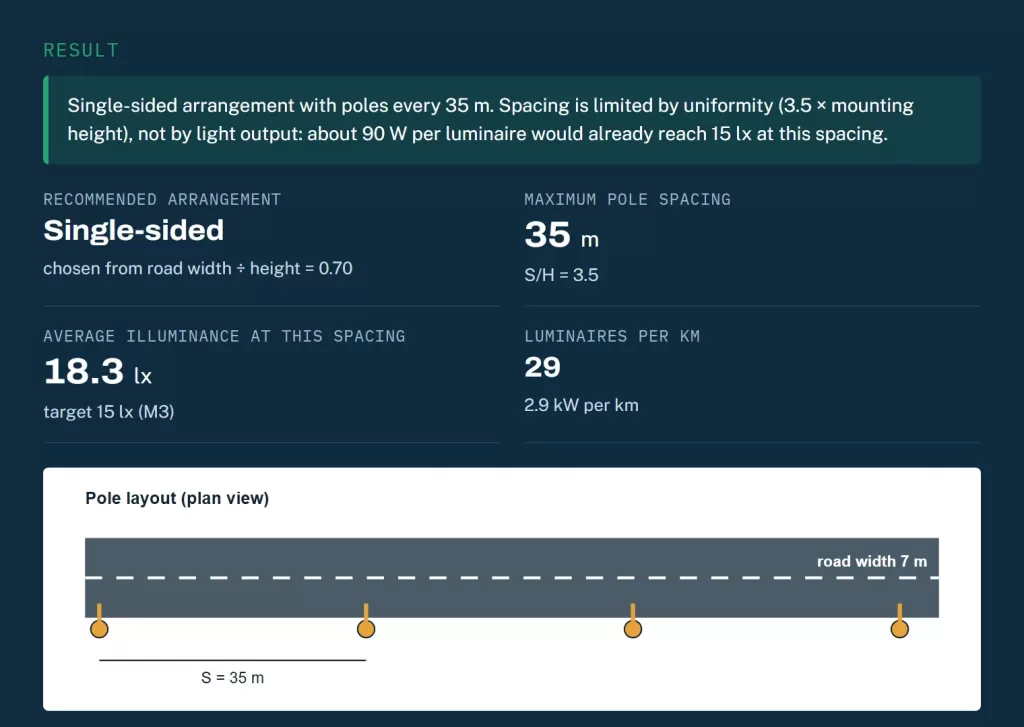
Open this example, then switch the class to M5 to see how much power you could save. The calculator uses the lumen method and caps the spacing for uniformity. A final design must still be checked in DIALux or a similar program with the luminaire’s photometric file, because uniformity and glare can only be verified that way.
Solar street lights and road classes
Many solar street light offers say nothing about road classes. A 30 W solar light on a 6 m pole can meet P3 or P4 on a residential street, but not M3 on an arterial road. For roads with an M class, solar lights need high-output optics, careful spacing, and batteries sized for the full night. See our guide to solar street light pole height and spacing.
If you have a tender specification, send it to us. We will tell you which of our LED street lights or solar street lights can meet the class, and provide the photometric calculation.
Sources
Frequently asked questions
What lighting class is a residential street?
Usually a P class: P3 or P4 (7.5 or 5 lx average) for typical residential streets, P2 or P1 (10 or 15 lx) for busier streets with shops or heavy pedestrian traffic. The local authority makes the final choice.
What is the difference between M and P classes?
M classes are for motorised traffic at medium and high speed and are specified in road surface luminance (cd/m²), which is what a driver sees. P classes are for pedestrians and slow traffic and are specified in horizontal illuminance (lux) on the ground.
How many lux is M3?
M3 requires an average road luminance of 1.0 cd/m². On dry asphalt this corresponds roughly to 15 lx average illuminance, but the exact relationship depends on the road surface and the luminaire, so M-class designs are checked in luminance.
Do I need to follow EN 13201 outside Europe?
Many countries outside Europe use EN 13201 or CIE 115 directly, or base national standards on them. North America mostly uses IES RP-8. Tender documents usually name the standard; if they do not, ask, because it changes the design.