
Solar Street Light Pole Height and Spacing Guide
How high to mount solar street lights and how far apart to space them, by road type and width. Includes layout rules for single-side, staggered and opposite arrangements, typical wattage by pole height, and a worked example.
Key points
- Choose the layout from road width: single-sided up to 1 × the pole height, staggered up to 1.5 ×, opposite beyond.
- Space poles at 3–4 times the mounting height.
- Match LED power to the pole: about 20–40 W at 5–6 m, 40–60 W at 7–8 m, 60–100 W at 9–10 m for solar.
- Check your road with the pole spacing calculator, then confirm with a lighting calculation.
Pole height and spacing decide how even the light on the road will be, how many poles you need, and, for solar projects, how big each battery and panel must be. Get them wrong and you get bright pools and dark gaps between poles, or a project that costs 30% more than it needed to. This guide gives the rules of thumb engineers use for a first layout. A final design should always be checked with a lighting simulation, which we provide on request.
Rule 1: Choose the layout from the road width
The ratio between the road width (W) and the mounting height (H) tells you where to place the poles:
| Layout | When to use | Notes |
|---|---|---|
| Single side | W ≤ 1.0 H | Simplest and cheapest. Common for village roads and residential streets. |
| Staggered (both sides, alternating) | W ≤ 1.5 H | Better uniformity on medium-width roads. |
| Opposite (both sides, facing) | W > 1.5 H | For wide roads and dual carriageways. |
| Central median | Divided roads with a median | Double-arm poles in the median light both carriageways. |
These ratios follow common road lighting practice, such as the Chinese urban road lighting design standard CJJ 45. Check the standard that applies in your country, for example EN 13201 in Europe or ANSI/IES RP-8 in North America, for the light levels required on each road class.
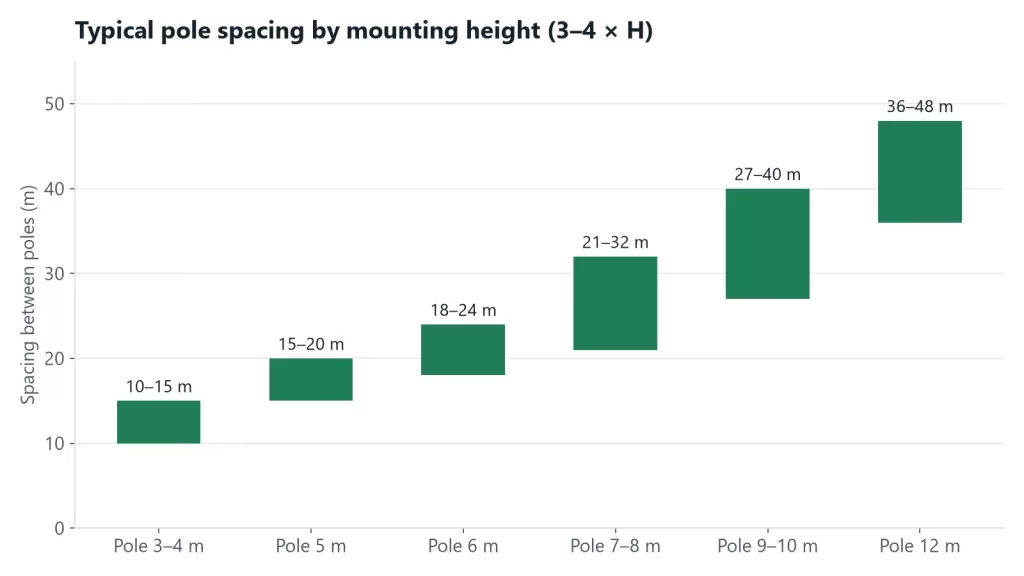
Rule 2: Space poles at 3–4 times the mounting height
| Mounting height | Typical spacing | Typical use |
|---|---|---|
| 3–4 m | 10–15 m | Footpaths, parks, campus walkways |
| 5 m | 15–20 m | Village lanes, residential access roads |
| 6 m | 18–24 m | Residential streets, car parks |
| 7–8 m | 21–32 m | Two-lane roads, industrial estate roads |
| 9–10 m | 27–40 m | Main roads, wider urban roads |
| 12 m | 36–48 m | Wide arterial roads, junctions |
Use the lower end of the range when uniformity matters: busy roads, pedestrian crossings and junctions. Use the upper end on rural roads where the aim is guidance rather than full illumination.
Rule 3: Match the light output to the pole height
Taller poles spread the light wider, but the same lamp gives a lower light level at ground. As a starting point for LED solar street lights:
| Mounting height | Typical LED power (solar) |
|---|---|
| 4 m | 15–20 W |
| 5–6 m | 20–40 W |
| 7–8 m | 40–60 W |
| 9–10 m | 60–100 W |
| 12 m | 100–150 W (usually split solar or grid-powered) |
These are typical values for LEDs with an efficacy of about 150–180 lm/W. What matters is the lumen output and the optic. A Type II distribution suits narrower roads; a Type III distribution throws light further across wider roads from one side.
Rule 4: Do not forget the bracket and tilt
The arm length (overhang) moves the light source towards the centre of the road. On roads wider than about 8 m with poles on one side, an overhang of 1–1.5 m noticeably improves uniformity on the far lane. Tilting the luminaire up by 5–15° widens the throw, but it also increases glare. Modern road optics are designed to work level or close to it.
For solar street lights there is an extra consideration: the panel must face the equator (south in the northern hemisphere, north in the southern hemisphere) and must not be shaded by trees or buildings at any time of day.
Worked example: a 7 m village road
- Road width: 7 m, two lanes, rural traffic
- W ≈ H, so a single-side layout with 7 m poles works
- Spacing: 3.5 × 7 m ≈ 25 m, so 40 poles per kilometre
- LED: 40–50 W solar street light with Type II optics
- Battery and panel: sized for the site with our solar street light calculator
Our pole height and spacing calculator checks this road against lighting class P3 (7.5 lx average). It caps the spacing at 3.5 × the pole height, 24 m, and shows that a 40 W light gives about 12.5 lx there: enough margin for dirt and ageing, or room for a smaller light if the budget is tight.
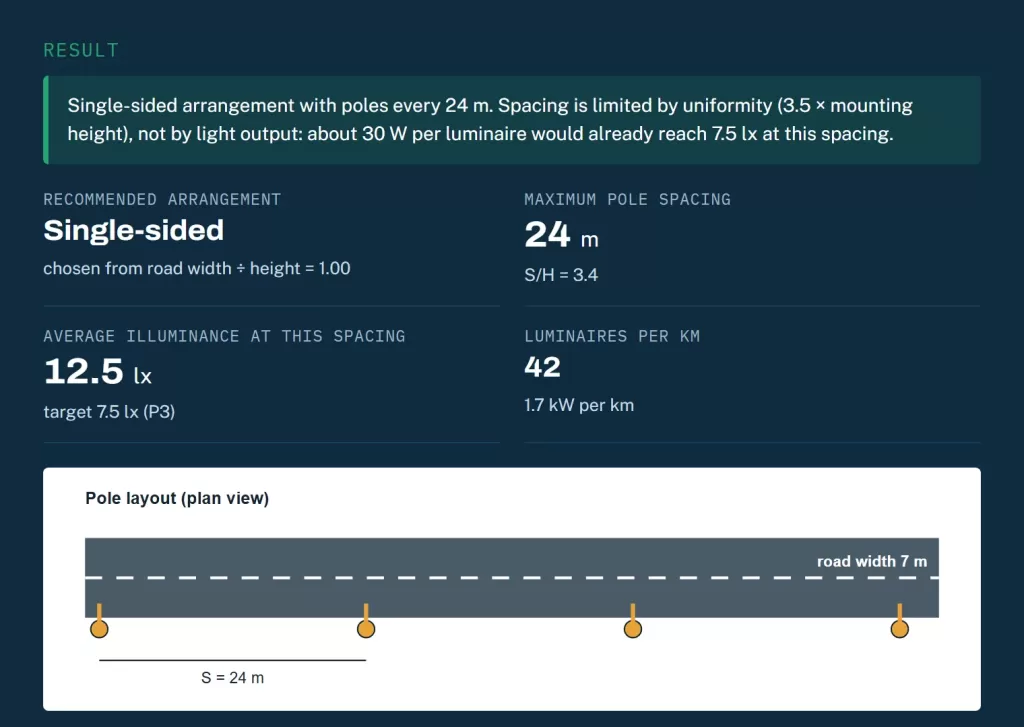
Open this example and enter your own road.
Moving the spacing from 25 m to 30 m would cut the project to 34 poles per kilometre, a 15% saving. But dark gaps would appear between poles unless each light also got a higher output, which means a bigger battery and panel. The cheapest project is the one with the right spacing for the light chosen, not the one with the fewest poles.
Send us your road
Send us the road width, number of lanes, site location and any lighting standard you have to meet. We will propose pole height, spacing and the right solar street light or LED street light configuration, with a simulation if needed.
Frequently asked questions
What is the standard spacing for street light poles?
A common rule is a spacing of 3 to 4 times the mounting height. For example, 6 m poles are usually spaced 18–24 m apart, and 8 m poles 24–32 m apart. Wider optics allow the upper end of the range; roads that need high uniformity need the lower end.
How high should a solar street light pole be?
For footpaths and village lanes, 3–5 m. For residential streets, 5–7 m. For two-lane roads, 7–9 m. For wider urban and main roads, 9–12 m. A practical starting point for a single-side layout is a mounting height roughly equal to the road width.
When should poles be on both sides of the road?
When the road is wider than about 1.5 times the mounting height. Up to about one mounting height, poles on one side are enough. Between one and one and a half times, a staggered layout on both sides works well. Beyond that, place poles opposite each other.
Does a taller pole mean I need a more powerful light?
Yes. Illuminance falls with the square of the distance, so mounting the same light higher spreads its output over a larger area at a lower level. Taller poles allow wider spacing, but each light then needs more lumens.