
Solar Street Lights in Nigeria: Sizing for the Rainy Season (Lagos, Abuja, Kano, Port Harcourt)
How to size solar street lights for Nigeria using satellite sun data for Lagos, Abuja, Kano and Port Harcourt: worst-month sun hours, panel and battery size for a 40 W light, rainy-season autonomy, and what to check in a quotation.

Key points
- Nigeria's worst months are in the rainy season: about 4.0 peak sun hours a day in Lagos (June) and Abuja (August), 3.4 in Port Harcourt (July), 5.4 in Kano (August).
- A 40 W light running 5 h at 100% and 7 h at 30% uses about 316 Wh a night and needs a 120 Wp panel in Lagos or Abuja, 150 Wp in Port Harcourt and 100 Wp in Kano.
- In the south, size the panel for recovery as well as the battery for autonomy: a 150 Wp panel in Port Harcourt takes about 25 sunny days to refill after a 5-day rainy spell; 200 Wp takes about 7.
- Ask for lithium (LiFePO4) batteries, MPPT controllers and a written sizing calculation for your city.
Solar street lighting makes more sense in Nigeria than almost anywhere: grid supply is unreliable, cable theft is common and many estate and rural roads have no network at all. Yet the most common complaint about solar street lights in Nigeria is the same everywhere: they work in the dry season and fade in July. The fix is not a different brand. It is sizing the system for the worst month at the actual site. This guide does that for four cities, using public satellite data and our free calculators.
Sun hours by city
We took monthly solar irradiation for 2015–2020 from PVGIS, the European Commission’s solar database, for each city. The figures are daily averages on a horizontal surface in kWh/m², which equal “peak sun hours”:
| City | Best month | Worst month | Worst-month sun hours |
|---|---|---|---|
| Kano | April: 7.2 | August | 5.4 |
| Abuja | February: 6.5 | August | 4.0 |
| Lagos | April: 5.9 | June | 4.0 |
| Port Harcourt | January, February: 5.8 | July | 3.4 |
The pattern is clear: the further south and the closer to the coast, the darker the rainy season. Port Harcourt’s July has about 40% less sun than its dry season, and only 63% of Kano’s worst month.
The light we sized
The example is a typical estate or rural road light:
- 40 W LED, running 5 hours at 100% from dusk and 7 hours at 30% after
- 90% efficient driver, LiFePO4 battery at 12.8 V, MPPT controller
- 4 nights of battery autonomy
That light uses about 316 Wh per night. The solar street light calculator turns this into panel and battery sizes for each city:
| City | Worst-month sun hours | Panel needed | Standard panel | Battery (4 nights) |
|---|---|---|---|---|
| Kano | 5.4 | 81 Wp | 100 W | 1,402 Wh (110 Ah) |
| Abuja | 4.0 | 110 Wp | 120 W | 1,402 Wh (110 Ah) |
| Lagos | 4.0 | 110 Wp | 120 W | 1,402 Wh (110 Ah) |
| Port Harcourt | 3.4 | 129 Wp | 150 W | 1,402 Wh (110 Ah) |
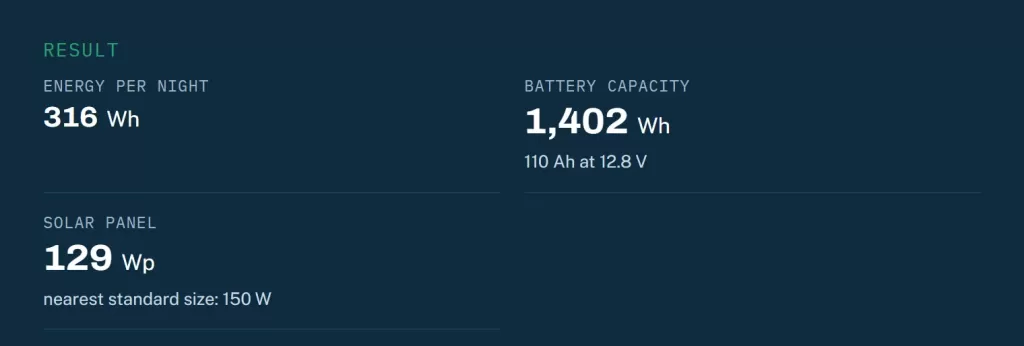
Open the Port Harcourt example in the calculator and enter your own wattage and schedule.
The rainy-season test
The panel size above balances one average day of the worst month. The rainy season adds a harder test: runs of heavily overcast days, followed by a few sunny days in which the battery must refill. We ran the Port Harcourt light through the battery autonomy calculator with a 5-day rainy spell, assuming the panel yields 15% of a normal day under heavy cloud:
- With a 110 Ah battery and a 150 Wp panel, the battery lasts 4.9 rainy days, just short of the 5-day spell. Worse, the sunny-day surplus is only about 52 Wh, so refilling the battery afterwards takes about 25 sunny days. The next storm arrives before the battery is full.
- With a 120 Ah battery and a 200 Wp panel, the light covers 5.7 rainy days and refills in about 7 sunny days.
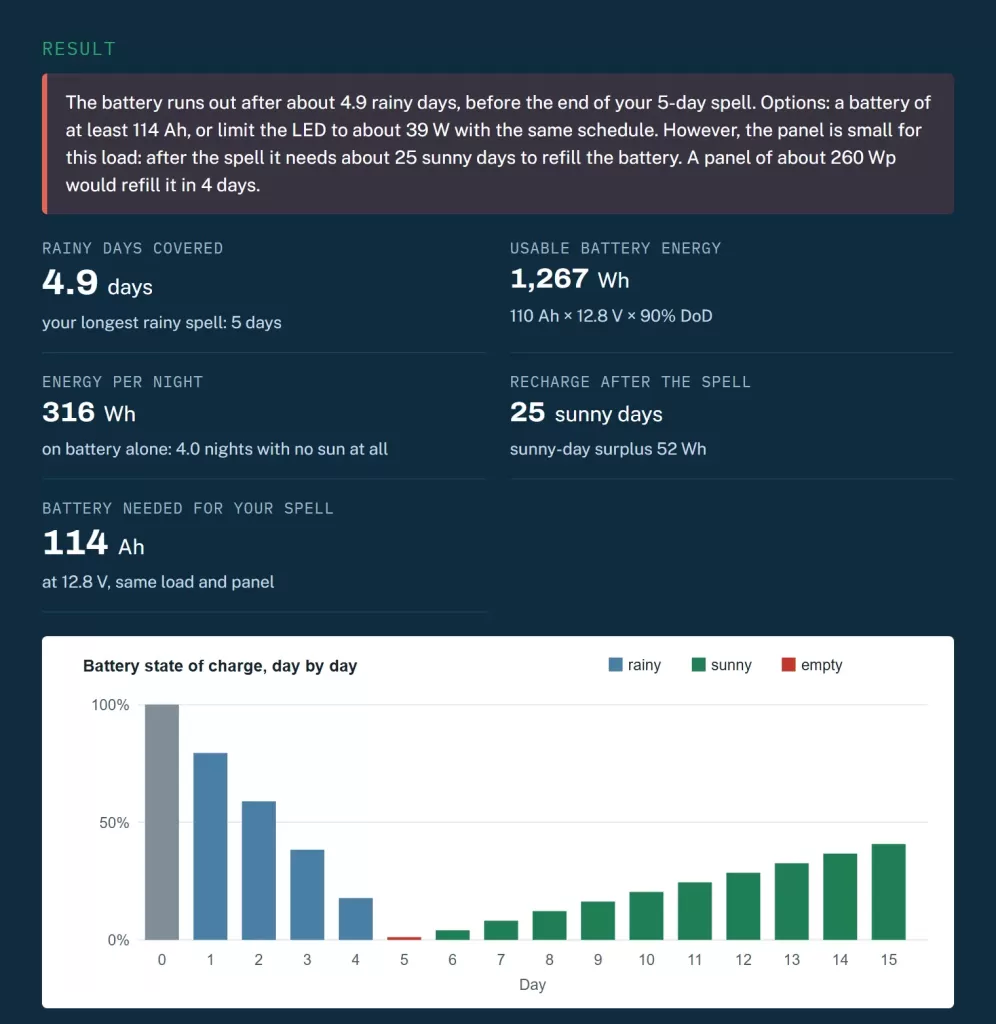
That second result is the one to buy. The extra 50 Wp of panel costs little compared with lights that are dark for weeks in August. Try the example yourself and raise the panel to 200 Wp to see the recovery time drop.
In Kano the same 110 Ah battery with a 120 Wp panel covers 5.2 rainy days and refills in about 5 sunny days, so the north can use a lighter system.
Pole height, spacing and wattage by road type
Panel and battery follow from the lamp wattage, and the wattage follows from the road. Typical layouts for Nigerian roads, checked in our pole height and spacing calculator:
| Road | Width | Pole | Lamp | Layout and spacing | Average light |
|---|---|---|---|---|---|
| Estate street | 6 m | 6 m | 30 W | One side, 21 m apart | about 12 lx (class P3 needs 7.5) |
| Busy estate or town street | 6 m | 6 m | 40 W | One side, 21 m apart | about 17 lx (class P2 needs 10) |
| Two-lane rural or state road | 7.3 m | 8 m | 60 W | One side, 28 m apart | about 15 lx (class M5) |
| Wider urban road | 10 m | 9 m | 60 W | Staggered, 31 m apart | about 15 lx (class M5) |
In each case the spacing is limited by uniformity (about 3.5 × the pole height), not by light output, so a modest lamp is enough. That matters for solar: every watt you do not need is battery and panel you do not have to buy. Many tenders over-specify 100 W “solar” lights on 7 m roads where 40–60 W of well-aimed light meets the class.
Heat, dust and the Harmattan
Two Nigerian conditions change the details of the design:
- Heat. Batteries age faster when hot. LiFePO4 tolerates heat far better than lead-acid or NMC lithium, but it still lasts longer in shade. In split systems, mount the battery box under the panel or in the pole, never in a dark box facing the afternoon sun.
- Harmattan dust. From roughly December to February, dust from the Sahara settles on panels, especially in the north. A dusty panel can lose a large share of its output. Fortunately this is the sunny season, so a correctly sized system has margin, but plan a cleaning round after the Harmattan and tilt the panel at least 10–15° so rain washes it in the wet season.
Nigeria lies between about 4° and 14° north, so panels should face south at a modest tilt. A flat or wrong-facing panel on an all-in-one light installed “as it comes” can lose 10–20% of its output.
Why solar street lights fail in Nigeria
Most failures come from a short list of causes:
- Battery too small for July/August, sized on the dry-season sun or on the annual average.
- Panel too small to refill the battery, so the light is never fully charged during the rains.
- Cheap or recycled cells, with real capacity far below the label.
- No dimming, so the light runs at full power all night and empties the battery by morning.
- Shading, from trees or buildings that were small when the light was installed.
- Theft and vandalism of panels and batteries on accessible poles.
The first two are design problems and are solved on paper before the order. The rest are about specification and installation. See how many rainy days a solar street light can last for the method behind the numbers above.
Import documents
Lighting products imported into Nigeria need a SONCAP certificate (Standards Organisation of Nigeria Conformity Assessment Programme) for customs clearance. Tell your supplier at the quotation stage that the goods are for Nigeria, so that product testing, the certificate and the shipping documents are planned in, rather than discovered at the port.
All-in-one or split?
An all-in-one light carries its panel on top of the housing, which limits the panel to roughly 20–80 Wp for typical sizes and fixes its angle. That is fine for paths and short estate roads with modest wattages, especially in the north. For main roads, higher wattages or the southern states, a split solar street light lets you mount a larger panel, tilted towards the sun, and keep the battery out of the heat. See all-in-one vs split solar street lights.
What to check in a quotation
- Panel watts and battery Wh for your city, with the sun hours they assumed. If the quote does not say, ask.
- Lithium (LiFePO4) battery, not lead-acid, and its usable Wh, not only Ah. See LiFePO4 vs gel.
- MPPT controller with a programmable dimming schedule and low-battery dimming.
- Anti-theft fixings for the panel and battery.
- Pole and foundation design for the local wind speed.
- Hot-climate battery placement: shaded, ventilated, or in the pole.
Get a sizing for your site
Send us the location (or GPS coordinates), road width, pole height and the number of lights. We check the panel and battery against satellite data for your exact site, not just the city, and quote complete sets with poles. Our solar street lights range from 15 W all-in-one lights to 60 W split systems, with larger systems on request.
Sources
Frequently asked questions
How many hours of sun does Nigeria get for solar street lights?
Satellite data from PVGIS (2015–2020, horizontal surface) give a worst-month average of about 4.0 kWh/m² per day in Lagos and Abuja, 3.4 in Port Harcourt and 5.4 in Kano. Those worst-month values, not the annual average, should be used to size the panel.
What size solar panel does a 40 W solar street light need in Lagos?
With a 5 h full-power and 7 h dimmed schedule (about 316 Wh a night), MPPT charging and Lagos's worst month of about 4.0 sun hours, about 110 Wp, so a 120 Wp panel. Running the light at full power all night would need more than double.
Do solar street lights work in the rainy season in Nigeria?
Yes, if the battery covers the longest run of overcast days and the panel is large enough to refill it afterwards. Southern cities need both more battery and more panel than the north. Under-sized lights are the main reason solar street lights get a bad name in the rainy season.