
LiFePO4 vs Gel vs Lithium-Ion (NMC) Batteries for Solar Street Lights
Which battery should a solar street light use? A comparison of LiFePO4, gel lead-acid and NMC lithium-ion on cycle life, usable capacity, heat and cold tolerance, safety, weight and lifetime cost.
Key points
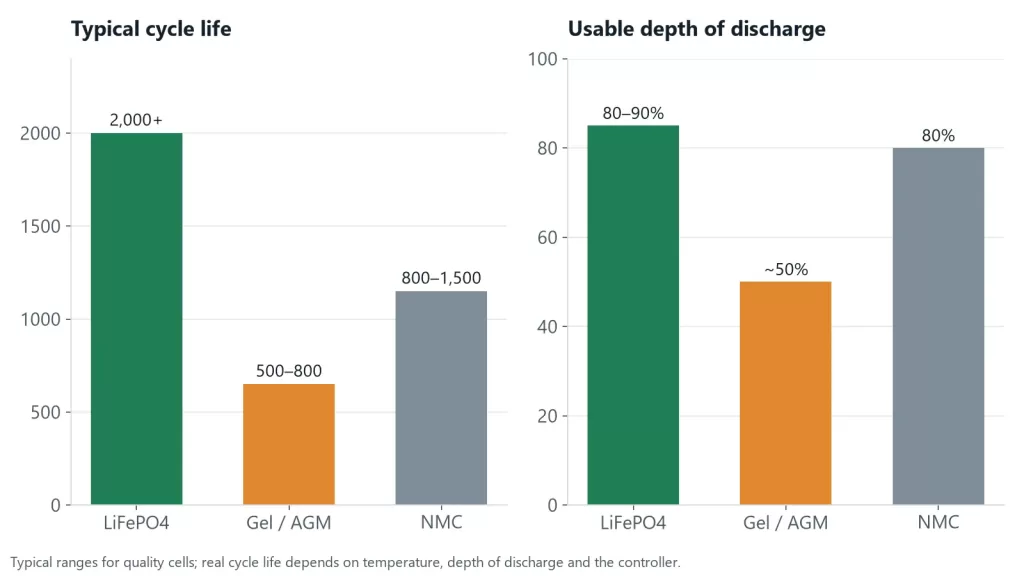
- LiFePO4 offers 2,000+ cycles and 80–90% usable capacity; gel about 500–800 cycles at 50%.
- For the same usable energy, gel needs nearly twice the nominal capacity and is 3–4 times heavier.
- LiFePO4 must not be charged below 0 °C without protection or heating.
- Use LiFePO4 for almost every project; gel only where budget or a buried cold-climate box requires it.
The battery is the most expensive part of a solar street light to replace, and the most common reason a light stops working before its time. There are three chemistries you will see in quotations. Here is how they compare in the conditions a street light actually lives in: one cycle every night, outdoors, for years.
The comparison
| LiFePO4 (lithium iron phosphate) | Gel / AGM lead-acid | NMC lithium-ion | |
|---|---|---|---|
| Typical cycle life | 2,000+ at 80% DoD | 500–800 at 50% DoD | 800–1,500 at 80% DoD |
| Usable depth of discharge | 80–90% | ~50% | 80% |
| Weight for the same usable energy | Low | 3–4 times heavier | Lowest |
| Heat tolerance | Good | Fair: ages quickly when hot | Poor: degrades and is a safety concern when hot |
| Charging in the cold (below 0 °C) | Not allowed without protection or heating | Possible at reduced rate | Not allowed without protection |
| Thermal stability and safety | Very stable | Stable, but contains acid and lead | Least stable of the three |
| Upfront cost | Medium | Lowest | Medium |
| Cost per stored kWh over its life | Lowest | Highest | Medium |
| Typical use | All-in-one and split street lights | Older split systems, buried boxes | Small garden lights, consumer products |
The figures are typical ranges for quality cells. Actual cycle life depends on temperature, depth of discharge and the charge controller.
Why LiFePO4 became the standard
More of the capacity is usable. A 1 kWh LiFePO4 pack can deliver 800–900 Wh night after night. A 1 kWh gel battery should deliver only about 500 Wh if you want it to survive more than a couple of years. For the same job you need roughly 1.8 times the gel capacity. Our battery sizing guide works through the numbers.
It survives the heat. A battery inside an all-in-one housing under a black panel in the midday sun can get very hot. LiFePO4 handles this far better than lead-acid or NMC, and it does not go into thermal runaway the way NMC can.
It is light enough for integrated designs. All-in-one solar street lights exist because LiFePO4 is compact and light enough to sit at the top of a pole.
Where gel batteries still make sense
- Very tight upfront budgets, where the buyer accepts replacing batteries after 2–3 years
- Buried battery boxes in cold climates, because the ground keeps the battery above freezing and lead-acid tolerates low-temperature charging better
- Retrofits of existing split systems designed around 12 V or 24 V lead-acid batteries
How chemistry changes the battery size
Usable depth of discharge decides how big the battery must be for the same job. Take a 60 W light that uses 453 Wh a night and must survive 3 nights without sun, so it needs 1,359 Wh of usable energy:
| Chemistry | Usable share | Battery to install |
|---|---|---|
| LiFePO4 | 90% | 1,359 ÷ 0.9 = 1,510 Wh (about 118 Ah at 12.8 V) |
| Gel / AGM | 50% | 1,359 ÷ 0.5 = 2,718 Wh (about 226 Ah at 12 V) |
The gel battery has to be almost twice as large, and it still wears out several times sooner. That is why the cheaper battery is usually the more expensive choice over the life of the light. See the full method in how to calculate solar street light battery capacity, or size your own light with the solar street light calculator.
What to ask your supplier about the battery
- Chemistry, nominal voltage and capacity in Ah. Calculate Wh yourself: V × Ah.
- Cell grade and origin. New grade-A cells, or recycled or B-grade cells? This is where cheap lights save money.
- Rated cycle life and at what DoD. “2,000 cycles” at 50% DoD is not the same as at 80%.
- Battery management system (BMS). Over-charge, over-discharge, short-circuit and temperature protection.
- Low-temperature charge protection if your site sees frost.
- Warranty on the battery itself, separately from the luminaire.
Our recommendation
Use LiFePO4 for almost every solar street light project, sized with a margin for ageing, with a BMS and an MPPT controller. Choose a split system with a shaded or buried battery if your site is extremely hot. Use gel only where the budget or the climate truly requires it.
See our solar street lights or send us your site details and we will recommend the battery and configuration.
Frequently asked questions
Which battery is best for solar street lights?
For most projects, LiFePO4 (lithium iron phosphate). It offers thousands of deep cycles, 80–90% usable capacity, good tolerance of heat, and a very stable chemistry. Gel batteries are still used where the upfront budget is very tight or the battery is buried in a cold climate.
How long does a LiFePO4 battery last in a solar street light?
Good LiFePO4 cells are typically rated for 2,000 or more cycles at 80% depth of discharge. A street light makes one cycle per night, and most nights use only part of the battery, so a well-sized LiFePO4 pack commonly lasts 5–8 years or more. Heat is the main factor that shortens its life.
Can LiFePO4 batteries be charged below freezing?
Standard LiFePO4 cells must not be charged below 0 °C. Charging them in the cold damages them permanently. For cold climates, use a controller with low-temperature charge protection, a self-heating battery, or a buried battery box that stays above freezing.
Why not use NMC lithium-ion batteries in street lights?
NMC cells store more energy per kilogram, but they are less thermally stable than LiFePO4 and age faster when kept hot and fully charged, which is exactly how a battery sits inside a light pole in the tropics. For outdoor lighting, LiFePO4 is the safer and longer-lasting choice.