
High Temperature LED High Bay Lights for Steel Mills, Foundries and Hot Factories
How heat under the roof of steel mills, foundries, glass works and dyeing plants shortens LED life, what makes a high bay suitable for high ambient temperatures, and a 48 × 24 m hot hall at 14 m worked through in our high bay calculator.
Key points
- Air under the roof of hot industrial halls often exceeds 50 °C; standard LED high bays rated to 40–50 °C fail early there.
- Choose fixtures rated for the measured ambient (for example up to 65 °C), with large heat sinks or heat pipes and a driver protected from the heat.
- Use a lower maintenance factor (0.7) and narrow beams for high, dusty, dark halls.
- In our 48 × 24 m example at 14 m, 32 × 200 W high bays give about 220 lx; spacing allows 150 W fixtures in a denser grid as an alternative.
The roof space of a steel mill, foundry, forge, glass works or dyeing plant is one of the harshest places to put an electronic device. Hot air rises from furnaces, ladles and dryers and collects under the roof, often well above 50 °C. Standard LED high bays, rated for 40–50 °C, run too hot there: their light output falls quickly and their drivers fail early. This guide explains how to choose and lay out high bays for hot halls.
Why heat matters to LEDs
An LED’s life is set by the temperature of its junction, which depends on the air around the fixture plus the heat the fixture must shed. Higher ambient air means a higher junction temperature for the same heat sink. Two things suffer:
- Lumen maintenance: LEDs lose light faster when hot.
- Driver life: electrolytic capacitors in the driver dry out much faster at high temperature; the driver is usually the first part to fail.
The 10-degree rule
A useful rule of thumb for drivers: the life of an electrolytic capacitor roughly halves for every 10 °C rise in its temperature. A driver designed to last 50,000 hours at a case temperature of 70 °C may last only about 25,000 hours at 80 °C and 12,500 hours at 90 °C. In a mill running around the clock (8,760 hours a year), 50,000 hours is under six years even at the design temperature; 12,500 hours at 90 °C is about a year and a half.
What to ask the supplier
- The rated ambient temperature (ta) of the complete luminaire, not just of the LEDs.
- A thermal test report at that ambient, showing the temperature at the driver’s tc point and the LED solder point, compared with their limits.
- The driver’s rated life at the measured tc temperature, from the driver manufacturer’s datasheet.
- Whether the output is derated at high ambient (some drivers reduce current automatically to protect themselves, which lowers the light level when it is hottest).
Measure first
Before choosing fixtures, measure the air temperature at the mounting height, in summer, with production running. Measure above furnaces, along crane runways and at the roof ridge, where hot air collects. The fixture’s ambient rating must exceed the highest value.
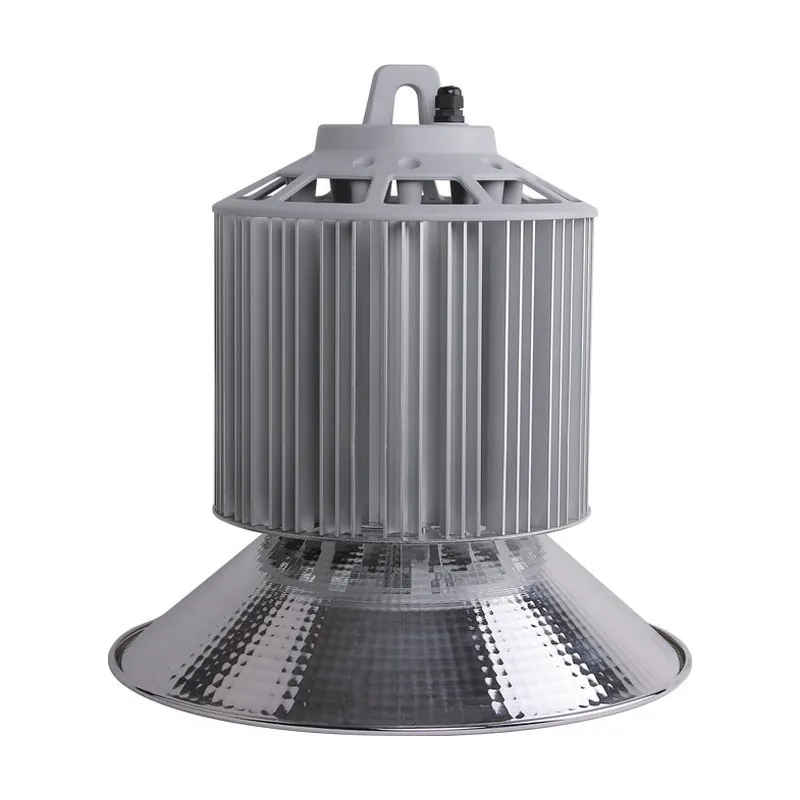
What makes a high bay suitable
- Rated ambient temperature above the measured value, for example our high-temperature high bay rated for −30 °C to +65 °C
- Large heat sink surface, such as high-purity aluminium fins with open air channels, or copper heat pipes that move heat quickly to a large fin array
- Driver separated from the LED board’s heat, or mounted remotely at a cooler level
- Sealed optics (IP65) to keep dust and oil off the LEDs and reflector
- Stainless or coated fixings where the air is corrosive
Layout in a hot hall: a worked example
A 48 × 24 m foundry hall, fixtures at 14 m to clear the crane, target 200 lx for rough work. The surfaces are dark (steelwork, dust), so we used the “dark” reflectance setting, and a maintenance factor of 0.7 for the dirty environment. Fixtures: 200 W at 110 lm/W with narrow (60°) beams to reach the floor from 14 m.
The high bay lighting calculator gives:
- Room index 1.21, utilisation factor about 0.51
- 32 fixtures in an 8 × 4 grid at 6 × 6 m
- About 219 lx average, 5.6 W/m², 6.4 kW in total
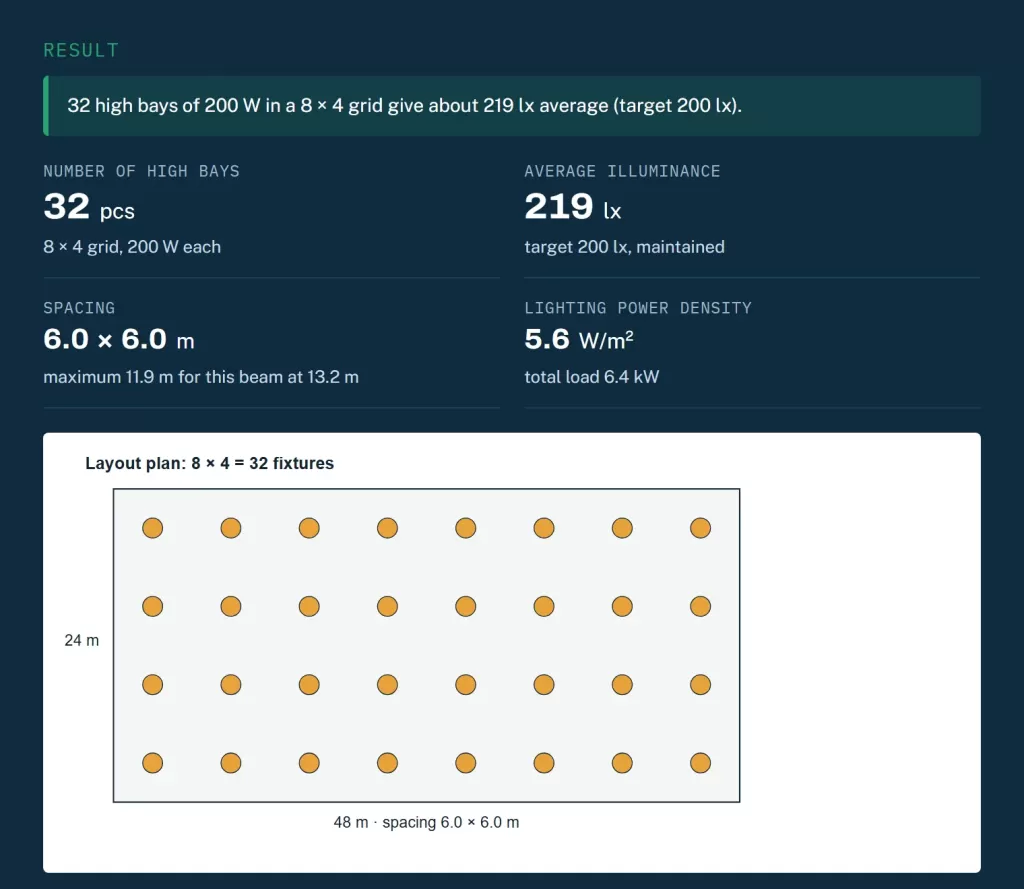
Open this example. An alternative is 45 × 150 W fixtures in a 9 × 5 grid at about 231 lx: more fixtures, each running cooler, with evener light. In very hot halls, more fixtures at lower power is often the more durable choice.
Energy: hot plants often run around the clock
Steel mills, foundries and glass works often operate 24 hours a day, which makes the energy case for LED stronger than in a normal factory. Take the foundry hall above with 32 old 400 W metal halide high bays (about 448 W each with the ballast), replaced by the 32 × 200 W LED layout, running 8,760 hours a year:
- Metal halide: about 125,600 kWh a year
- LED: about 56,100 kWh a year
- Saving about 69,500 kWh, roughly US$10,400 a year at US$0.15/kWh
The saving only materialises if the LED fixtures survive the heat, so the extra cost of a properly rated high-temperature fixture is small compared with replacing failed standard fittings over a crane runway. Run your own figures in the LED retrofit savings calculator.
Maintenance in dirty halls
- Clean covers and fins regularly; dust on the fins reduces cooling as well as light.
- Plan access: fixtures at 14 m over crane runways need scheduled shutdowns or crane-mounted platforms.
- Keep spare drivers on site; a driver swap is much quicker than a fixture swap.
Beyond high bays
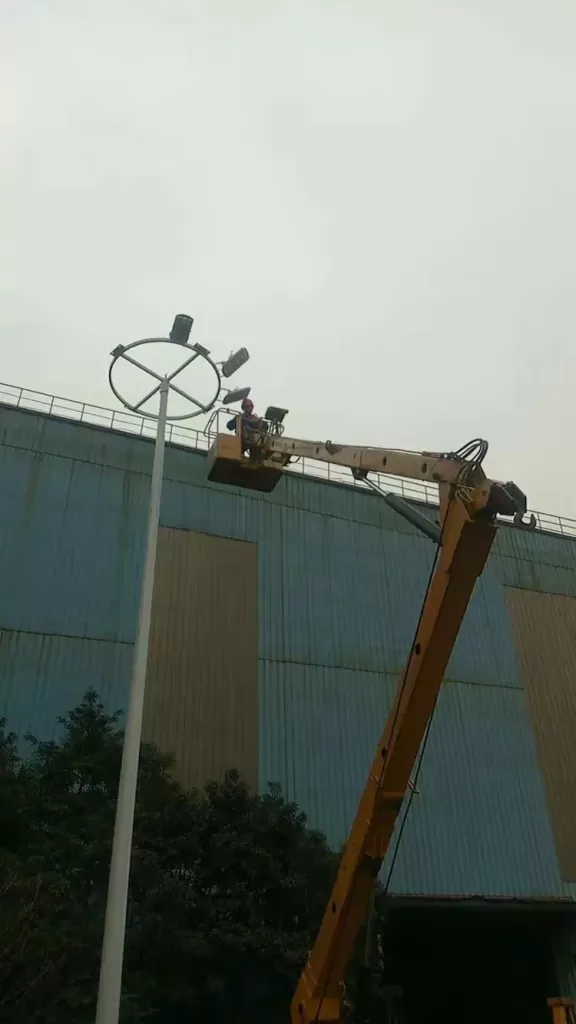
For the hottest zones above furnaces, or where fixtures must be aimed from the side of the hall, heat-pipe floodlights mounted on columns or walls can reach the floor without sitting in the hottest air. Our heat-pipe high bay and flood light runs from 200 W to 1500 W with reflectors from 25° to 120°.
For the general method, see how many LED high bay lights do I need. Send us the hall dimensions, mounting height and measured roof temperature, and we will propose fixtures and a layout.
Sources
Frequently asked questions
What temperature can LED high bay lights withstand?
Standard LED high bays are usually rated for an ambient of about 40–50 °C. High-temperature models are rated higher; our BG-NGW series is rated for −30 °C to +65 °C ambient. Always compare the rating with the measured air temperature at the mounting height, in summer.
Why do LED lights fail in hot factories?
Heat raises the LED junction temperature and the temperature of the driver's electrolytic capacitors. Both shorten life sharply: LEDs lose light faster and drivers fail early. A fixture rated for a lower ambient than the real one is the most common cause.
Should the driver be separate from a high temperature high bay?
Where the air at the luminaire is very hot, mounting the driver remotely at a cooler level is a good option. Otherwise, choose fixtures with the driver thermally separated from the LED board and rated for the ambient.