
Choosing an LED High Bay Light Manufacturer: What to Check Before You Order
How importers and contractors choose an LED high bay manufacturer: product range, real test data, drivers and heat sinks, certificates, samples, quality control, warranty, lead times and shipping.
Key points
- Judge a high bay supplier by test data, component choices and quality control, not by catalogue wattage or price per piece.
- Ask for photometric files (IES or LDT), LM-79 or equivalent test reports, driver brand and surge rating, and heat sink temperature data.
- Order samples, run them at full power for days, and measure input power and light before ordering in volume.
- Agree warranty terms, spare parts and response times in writing; for projects, ask for support with layouts and documents.
Hundreds of factories make LED high bays, and on a website they all look similar: UFO or linear, 100–300 W, 150 lm/W, five-year warranty. The differences show up after a year in a hot warehouse. This guide explains what experienced buyers check before placing an order.
1. Product range that fits your market
| Need | Typical products |
|---|---|
| General warehouses | UFO high bays 100–200 W |
| Aisles and racks | Linear high bays, narrow optics |
| Heavy industry, steel | Heat-pipe or high-power high bays, high-temperature versions |
| Hot roofs, foundries | High-temperature high bays |
| Hazardous areas | Explosion-proof high bays |
| Budget projects | Economy high bays |
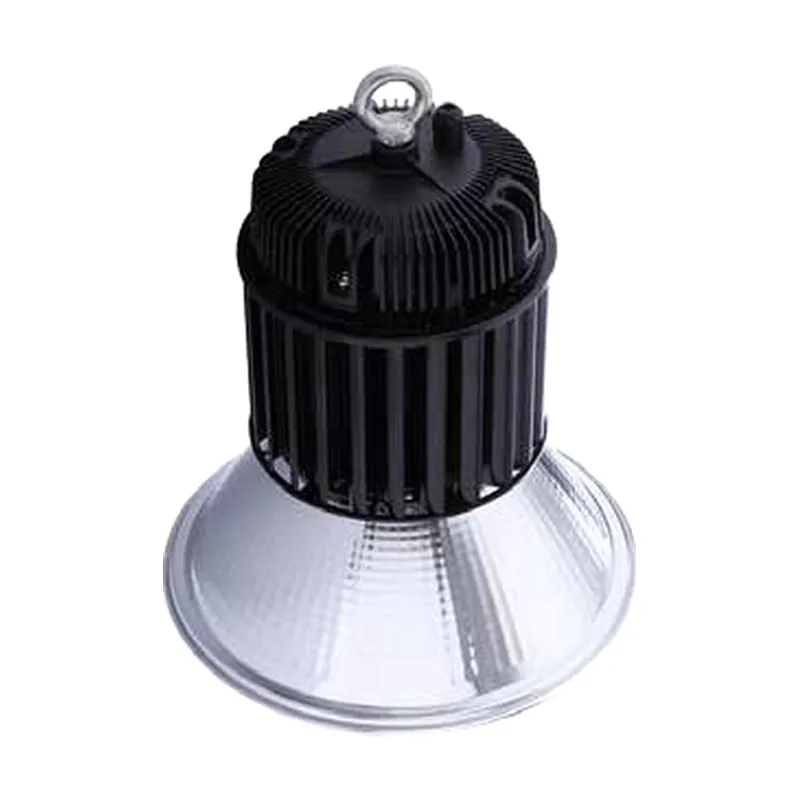
Our range includes UFO high bays, heat-pipe high bays, economy high bays and high-temperature high bays.
2. Real test data
Ask for:
- Photometric files (IES or LDT) for each optic, so you or your designer can run layouts
- Test reports of the complete fixture: input power, lumens, efficacy, power factor, CCT and CRI
- LM-80 data for the LED package, with TM-21 projection
- Temperature tests showing LED and driver temperature at rated ambient
If the supplier cannot provide photometric files, layout calculations are guesses.
3. Components
| Component | Ask |
|---|---|
| LEDs | Package type and brand, drive current |
| Driver | Brand, efficiency, PF, THD, surge rating, dimming |
| Heat sink | Material, fin design, weight per watt |
| Lens / reflector | Material (PC, PMMA, glass), beam options |
| Surge protection | Built-in kV rating, separate SPD option |
| Cable and connectors | Waterproof grade, length |
Weight is a rough guide: a 150 W high bay that weighs much less than competitors may have too little aluminium to cool it.
4. Certificates and documents
Requirements depend on your market: safety and EMC certificates, energy-efficiency listings, or test reports demanded by tenders. Ask which certificates apply to the exact model, and check certificate numbers and validity.
5. Samples and testing
- Order samples of each model and optic
- Measure input power and power factor with a meter
- Run them at full power for several days; check temperature with a thermometer or thermal camera
- Measure light with a lux meter at a fixed distance and compare models
- Open one sample to check build quality and sealing
6. Quality control
- Incoming inspection of LEDs and drivers
- Ageing (burn-in) tests before packing
- Final inspection and photos of each batch
- Third-party pre-shipment inspection for large orders
7. Warranty and after-sales
- Warranty period for fixture and driver (five years is common)
- What happens when a fixture fails: replacement, spare parts, shipping cost
- Spare drivers shipped with large orders
- Response time for claims
8. Project support
For contractors and distributors, support often matters as much as the product:
- Lighting layouts and lux calculations
- Energy savings calculations for customers
- Product data sheets and installation instructions in English
- Help with tender documents
We use our high bay calculator for quick layouts and photometric files for detailed designs. See how many LED high bay lights you need for the method.
9. Lead time, packaging and shipping
- Standard lead times are often 2–4 weeks after sample approval, longer in peak season
- Packaging should survive container transport and local handling
- Mixed containers with other products can reduce freight per unit
- Check HS codes and duties for your country
10. Price, compared fairly
Compare offers on:
- Delivered lumens and efficacy, not watts
- Driver and component quality
- Warranty terms
- Total cost including freight and duties
A slightly higher price for a fixture that lasts and keeps its output is usually cheaper over five years.
Red flags
- No photometric files or test reports
- Efficacy claims far above the market without data
- Unknown driver with no surge rating
- Very light fixtures for their wattage
- Unwilling to send samples or to explain warranty terms
Questions to ask on a factory call or visit
When you speak to a potential supplier, a few questions reveal a lot. Ask who designs the products and whether the factory has its own optical and thermal testing. Ask which driver brands they use and what surge level each model has. Ask how many units fail during ageing tests and what happens to them. Ask for photos or videos of the production line and the ageing room, and for the last third-party inspection report.
Good suppliers answer with numbers and documents. Vague answers, or a reluctance to share test data, are a warning even when the price is attractive.
Building a long-term relationship
Most distributors work with a small number of factories for years. Consistency matters: the same quality in every batch, the same drivers, and early notice when a component changes. Agree that the factory will tell you before changing LEDs or drivers, and keep a reference sample from your first order to compare against later batches.
Small first orders
A sensible first order is a mixed container or a small project with a few hundred fixtures, rather than the largest possible order at the lowest price. It tests the factory’s quality, packaging, documents and response to problems before your reputation depends on it.
Working with us
We manufacture LED high bays, street lights, floodlights and explosion-proof lights in Xiangtan, Hunan, and support importers and contractors with samples, test data, layouts and documents. See our factory projects, then send us your application, quantities and market requirements.
Sources
Frequently asked questions
How do I find a reliable LED high bay manufacturer?
Look for a supplier that can provide test reports, photometric files and component details, offers samples, explains its quality control and warranty, and has references in similar projects. Visit or audit the factory for large orders.
What should be in an LED high bay specification?
Power, lumens and efficacy of the complete fixture, beam angles, CCT and CRI, driver brand, power factor and surge rating, IP and IK ratings, operating temperature, dimming and sensor options, mounting options and warranty.
Why do cheap LED high bays fail?
Usually because of under-sized heat sinks, low-quality drivers, missing surge protection and LEDs driven too hard. They may look the same in photos but run hotter and lose light or fail within a few years.