
Warehouse LED Lighting Upgrade: Layout, Savings and a Step-by-Step Plan
How to upgrade a warehouse to LED: survey, light levels, layout, one-for-one or redesign, sensors, a 70-fixture payback example and installing without stopping work.
Key points
- Start with a survey: hall size, mounting height, racking, operating hours and the light level you actually need.
- In our 80 × 50 m example at 11 m, 70 × 150 W LED high bays give about 215 lx at 2.6 W/m².
- Replacing 70 × 400 W metal halide fixtures with them saves about 103,000 kWh and US$18,000 a year, a payback of about 9 months.
- Occupancy sensors in low-traffic aisles cut the remaining LED energy further; install in zones so the warehouse keeps working.
Warehouse lighting is one of the clearest LED upgrades there is. The lights run long hours, the old metal halide and sodium fixtures waste much of their energy, and relamping at 10 m or more is expensive. Yet many upgrades leave money on the table: they swap fixtures one for one without checking the layout, ignore the racking aisles, or skip sensors. This guide walks through an upgrade from survey to installation, with a worked example.
Step 1: survey the warehouse
Collect, for each area:
- Dimensions and mounting height (to the bottom of the fixture)
- Use: bulk storage, racking aisles, picking, packing, loading docks, offices
- Racking: height, aisle widths and orientation
- Existing fixtures: type, wattage, quantity, and whether the light is even
- Operating hours: hours per day, days per year, shifts, and which areas are empty most of the time
- Electricity price, including demand charges if any
- Environment: dust, temperature under the roof, cold stores, washdown
Photos of the ceiling, racking and existing fixtures save a lot of questions later.
Step 2: decide the light level
| Area | Typical maintained illuminance (EN 12464-1) |
|---|---|
| Storage without people | about 100 lx |
| Storage and racking aisles with people | about 150 lx |
| Dispatch, packing, loading docks | about 200 lx |
| Picking and work at benches | 300 lx or more |
A common mistake is to light the whole building to the highest level needed anywhere. Zoning the light levels is cheaper and often better.
Step 3: lay out the fixtures
For open areas, the lumen method gives the number of fixtures, and the spacing check makes sure the light is even. Take an open warehouse of 80 × 50 m, fixtures at 11 m, target 200 lx for dispatch work, 150 W high bays at 140 lm/W with 90° beams. Our high bay and warehouse lighting calculator gives:
- 70 fixtures in a 10 × 7 grid, at 8.0 × 7.1 m spacing (the limit for this beam is 12.2 m)
- About 215 lx average
- 2.6 W/m², 10.5 kW in total
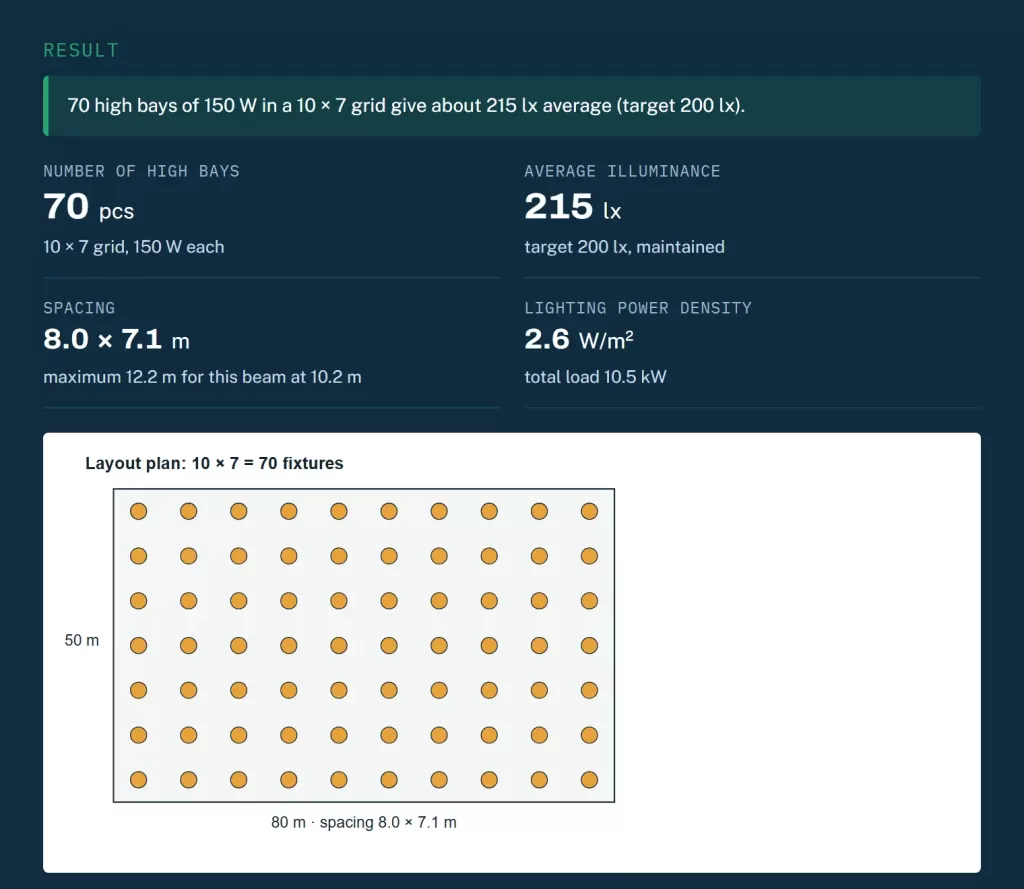
Open this example and enter your own building. With 200 W fixtures, 54 would do (9 × 6, about 220 lx): fewer fittings to install, slightly less even light. For the full method, see how many LED high bay lights do I need.
Racking aisles
For aisles between high racking, the task is the vertical face of the shelves. Use aisle optics in a single row over each aisle, spaced roughly 1–1.5 times the mounting height, and check vertical illuminance on the rack faces in a photometric calculation. See UFO vs linear high bay lights for the choice of fixture.
Step 4: estimate the savings
Assume the warehouse currently has 70 × 400 W metal halide high bays (about 448 W each with magnetic ballasts), runs 16 hours a day, 310 days a year, pays US$0.15/kWh and spends about US$40 per fixture a year on relamping and repairs. Replacing them with the 70 × 150 W LED layout above, at US$160 per fixture plus US$40 installation, our LED retrofit savings calculator gives:
- Energy: about 155,500 kWh a year before, 52,100 kWh after; 103,500 kWh saved (66%)
- Money: about US$15,500 in energy plus US$2,600 in maintenance, US$18,100 a year
- Investment US$14,000, payback about 9 months
- About 52 tonnes of CO₂ avoided a year at 0.5 kg/kWh
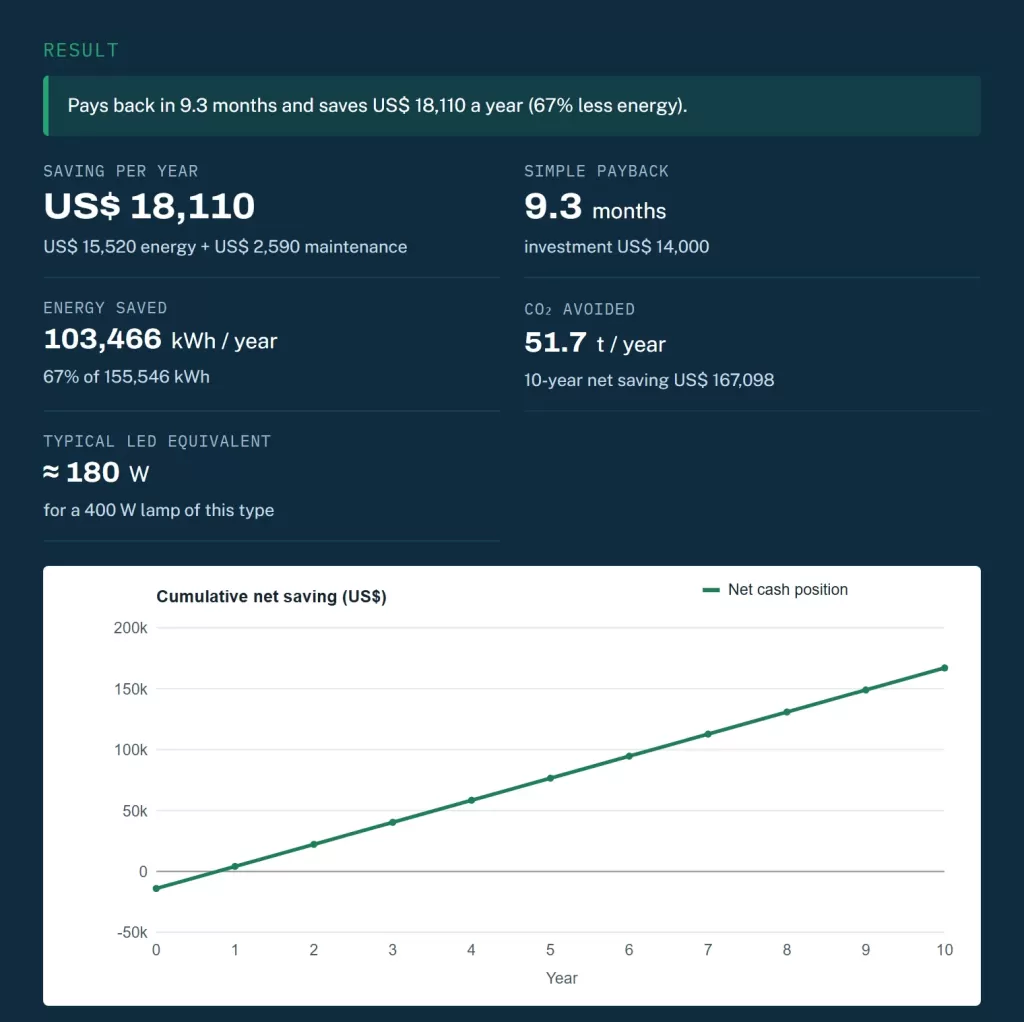
Open this example and enter your own fixtures, hours and tariff. The calculator exports a PDF report you can attach to a budget request.
Step 5: add controls where they pay
LEDs can dim and switch instantly, which metal halide cannot. Options, in order of typical value:
- Occupancy sensors in low-traffic aisles. Each fixture or row dims to 10–20% when nobody is there and returns to full output within a second. In bulk storage visited a few times an hour, this can cut the remaining energy by a third or more. In the example, if sensors and daylight dimming reduced the LED energy by 30%, the saving would rise from about 103,500 to about 119,000 kWh a year.
- Daylight dimming near roof lights and dock doors.
- Zoned switching by area and shift.
- Scheduling for areas used only on some shifts.
Order the fixtures with the right dimming interface (1–10 V or DALI) and sensor sockets from the start; adding them later is harder.
Step 6: plan the installation
- Work in zones, moving the stock and the lifts zone by zone, so the warehouse keeps operating.
- Night or weekend work for areas that cannot stop.
- Pre-assemble fixtures, hooks, safety cables and plugs on the ground.
- Check the circuits: LED drivers draw much less current but have inrush current at switch-on; check breaker types and the number of fixtures per circuit.
- Dispose of old lamps properly: metal halide and fluorescent lamps contain mercury and must be recycled.
- Commission and measure: check the light levels with a lux meter at agreed points, and set and test the sensors.
A crew with two lifts can usually install 30–60 high bays a day in an open area, fewer among racking.
Choosing the fixture
- Efficacy of 130–150 lm/W for the complete fixture, from a test report
- Beam angle matched to the height: wide below about 8 m, medium at 8–12 m, narrow above
- Driver from a known maker, with surge protection, and dimming if controls are planned
- IP65 in dusty or damp warehouses, rated ambient temperature for hot roofs or cold stores
- Weight and mounting: hook, bracket or chain, and a safety cable
Our LED high bay range runs from 30 W economy fixtures to 1500 W heat-pipe high bays. Send us the floor plan, mounting height and current fixtures, and we will return a layout, a savings estimate and a quotation.
Sources
Frequently asked questions
How much does it save to switch a warehouse to LED?
Typically 50–70% of the lighting energy when replacing metal halide or high-pressure sodium, plus the cost of relamping. In our 70-fixture example at 16 hours a day, 310 days a year, the saving is about 103,000 kWh a year; occupancy sensors can add more in aisles with little traffic.
How many lux does a warehouse need?
EN 12464-1 recommends about 100 lx for storage areas without people, 150 lx for storage with people, 200 lx for dispatch and packing areas, and 300 lx or more for work at benches and control points. Racking aisles need vertical light on the shelves as well.
Can I replace warehouse lights one for one with LED?
Often yes, if the old layout was even and the new fixtures have the right beam. But many old layouts were set by the lamp sizes available at the time; a quick calculation may show that fewer, or differently placed, fixtures would light the floor more evenly.
How long does a warehouse LED upgrade take?
A crew with two lifts typically installs 30–60 high bays a day in an open warehouse. Working in zones, or at night and weekends, keeps the warehouse running.