
UFO vs Linear High Bay Lights: Which Is Better for Your Building?
UFO (round) and linear LED high bays compared: light distribution, mounting heights, racking aisles, glare, heat and installation, with a 30 × 20 m workshop worked through in our high bay calculator.
Key points
- UFO (round) high bays suit open halls with mounting heights of about 6–15 m; linear high bays suit lower ceilings, aisles and areas where glare matters.
- Above 15 m, heat-pipe and reflector high bays with narrow beams outperform both.
- In a 30 × 20 m workshop at 8 m, 15 wide-beam 150 W high bays give about 230 lx; the count is set by spacing, so 130 W per fixture would already reach 200 lx.
- Choose by beam, spacing, IP rating and thermal design first; the housing shape comes second.
Walk through any industrial supplier’s catalogue and you will see two shapes of LED high bay: round “UFO” fixtures and long linear ones. Both can light a warehouse well. The right choice depends on mounting height, what is on the floor and how much glare the people below will accept. This guide compares them and runs a real example through our high bay calculator.
The two shapes
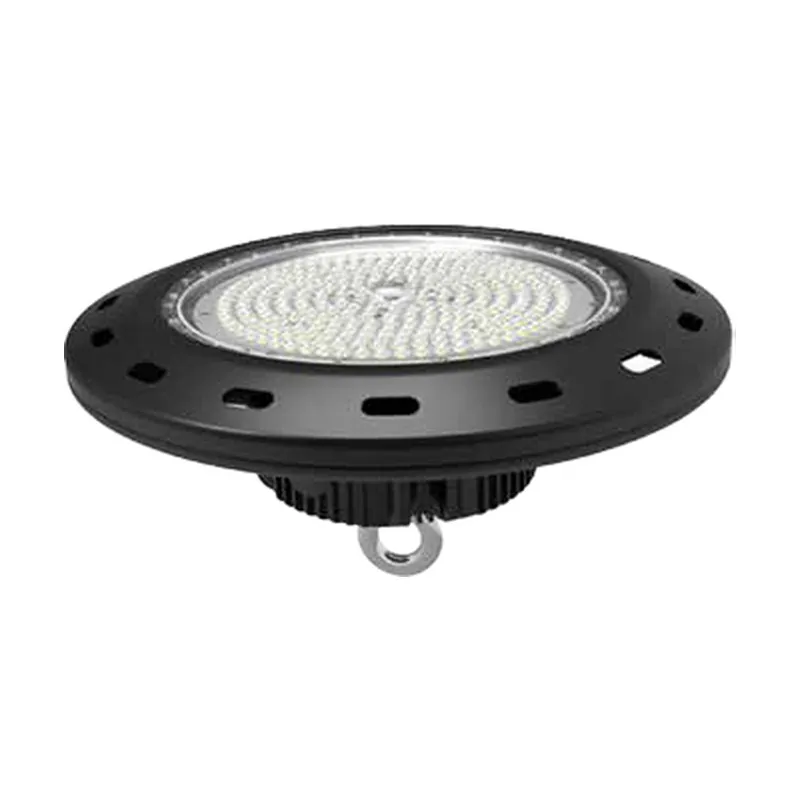
UFO (round) high bays are compact discs or cylinders, typically 100–240 W, with a die-cast or extruded aluminium heat sink on top and a round light pattern. They hang from a hook, chain or bracket, and one fixture replaces one old metal halide lamp.
Linear high bays are long, flat fixtures, typically 0.6–1.2 m, with LED boards along their length. Their light pattern is elongated, which suits aisles and lower ceilings, and they are often mounted in continuous rows.
| UFO / round high bay | Linear high bay | |
|---|---|---|
| Typical power | 100–240 W | 80–300 W |
| Best mounting height | About 6–15 m | About 4–12 m |
| Light pattern | Round | Elongated |
| Racking aisles | With 60° or aisle optics | Very good with aisle lenses |
| Glare at low heights | Higher (concentrated source) | Lower (larger luminous area) |
| Installation | One hook per fixture, fast | Two suspension points, more alignment |
| Replacing metal halide | Direct, one for one | May need a new layout |
Worked example: a 30 × 20 m workshop
A workshop of 30 × 20 m with fixtures at 8 m, work at bench height (0.8 m), target 200 lx for rough industrial work, and 150 W round high bays at 130 lm/W with wide (120°) beams. Our high bay lighting calculator gives:
- Room index 1.67, utilisation factor about 0.59
- 14 fixtures for the light level alone, but the spacing limit of 10.8 m (1.5 × 7.2 m) and the hall’s proportions give a 5 × 3 grid of 15 fixtures at 6.0 × 6.7 m
- About 230 lx average, 3.75 W/m²
- Because spacing sets the count, about 130 W per fixture would already reach 200 lx
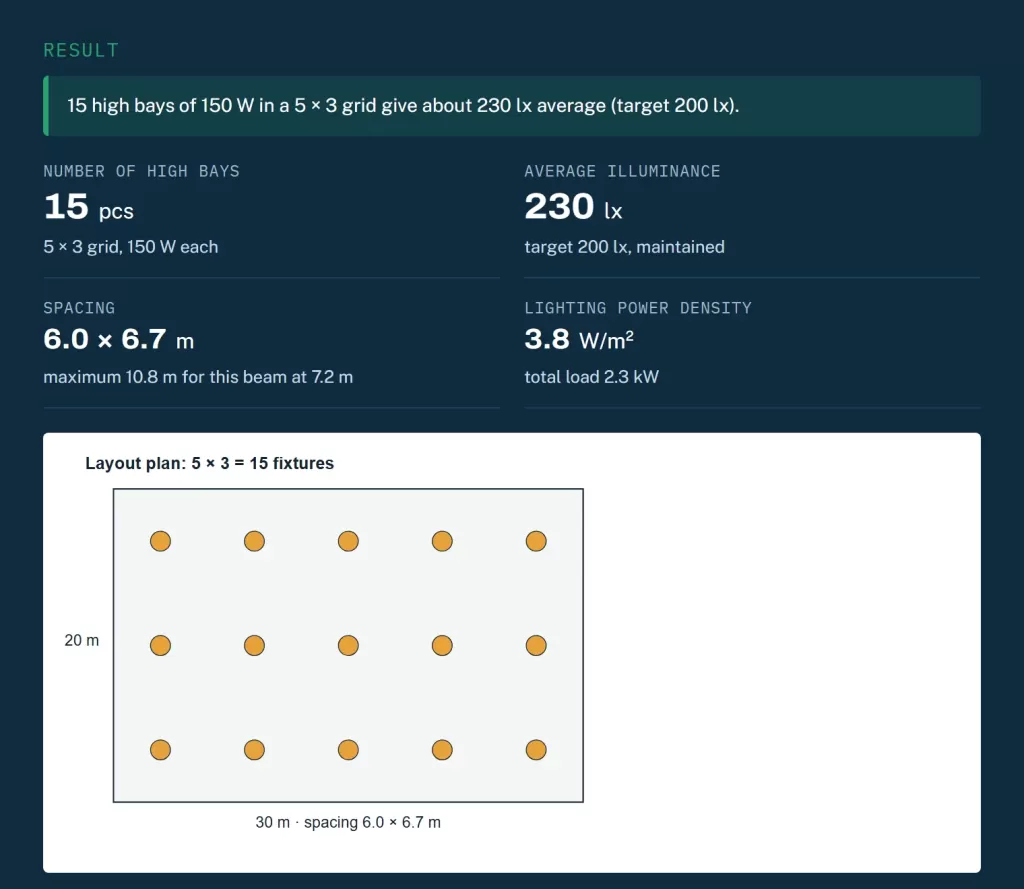
Open this example in the high bay calculator and switch the beam to 90° to see the effect: the spacing limit tightens to 8.6 m and the layout becomes 4 × 4 = 16 fixtures at about 258 lx.
That is the real difference between fixture types in a calculation: not the housing shape, but the beam and the spacing it allows. A wide beam lets fewer fixtures cover the floor evenly at low heights; a narrow beam needs closer spacing but puts more light on the floor from high up.
When to choose UFO
- Open halls, warehouses with low or no racking, workshops and sports halls with mounting heights of about 6–15 m
- One-for-one replacement of round metal halide or HPS high bays on existing hooks
- Dusty or humid areas, where a sealed IP65 round fixture is easy to clean
When to choose linear
- Lower ceilings (4–7 m) where glare and uniformity matter, such as assembly lines and retail warehouses
- Narrow racking aisles, with aisle optics
- Continuous-row layouts that follow conveyors or production lines
Glare: the reason linear fixtures win under low ceilings
A UFO high bay packs 15,000–30,000 lumens into a disc of about 30–40 cm. Seen from below at a shallow angle, that is a very bright spot. Higher up, it is out of the normal field of view and glare is rarely a problem; under a 5 m ceiling, people on a forklift or at a workbench see it all day.
EN 12464-1 limits discomfort glare with the unified glare rating (UGR). Typical limits include about 25 for rough industrial work and storage, 22 for medium assembly work and 19 for fine work and inspection. Ways to meet them:
- Mount higher where the structure allows.
- Use a larger luminous area: linear high bays spread the same lumens over a long lens, lowering luminance.
- Use prismatic or frosted covers and anti-glare reflectors on round fixtures.
- Orient linear fixtures along the main line of sight in aisles, so people look along them rather than across.
The UGR of a real layout comes from a photometric calculation with the luminaire files, so ask for it when glare matters.
Racking aisles
Warehouses with high racking are a separate design problem. The task is not the floor but the vertical faces of the racks, where labels must be read from the top shelf to the bottom. Wide-beam fixtures waste most of their light on rack tops; narrow-beam ones leave the lower shelves dark.
The usual solution is an aisle optic: a lens that throws a long, narrow pattern down the aisle (often described as something like 30° × 90°). Fixtures go in a single row over the centre of each aisle, spaced roughly 1–1.5 × the mounting height. Linear fixtures do this naturally; round fixtures need a dedicated aisle lens. For racking aisles, a lighting calculation with vertical illuminance on the rack faces is essential, because the floor average says little about whether the bottom shelf can be read.
Weight, mounting and maintenance
- UFO fixtures usually hang from a single hook or a U-bracket. Typical weights of 3–8 kg make them quick to install from a lift. Always add a safety cable independent of the hook.
- Linear fixtures need two suspension points and alignment along the row, which takes longer, but rows can be prewired and connected end to end.
- Driver access differs: some round fixtures have the driver integrated in the body, others carry it on top or on the bracket. A separate driver is easier to replace without taking the fixture down.
- Cleaning: round sealed fixtures with open fins shed dust better; flat linear fixtures collect it on top. In dusty plants, check the IP rating and plan cleaning.
Sensors and dimming
Warehouses often have long hours with little activity in most aisles. Occupancy sensors that dim each fixture or aisle to a low background level when nobody is there can save a large share of the energy in low-traffic stores. Both UFO and linear fixtures are available with 1–10 V or DALI dimming and with sensor sockets; specify this at the order stage, because adding sensors later is harder.
When neither: high ceilings and hot halls
Above about 15 m, or under hot roofs in steel mills and foundries, the thermal design and optics matter more than the shape. Heat-pipe high bays move heat from the LEDs to large fin arrays and use faceted reflectors from 25° to 120°. See our high-temperature high bay, rated to 65 °C ambient, and the heat-pipe high bay range.
Checklist
- Target lux by area, from EN 12464-1 or your client’s standard
- Mounting height above the working plane
- Beam angle chosen for the height and any racking
- Spacing within the limit for that beam
- IP rating for dust, humidity and washdown
- Driver quality and surge protection; dimming or sensors if the hall is not always in use
For the full method, see how many LED high bay lights do I need. Our LED high bay range includes UFO, fin and heat-pipe fixtures from 30 W to 1500 W; send us your floor plan and we will propose the type and layout.
Sources
Frequently asked questions
What is the difference between UFO and linear high bay lights?
A UFO high bay is a round, compact fixture with a round light pattern, usually hung from a hook or bracket. A linear high bay is a long, rectangular fixture with an elongated pattern, often used in rows. UFOs are quicker to install and suit open halls; linear fixtures spread light more evenly at lower heights and along aisles.
Which is better for a warehouse with racking?
For high racking, use luminaires with narrow or aisle optics mounted over the centre of each aisle. Linear fixtures with aisle lenses are common; round high bays with 60° reflectors also work well when spaced along the aisle.
At what height should I use UFO high bays?
Typically from about 6 m to 15 m. Below 6 m, wide linear fixtures or low bays usually give better uniformity and less glare; above 15 m, narrow-beam high bays or heat-pipe fixtures are better.