
IP65 vs IP66 vs IP67 for Outdoor Lights (and Why IK Ratings Matter Too)
What IP65, IP66, IP67 and IP68 mean for street lights, floodlights and high bays, which rating each application needs, why IP67 is not always better than IP66, and how IK impact ratings complete the specification.
Key points
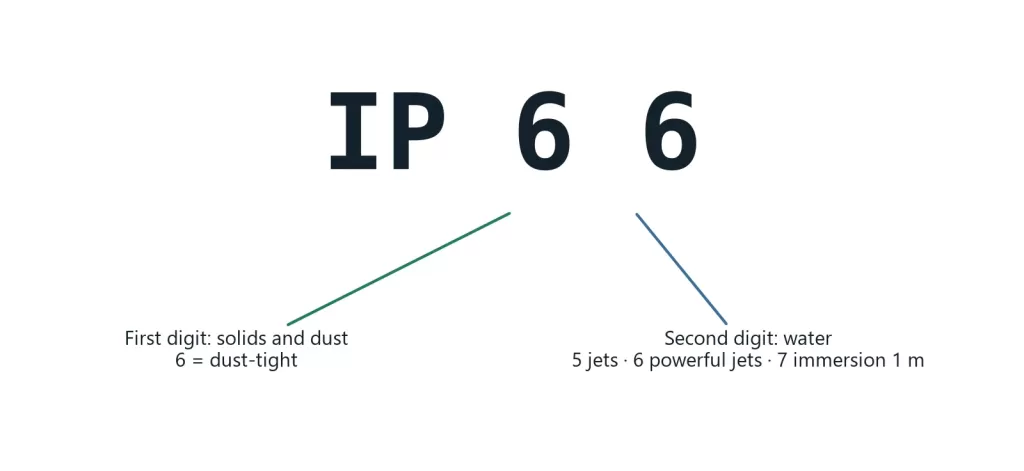
- First digit = dust (6 is dust-tight); second digit = water (5 jets, 6 powerful jets, 7 immersion).
- IP67 does not automatically include IP66: they are different tests. Look for IP66/IP67 when both matter.
- Street lights need IP65–IP66, floodlights and tunnels IP66, in-ground lights IP67, pool lights IP68.
- Add IK impact rating and corrosion protection to the specification.
IP ratings appear on every outdoor luminaire datasheet, and buyers often treat a higher number as automatically better. It is not quite that simple. This guide explains what each rating is tested against and which one each application really needs.
How to read an IP code
The code comes from IEC 60529. The first digit is protection against solids and dust; the second digit is protection against water.
| First digit | Protection against solids |
|---|---|
| 5 | Dust-protected: some dust may enter, but not enough to interfere with operation |
| 6 | Dust-tight: no dust enters |
| Second digit | Protection against water | Test (simplified) |
|---|---|---|
| 4 | Splashing water | Water splashed from all directions |
| 5 | Water jets | 6.3 mm nozzle, about 12.5 litres per minute, from all directions |
| 6 | Powerful water jets | 12.5 mm nozzle, about 100 litres per minute |
| 7 | Temporary immersion | Immersed to 1 m for 30 minutes |
| 8 | Continuous immersion | Conditions agreed by the manufacturer, beyond IPX7 |
So IP65 is dust-tight and protected against water jets; IP66 against powerful jets; IP67 against temporary immersion.
IP66 vs IP67: different tests, not a ladder
IPX7 is tested in still water; IPX6 with powerful jets. A luminaire that survives immersion can still let water in under a high-pressure jet hitting a seal at an angle, and vice versa. Up to IPX6 the ratings are cumulative, but IPX7 and IPX8 do not automatically include IPX5 or IPX6. When both matter, look for a dual marking such as IP66/IP67.
What the laboratory tests actually do
IEC 60529 defines each test, and knowing them helps you judge whether a rating fits your site:
| Rating | Test (simplified) |
|---|---|
| IP5X, dust-protected | Talcum dust circulated in a chamber; some dust may enter, but not enough to interfere with operation |
| IP6X, dust-tight | The same chamber, usually with the enclosure under vacuum, typically for 8 hours; no dust may enter |
| IPX5, water jets | 6.3 mm nozzle, 12.5 litres per minute, from about 3 m, for at least 3 minutes |
| IPX6, powerful jets | 12.5 mm nozzle, 100 litres per minute, from about 3 m, for at least 3 minutes |
| IPX7, temporary immersion | Lowest point 1 m below the surface (top at least 0.15 m down) for 30 minutes |
| IPX8, continuous immersion | Conditions agreed by the manufacturer, more severe than IPX7 |
Two points matter for lighting. First, the tests are short: three minutes of jets, thirty minutes of immersion, on a new sample at room temperature. Real luminaires face years of heating and cooling, UV and vibration, which is why seal materials and breathers (below) matter. Second, IPX6 is a much harsher water test than IPX5: eight times the flow through a twice-as-wide nozzle. For tunnel washing or high-pressure cleaning, IPX5 is not enough.
Which rating for which light?
| Application | Typical rating | Why |
|---|---|---|
| Street lights | IP65–IP66 (optical and driver compartments) | Rain, dust, insects; IP66 for coastal and tropical sites |
| Floodlights, high masts, ports | IP66 | Driving rain, wind, salt spray, pressure cleaning |
| Tunnel lights | IP66 | Tunnel washing with high-pressure jets |
| Solar street lights | IP65 or better | Battery and controller compartment matters most |
| Indoor high bays, dry warehouses | IP20–IP44 | No water exposure |
| High bays in food plants, washdown areas | IP65–IP66 | Cleaning with hoses |
| In-ground uplights | IP67 | Standing water |
| Fountain and pool lights | IP68 | Continuous immersion |
The rating is only as good as the assembly
An IP rating is earned by a sample in a laboratory. On site, three things decide whether water stays out:
- Cable glands of the right size for the cable, tightened properly
- Breathers. Lights heat up at night and cool down in the morning. Without a pressure-equalising breather valve, the cycle pulls moist air past the seals and condensation forms inside the glass. Our heat-pipe high bays and floodlights use breather valves for this reason.
- Gaskets that keep their elasticity: silicone rather than cheap rubber, and not crushed by over-tightening
Condensation or a leak?
Water inside a luminaire is not always a leak. A quick way to tell:
| What you see | Likely cause | Fix |
|---|---|---|
| Fine mist inside the glass in the morning, gone by midday | Condensation from breathing through seals | Breather valve, better gaskets |
| Droplets or pooled water at the lowest point | Leak through a seal, gland or crack | Replace gasket or gland; check cover screws |
| Water inside after cleaning or a storm only | Jets or driving rain beating a seal | Higher water rating (IPX6), better gasket design |
| Rust stains or white residue inside | Long-term moisture, often both causes | Replace the luminaire or the sealed module |
Solar street lights: check every compartment
A solar street light has more enclosures than a grid light: the lamp head, the battery box, the controller and the panel junction box. The LED module may be IP66 while the battery compartment is only IP54, and it is the battery and controller that suffer most from moisture. Ask for the rating of each part, and look for IP67 or IP68 junction boxes on the panel.
IK: protection against impact
IEC 62262 rates impact resistance from IK00 to IK10:
| IK code | Impact energy |
|---|---|
| IK07 | 2 J |
| IK08 | 5 J |
| IK09 | 10 J |
| IK10 | 20 J |
IK08 is a common minimum for street lights. Choose IK09–IK10 for luminaires within reach of people, in sports halls where balls hit the fixtures, or anywhere vandalism is a risk. Tempered glass and polycarbonate covers behave differently: glass resists scratches and UV, polycarbonate resists impact better.
Corrosion: the rating nobody tests on site
Water and dust are only half of the story outdoors. On coastal roads, near chemical plants and in ports, corrosion ends more luminaire lives than water does. Three things to specify:
- Fasteners in stainless steel, at least on the outside of the luminaire. Mixed metals corrode fastest where they touch.
- A salt-spray test on the housing finish, stated in hours. Our heat-pipe floodlights, for example, use hardware that has passed a 500-hour salt spray test.
- Corrosion grade for hazardous and industrial sites. Explosion proof lights are often rated WF1 (outdoor, mildly corrosive) or WF2 (strongly corrosive) under the Chinese standard; ask what the rating is based on.
A powder coat applied over a properly pre-treated die-cast housing, with sealed cable entries, matters as much as the IP number on the label.
How to check a test report
When a supplier sends an IP test report, check:
- Which laboratory issued it, and whether it is independent and accredited
- Which model and compartment were tested: a report for a 60 W sample does not automatically cover the 200 W version with a different housing
- Which ratings were tested: IP66 and IP67 are separate tests, so a dual marking needs both
- The date and the sample: a report from years ago may predate changes to the gasket or gland
What to put in your specification
Write the rating per compartment (optics and driver), require the test report for the rating claimed, and add IK, corrosion protection for coastal or chemical sites, and the operating temperature range. Our LED street lights, floodlights and high bays list the IP rating of each model on its product page, from IP44 for dry indoor high bays to IP67 for modular street and tunnel lights.
Sources
Frequently asked questions
Is IP65 good enough for a street light?
IP65 is the minimum commonly accepted for street lights and works in most climates. IP66 adds protection against powerful water jets, which helps on coastal roads, in tropical downpours and where lights are cleaned with pressure washers.
Is IP67 better than IP66?
Not necessarily. IP67 is tested by temporary immersion in still water; IP66 by powerful water jets. A luminaire can pass one test and fail the other. For lights that will never be submerged, IP66 is often the more relevant test. Some products are tested for both and marked IP66/IP67.
What IP rating does an in-ground uplight need?
At least IP67, because it can sit in standing water after rain. Lights in fountains and pools need IP68, with the depth and duration stated by the manufacturer.
What IK rating should a street light have?
IK08 (5 joules) is a common minimum for street lights out of reach. IK09 or IK10 (10 or 20 joules) is advisable for low-mounted fittings in public places, sports halls where balls hit the luminaires, and areas with vandalism.