
Lighting Market Brief, 26 October 2026: Lithium Nears RMB 100,000, China Module Price Floor Proposed, Freight Rates Rise
Lithium carbonate falls another 6% and 100 Ah LFP cells edge lower, Chinese polysilicon makers propose a module price floor while TOPCon prices hold at US$0.107/W, Drewry's container index rises 2% to US$4,585, Juba starts a solar street lighting project, and Punjab orders 7,968 monitored village solar street lights.
Five things that matter to people who buy road and area lighting this week. Each item covers what happened, why it matters for a lighting project, and where to read more. Sources are listed at the end.
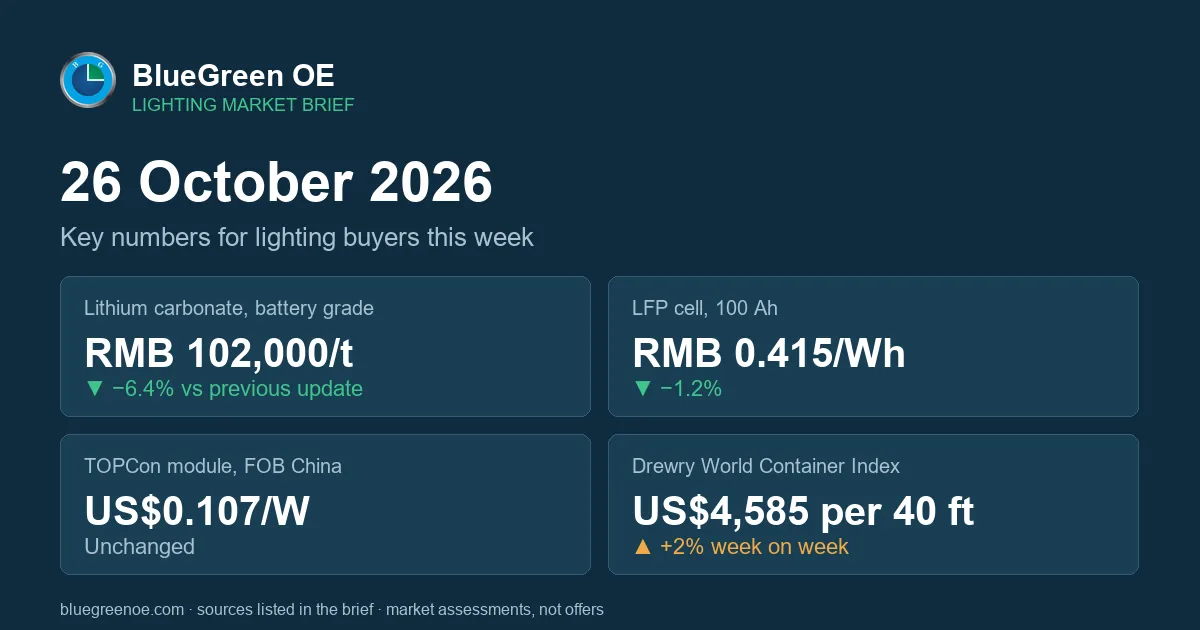
Key numbers this week
| Indicator | Latest | Change | What it affects |
|---|---|---|---|
| Lithium carbonate, battery grade (China, InfoLink) | RMB 102,000/t (21 Oct) | −6.4% vs previous update | Future cell prices |
| LFP cell, 100 Ah (China, InfoLink) | RMB 0.415/Wh (21 Oct) | −1.2% | Battery cost of solar street lights |
| TOPCon module, FOB China (OPIS) | US$0.107/W (20 Oct) | Unchanged, second week | Solar panel cost |
| Drewry World Container Index | US$4,585 per 40 ft (22 Oct) | +2% week on week | Freight cost per shipment |
| LME aluminium, cash | about US$3,040/t (23 Oct) | Little changed in a week | Luminaire housings and heat sinks |
1. Lithium carbonate heads towards RMB 100,000; small LFP cells keep slipping
What happened. InfoLink’s assessment of 21 October put battery-grade lithium carbonate at an average of RMB 102,000 per tonne (range RMB 99,000–105,000), down 6.4% from its 14 October figure of about RMB 109,000. 100 Ah LFP cells averaged RMB 0.415/Wh (−1.2%) and 280 Ah and 314 Ah cells RMB 0.358/Wh (−0.7%). InfoLink links the fall to expected supply recovery, including mine restarts in Jiangxi and higher port inventories, but notes that the decline “has outpaced” the actual weakening of supply and demand. It expects lithium carbonate to settle around RMB 100,000/t and 100 Ah cell prices to stabilise after successive declines.
Sources disagree on the level. TrendForce’s 22 October figure for battery-grade lithium carbonate was about RMB 140,000/t, also down about 6.6%. The direction is the same; the gap is in methodology, so compare like with like when tracking a price over time.
Why it matters. This is the third weekly fall we have reported, and 100 Ah-class cells, the format used in most solar street light batteries, keep taking the largest cuts. If InfoLink’s view holds, the fall in cell prices is slowing, so the gain from waiting for further cuts is getting smaller. Battery quotations made in September are worth refreshing. Use the saving to specify enough storage for the site’s rainy-day autonomy, not to cut the price.
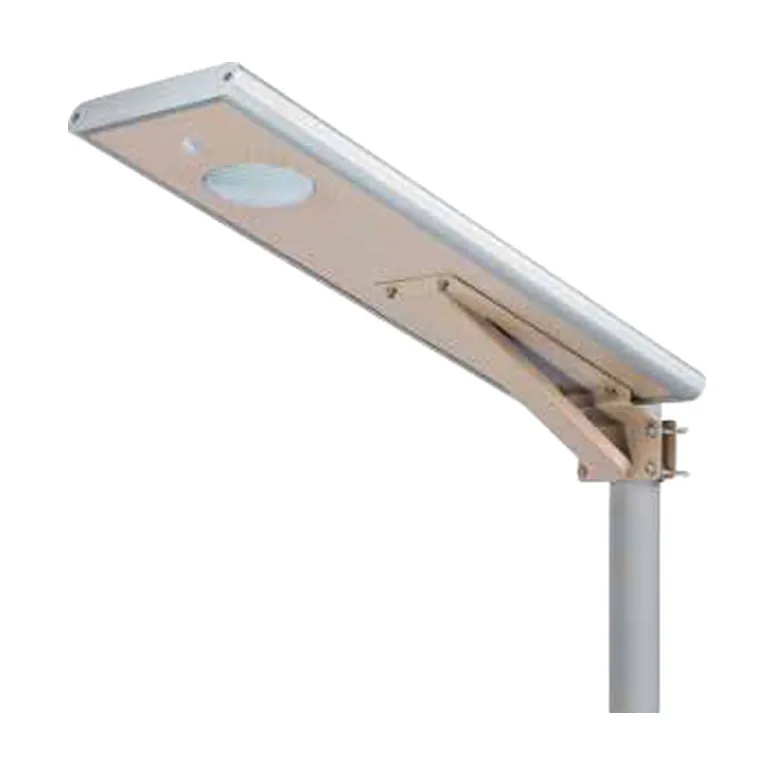
Read more: How to calculate solar street light battery capacity · How many rainy days should a solar street light cover? · Battery autonomy calculator
2. Chinese polysilicon makers propose a module price floor; the market is not following yet
What happened. At a meeting in Hangzhou on 11 October, China’s eight main polysilicon manufacturers discussed minimum prices of CNY 0.79/W for TOPCon modules (about US$0.118/W FOB), CNY 0.86/W for back-contact modules and CNY 43/kg for polysilicon, as reported by pv magazine on 23 October. Actual trade has not moved: OPIS assessed TOPCon modules below 645 W at US$0.107/W FOB China on 20 October, unchanged for a second week. Industry agreements of this kind are not legally enforceable. One tier-1 manufacturer called the plan “one-sided wishful thinking”, and producers quoted in the report expect prices to stay stable or edge lower for the rest of the year as they clear inventory.
Why it matters. The solar panel is the second-largest cost in a solar street light after the battery. For now, panel prices are steady. If the floor does take hold, it would add about 10% to module prices. In a street light with a 100–200 W panel, that is a few US dollars per pole, so it is not a reason to rush a decision. It is a reason to agree how long a quotation’s validity period lasts and to state the panel wattage and cell type on the order.
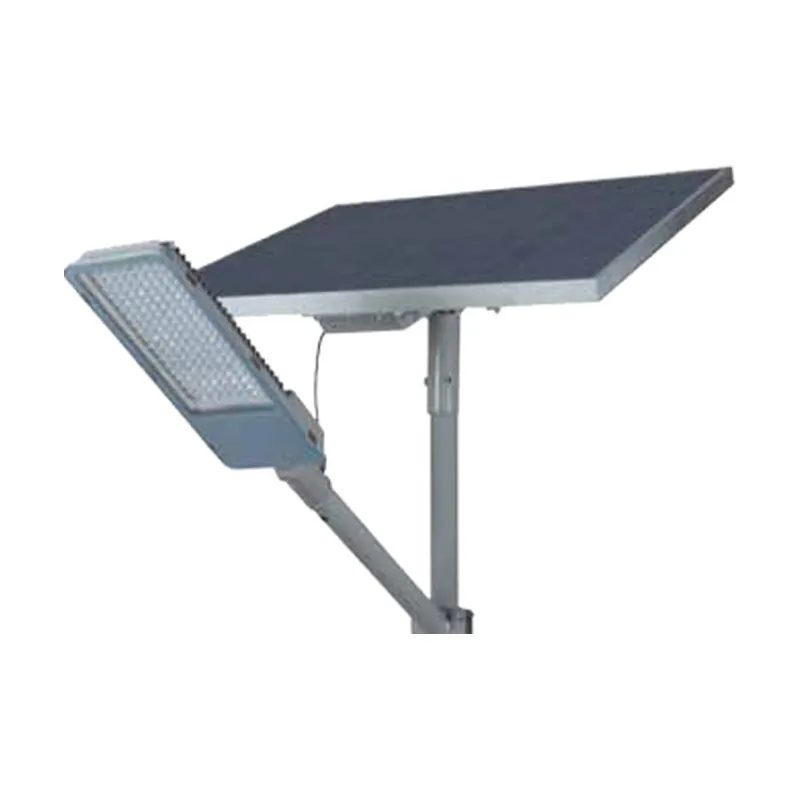
Read more: All-in-one vs split solar street lights · Solar street light calculator · Our solar street lights
3. Container rates rise for a second week
What happened. Drewry’s World Container Index rose 2% to US$4,585 per 40 ft container on 22 October, its second weekly rise in a row and the highest level in 15 weeks. Shanghai–Rotterdam rose 3% to US$3,632 and Shanghai–Genoa 5% to US$4,152. Drewry counted eight blank (cancelled) sailings announced on Asia–Europe for the following week, up from two, and expects Asia–Europe rates to rise slightly amid tight capacity. It expects transpacific rates to stay stable.
Why it matters. Drewry does not publish lanes to Africa, the Gulf or South America in this index, but the main east–west lanes usually set the direction for other routes from China. For lighting orders, freight is a small share of the value of a container of street lights. On large, low-value items such as poles, it is a much larger share. On FOB orders, book space early before the end-of-year peak. On CIF quotations, check how long the freight price is held.
Read more: Our factory and production capacity · Contact us for a CIF quotation
4. Juba starts a solar street lighting project, with a US$5,000 fine for damaging poles
What happened. On 20 October, Juba County in South Sudan’s Central Equatoria State broke ground on a solar street lighting project along Bilpam Road, carried out by Light House General Trading and Investment Co. Ltd. The county commissioner said the aim is better road safety and security and that lighting will be extended to other county roads. He warned that anyone who damages or knocks down a pole faces a US$5,000 fine and three months’ imprisonment. The reports do not give the number of lights, the road length, the cost or maintenance arrangements.
Why it matters. The size of the penalty shows how seriously local authorities treat vandalism and vehicle damage. In projects like this, poles and fittings are at risk, not only cables. For buyers in similar settings, the practical measures are tamper-resistant fasteners, batteries mounted high or inside an all-in-one housing, a sensible pole setback from the carriageway, and a stock of spare heads and poles agreed at tender stage. It also helps to write the maintenance responsibility into the contract, which these reports leave out.
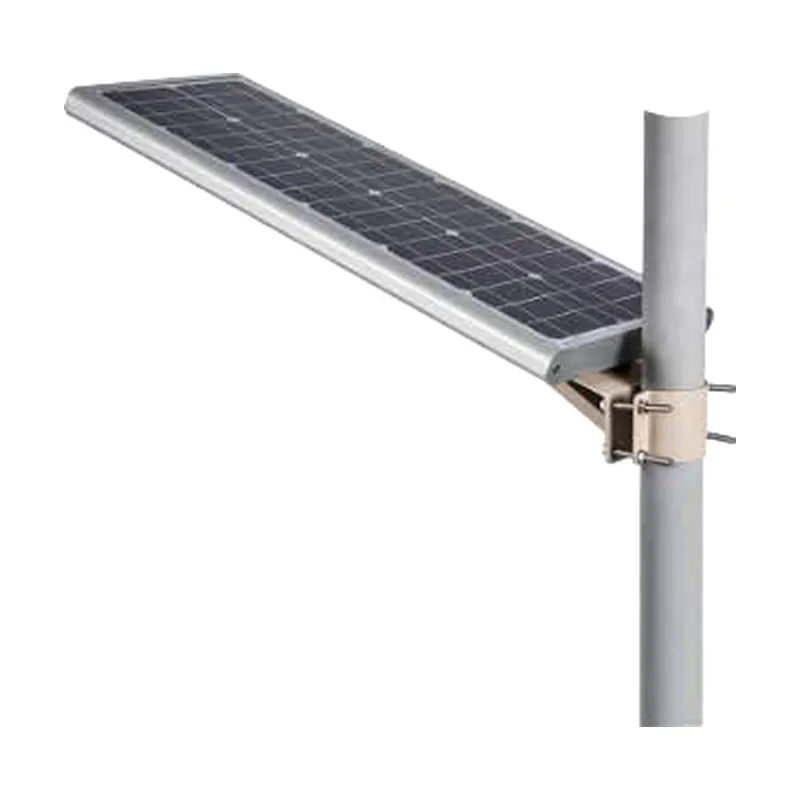
Read more: Solar street light pole height and spacing · Solar street lights in Nigeria: buyer’s notes · Brief of 12 October: cable theft and solar
5. Punjab orders 7,968 village solar street lights with remote monitoring
What happened. The Punjab Energy Development Agency (PEDA) has awarded KLK Ventures a work order to design, supply, install and commission 7,968 solar street lighting systems across Gram Panchayats (village councils) in Punjab, India, according to reports on 21–22 October. The systems use 12 W LED lights with remote monitoring and geo-tagging; 7,003 come with poles and 965 without, and the order includes a five-year comprehensive warranty and annual maintenance. Reports describe it as part of a wider need for about 50,000 solar street lights in Punjab’s villages.
Why it matters. Two details are worth copying into rural tenders elsewhere. The wattage is deliberately modest: 12 W is enough for village lanes, and every watt saved shrinks the battery and panel. And even low-cost village lights are now expected to report their status remotely and be located on a map, so failed units can be found and fixed under the warranty.
Read more: All-in-one vs split solar street lights · Solar street light calculator · Our solar street lights
The market brief is compiled by the BlueGreen OE engineering team from the public sources listed below. Prices are market assessments, not offers. Send us your project details for a current quotation.
Sources
- InfoLink — Lithium salt prices continue to decline; cell prices edge lower and ESS prices hold steady (21 Oct 2026)
- TrendForce — Li-ion battery price trends (updated 22 Oct 2026)
- pv magazine USA — China solar module prices steady as proposed price floors meet skepticism (23 Oct 2026)
- Drewry — World Container Index (22 Oct 2026)
- Eye Radio — Juba county launches solar street lighting project along Bilpam Road (20 Oct 2026)
- One Citizen Daily — Juba County launches solar street lighting along Bilpam road (21 Oct 2026)
- Discovery Alert — Aluminium price outlook, LME stocks, October 2026
- Energetica India — KLK Ventures secures PEDA order for 7,968 solar street lights (21 Oct 2026)
Frequently asked questions
What is the price of lithium carbonate and LFP cells in late October 2026?
InfoLink's 21 October 2026 assessment put battery-grade lithium carbonate at about RMB 102,000/t, down 6.4% from its previous update, with 100 Ah LFP cells at about RMB 0.415/Wh (−1.2%) and 280/314 Ah cells at about RMB 0.358/Wh (−0.7%). TrendForce's 22 October figure for lithium carbonate was higher, about RMB 140,000/t, but also down about 6.6%, so the two assessments differ in level but agree on direction.
Are solar panel prices going up in late 2026?
Not so far. OPIS assessed TOPCon modules at US$0.107/W FOB China on 20 October 2026, unchanged for a second week. China's main polysilicon producers proposed a floor of CNY 0.79/W (about US$0.118/W) for TOPCon modules, roughly 10% above current trade, but industry agreements are not legally binding and manufacturers quoted by pv magazine expect prices to stay flat or edge lower to the end of the year.