
Solar Street Lights with Motion Sensors: How They Work and How Much They Save
How motion (PIR and microwave) sensors work on solar street lights, how much battery they save, where they make sense and where they do not, with a battery autonomy example and recommended settings.
Key points
- A motion sensor keeps the light at a low level and raises it when someone approaches; on quiet roads it cuts nightly energy substantially.
- In our example, a profile that averages 20% after midnight instead of 30% cuts nightly energy from 316 to 249 Wh and extends rainy-day autonomy from 4.5 to 6.0 days with the same battery.
- Motion dimming suits paths, estates, car parks and rural roads; on busy roads or where a lighting class must be met at all times, use a fixed schedule.
- Specify the sensor type, detection range, standby level, boost level and hold time.
A solar street light spends most of the night lighting an empty road. A motion sensor changes that: the light idles at a low level and brightens only when a person or vehicle approaches. Because every watt-hour saved at night is a watt-hour the battery does not need to store, motion sensing is one of the cheapest ways to make a solar light last longer in bad weather. This guide explains how it works and puts numbers on the savings.
How it works
- Standby. After dusk the controller runs the LED at a programmed level, often 100% for the first hours of the evening and 10–30% after that.
- Detection. A sensor under the housing watches the road. When it sees movement, it signals the controller.
- Boost. The controller raises the output, typically to 100%, for a hold time of 15–60 seconds, extended while movement continues.
- Return. With no further movement, the light fades back to standby.
Sensor types
| PIR (passive infrared) | Microwave (radar) | |
|---|---|---|
| Detects | Changes in heat (people, vehicles) | Any movement that reflects the signal |
| Typical range | 5–10 m below a 3–6 m pole | 8–15 m |
| Hot climates | Range drops when air is near body temperature | Unaffected |
| False triggers | Few | Branches, rain, traffic outside the road |
| Own consumption | Very low | Low |
For most solar street lights on 4–8 m poles, a PIR sensor is the simple choice; microwave sensors suit higher poles and very hot climates, if the area around the pole is clear.
How much does it save?
Savings depend on how busy the road is. On a quiet estate road, the light spends most of the night at standby; on a busy road, it is boosted most of the time and the saving disappears.
We compared two profiles for a 40 W light in our battery autonomy calculator, with a 100 Ah 12.8 V LiFePO4 battery, a 120 Wp panel, 4.5 sun hours and a 4-day rainy spell:
| Profile | Equivalent night | Energy per night | Rainy days covered | Recovery after spell |
|---|---|---|---|---|
| Fixed schedule: 5 h at 100%, 7 h at 30% | 7.1 h at full power | 316 Wh | 4.5 days | about 14 sunny days |
| Motion: 4 h at 100%, then standby with boosts averaging 20% for 8 h | 5.6 h at full power | 249 Wh | 6.0 days | about 6 sunny days |
The motion profile cuts the nightly energy by about a fifth. With the same battery and panel, the light lasts one and a half days longer in a storm and recovers more than twice as fast. Alternatively, you can keep the autonomy and fit a smaller battery and panel.
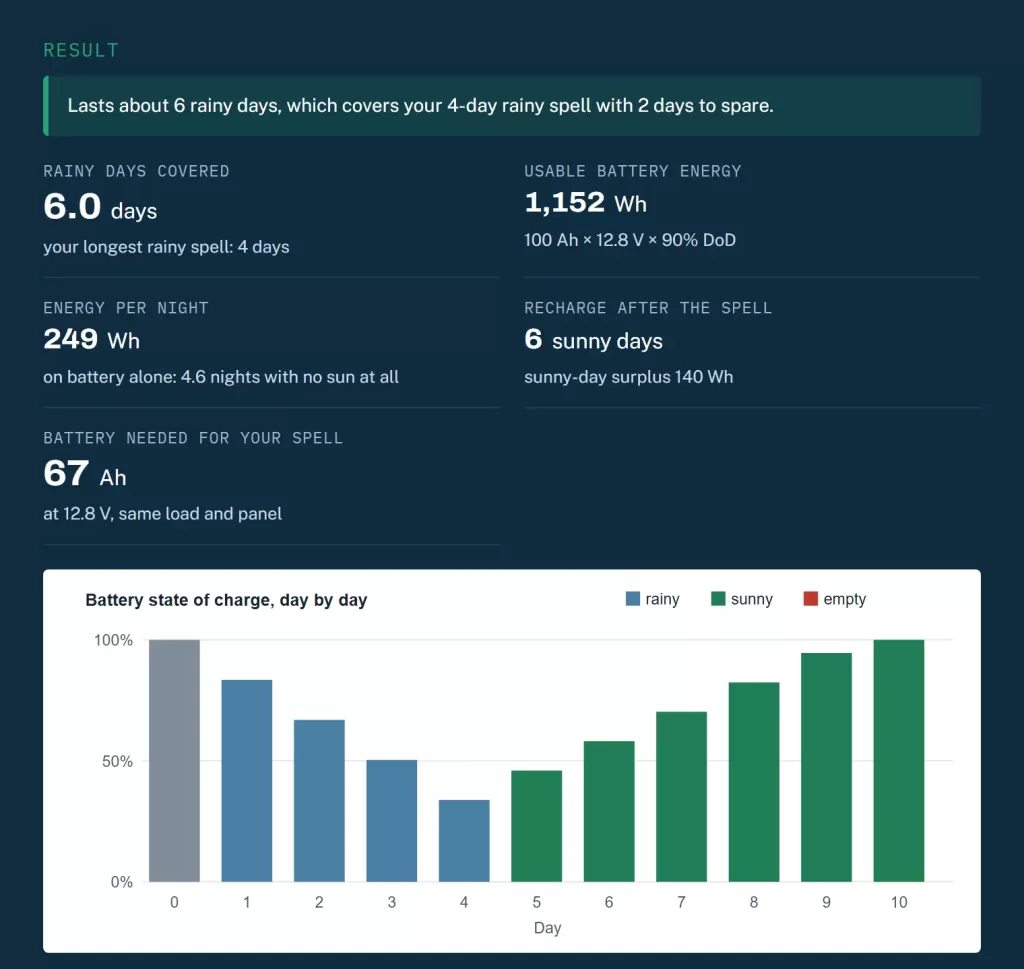
Open this example and set the dimmed level to the average you expect on your road. A 20% average assumes a quiet road; if people pass every few minutes all night, use 40–50%.
How busy is “quiet”? Estimating the boost share
The saving depends on how often the light is boosted. You can estimate it from the traffic after midnight and the hold time:
Boost share = passes per hour × hold time ÷ 3,600 s
Average output = standby + (100% − standby) × boost share
With a 20% standby level and a 30-second hold:
| Passes per hour after midnight | Boost share | Average output | Comment |
|---|---|---|---|
| 0 | 0% | 20% | Empty car park or path |
| 5 | 4% | 23% | Quiet estate road |
| 20 | 17% | 33% | Busy estate road, village centre |
| 60 | 50% | 60% | Steady traffic: the saving mostly disappears |
| 120 or more | 100% | 100% | Busy road: use a fixed schedule instead |
Passes that overlap (two cars a few seconds apart) boost the light only once, so real shares are a little lower than the formula, but it is a safe planning figure. If you do not know the traffic, a short count on site between midnight and 2 a.m. is worth more than any assumption.
Detection geometry
A sensor on a pole sees a cone below it. As a rough guide, a PIR sensor at 4–6 m covers a circle of about 8–12 m diameter on the ground; a microwave sensor covers more, often 12–16 m, and sees through thin plastic covers. Points to check:
- Aim and position: the sensor should look at the road or path, not at a neighbouring busy road, swaying trees or a car park entrance.
- Spacing vs. detection: if poles are 25 m apart and each sensor covers only 10 m, a pedestrian walks in standby light between poles. Some systems link neighbouring lights so that a detection boosts the next two or three poles ahead; ask whether yours can.
- Mounting height: PIR range falls as the sensor goes higher, so very tall poles favour microwave.
- Fade times: a smooth ramp of 1–3 seconds up and longer down avoids the “flash” effect and is more comfortable for drivers and residents.
Troubleshooting
| Symptom | Likely cause | What to do |
|---|---|---|
| Light stays bright all night | Microwave sensor sees passing traffic, branches or rain | Reduce sensitivity, re-aim, or switch to PIR |
| Light never boosts on hot nights | PIR range falls when the air is near body temperature | Use microwave, or raise the standby level |
| Battery empties despite the sensor | More traffic than planned, so the boost share is high | Lower boost level, shorten hold time, or resize the system |
| Boost comes too late for drivers | Detection zone too small for vehicle speed | Use linked poles or a longer range sensor |
Where motion sensors make sense
- Estate roads, paths and parks, where few people pass after midnight
- Car parks and loading areas that are empty most of the night
- Rural roads between villages
- Perimeter and security lighting, where a sudden increase in light also deters intruders
Where they do not
- Busy roads, where the light would be boosted most of the time
- Roads with a required lighting class, unless the standby level itself meets the class
- Places where sudden changes in brightness are unwelcome, such as junctions where drivers need steady light
Settings to specify
- Sensor type (PIR or microwave) and detection range at your mounting height
- Standby level after the evening period, for example 20–30%
- Boost level, usually 100%
- Hold time, for example 30 seconds
- Time of the switch from evening level to standby, for example midnight or 5 hours after dusk
- Low-battery behaviour: the controller should reduce both standby and boost levels when the battery runs low
The settings should be adjustable on site, by remote control or app, so they can be tuned after installation.
Sizing with motion dimming
Use the equivalent full-power hours from your profile when sizing the battery and panel in the solar street light calculator. Be conservative: assume more traffic than you expect, because a light that is boosted more than planned will drain its battery in the first rainy week. For the full method, see how many rainy days a solar street light can last.
Our all-in-one solar street lights combine light control with motion sensing. Tell us how busy the road is and we will set the profile and size the system.
Sources
Frequently asked questions
How does a motion sensor on a solar street light work?
The light runs at a low standby level, typically 10–30%. When the sensor detects movement within its range, the controller raises the output to full or near-full brightness for a set hold time, usually 15–60 seconds, then returns to standby.
PIR or microwave sensor: which is better for solar street lights?
PIR (passive infrared) sensors detect body heat, use very little power and are not triggered by rain or swaying branches as easily, but their range drops in hot weather. Microwave (radar) sensors have a longer range and work in any temperature but can be triggered by moving branches or traffic outside the road.
Can motion sensors be used on public roads?
On roads that must meet a lighting class at all times, the standby level must still meet the class, so the savings are smaller. Motion dimming is most useful on paths, estates, car parks and low-traffic rural roads.