
How Many Watts Does an LED Street Light Need? 50 W, 100 W, 150 W or 200 W
How to choose LED street light wattage from road width, pole height and lighting class, with worked examples for 6, 7, 10 and 14 m roads, a quick wattage table, and why lumens matter more than watts.
Key points
- Wattage follows from road width, pole height and the lighting class, not from the old lamp.
- As a guide: 30–60 W for lanes on 6–8 m poles, 60–120 W for two-lane roads on 8–10 m, 120–250 W for arterials on 10–12 m, 200 W and up for wide highways.
- Compare lumens and efficacy, not watts: a 100 W light at 130 lm/W gives 30% more light than one at 100 lm/W.
- Spacing is often limited by uniformity (about 3.5 × pole height), so a lower wattage at the same spacing can be enough.
“What wattage do we need?” is usually the first question in a street lighting inquiry, and the honest answer is: it depends on three numbers you already know. The width of the road, the height of the poles, and the lighting class your road owner requires. This guide turns those three numbers into a wattage, with worked examples you can check yourself.
Start from lumens, not watts
A watt measures power drawn, not light delivered. What lights the road is the luminaire’s lumen output, which is wattage × efficacy:
| Luminaire | Efficacy | Lumens |
|---|---|---|
| 100 W, older LED design | 100 lm/W | 10,000 lm |
| 100 W, modern LED design | 130 lm/W | 13,000 lm |
| 80 W, modern LED design | 130 lm/W | 10,400 lm |
So an 80 W light at 130 lm/W does the same job as a 100 W light at 100 lm/W. When you compare quotes, ask for the measured luminaire lumens (from an integrating-sphere report, not the LED chip rating) and compare those.
The three inputs
- Road width (W). The light has to cover it. Wider roads need more lumens per metre of road, or poles on both sides.
- Mounting height (H). Higher poles spread the light further, so they can be spaced further apart, but each luminaire then needs more lumens.
- Lighting class. EN 13201 classes set the target: about 7.5 lx for a minor road (M5), 15 lx for an urban arterial (M3), 22 lx for a main road (M2), 30 lx for a motorway (M1). Residential P classes run from 2 to 15 lx. See our guide to road lighting classes.
Four worked examples
We ran four typical roads through our free pole height and spacing calculator, assuming LED street lights at 130 lm/W and a maintenance factor of 0.8:
| Road | Pole height | Class (target) | Luminaire | Layout | Spacing | Average on the road |
|---|---|---|---|---|---|---|
| 6 m residential road | 8 m | M5 (7.5 lx) | 60 W | Single-sided | 28 m | 16.6 lx |
| 7 m two-lane road | 10 m | M3 (15 lx) | 100 W | Single-sided | 35 m | 18.3 lx |
| 10 m urban road | 10 m | M3 (15 lx) | 120 W | Single-sided | 35 m | 18.1 lx |
| 14 m four-lane road | 12 m | M2 (22 lx) | 200 W | Staggered | 42 m | 27.6 lx |
Two things stand out. First, in all four cases the spacing is limited by uniformity (3.5 × the pole height), not by light output: the poles cannot go further apart without dark patches between them, even though the luminaires could light a longer stretch. Second, that means the wattage in each row is more than the class needs. The calculator works out what would be enough at the same spacing: about 30 W for the residential road, about 82 W for the two-lane road, about 100 W for the 10 m road and about 160 W for the four-lane road.
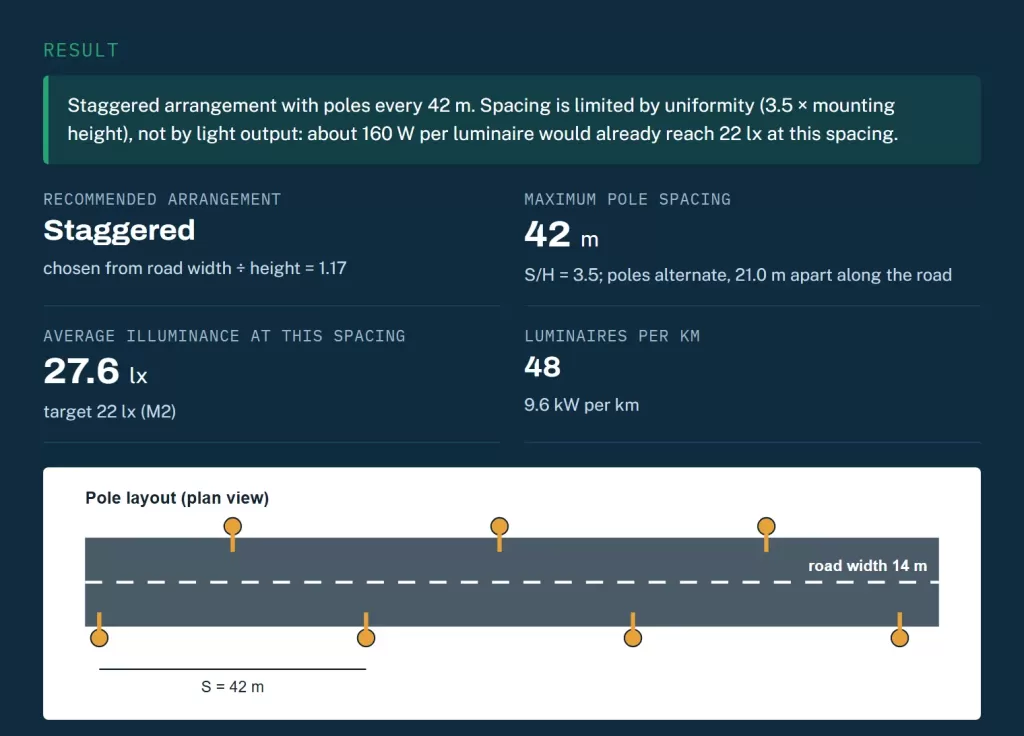
Open this example in the pole spacing calculator and change the wattage to see where the average drops below the target.
What the extra watts cost per kilometre
Choosing the “enough” wattage rather than a round catalogue number looks like a small saving per light, but street lights burn about 4,400 hours a year. Per kilometre of road, at 12 hours a night and US$0.15/kWh:
| Road | Lights per km | Energy at the wattage above | Energy at “enough” wattage | Saving per km per year |
|---|---|---|---|---|
| 6 m residential (60 W vs 30 W) | 36 | 9,461 kWh | 4,730 kWh | about US$710 |
| 7 m two-lane (100 W vs 82 W) | 29 | 12,702 kWh | 10,416 kWh | about US$343 |
| 10 m urban (120 W vs 100 W) | 29 | 15,242 kWh | 12,702 kWh | about US$381 |
| 14 m four-lane (200 W vs 160 W) | 48 | 42,048 kWh | 33,638 kWh | about US$1,261 |
Over 15 years and a network of tens of kilometres, that is a real budget line. In practice you would not choose exactly 82 W; you would pick the nearest available power and keep a margin for ageing (see below). Modular luminaires and programmable drivers make it easy to set the output to what the road needs rather than to a catalogue step.
Optics: putting the lumens on the road
Two luminaires with the same lumens can light the same road very differently. The light distribution decides how much of the output lands on the carriageway rather than the verge, the houses or the sky:
- Type II (in the IES classification): a fairly narrow, long distribution for narrow roads and paths, with poles at the roadside.
- Type III: a wider throw across the road, the most common choice for two-lane and urban roads lit from one side.
- Type IV: a forward throw for wide roads and areas lit from the edge, such as car parks.
A good road optic also controls glare (the threshold increment in EN 13201) and keeps uniformity high at wide spacing. That is why a well-designed 80 W luminaire can outperform a cheap 120 W one: it wastes less. Ask for the IES or LDT photometric file and have the road calculated with it.
Colour temperature, ageing and the maintenance factor
Colour temperature. Warm-white LEDs (3000 K) are slightly less efficient than neutral white (4000 K), typically by 5–10%. Many cities now specify 3000 K or lower for residential roads to reduce glare and sky glow, so allow a little more wattage for the same lumens.
Ageing. LEDs slowly lose output. A specification such as L80 at 60,000 hours means that at least 80% of the initial lumens remain after 60,000 hours. The maintenance factor (MF) in a lighting calculation accounts for this and for dirt on the cover; 0.8 is a common value for sealed LED street lights in normal environments, lower in dusty or polluted areas.
Constant light output (CLO). Some drivers start at a reduced current and raise it gradually over the years, so the light stays at the design level and the early-life energy is saved. It is a neat way to avoid over-lighting a new installation.
Quick wattage table
For budgets and first quotes, this table gives typical ranges for modern LED street lights at 120–140 lm/W:
| Road | Typical width | Pole height | LED power |
|---|---|---|---|
| Paths, lanes, compounds | 3–6 m | 4–6 m | 20–40 W |
| Residential streets | 5–7 m | 6–8 m | 30–60 W |
| Collector roads | 7–10 m | 8–10 m | 60–120 W |
| Urban arterials | 10–15 m | 10–12 m | 120–250 W |
| Highways and expressways | 2 × 7.5–11 m | 12–14 m | 200–350 W |
The final value comes from a photometric calculation with the luminaire’s IES file, which checks uniformity and glare as well as the average.
Why not just buy the biggest wattage?
Over-lighting costs money three times: a higher price per luminaire, more electricity every night for 15 years or more, and, for solar projects, a bigger panel and battery. It also increases glare and light spill into houses. The right approach is to pick the lowest wattage that meets the class at the spacing the poles allow, then add a small margin for lumen depreciation.
Replacing old lamps
If you are retrofitting, the old lamp wattage is a useful sanity check but not the answer. A 250 W high-pressure sodium lamp draws about 290 W with its ballast; it is usually replaced by 100–120 W of LED. Our HPS to LED conversion chart gives the equivalents for 70–1000 W lamps, and the LED retrofit calculator shows the payback.
Choosing a luminaire that can follow the calculation
A modular street light makes wattage selection easy, because one housing covers a wide range: our LDM30C modular LED street light runs from 30 W to 350 W in seven housing sizes, so a project with several road types can use one fitting throughout. For solar roads, see our guide to solar street light pole height and spacing.
Send us your road widths, pole heights and the class from your tender. We will return the wattage for each road with a photometric layout.
Sources
Frequently asked questions
What wattage LED street light do I need for a residential street?
Usually 30–60 W on 6–8 m poles. A 6 m wide residential road with 8 m poles needs only about 30 W at 130 lm/W to reach class M5 (about 7.5 lx) at 28 m spacing; 40–60 W gives margin and allows wider spacing or a higher class.
Is a 100 W LED street light enough for a main road?
For a two-lane road (7 m) on 10 m poles, yes: 100 W at 130 lm/W gives about 18 lx average at 35 m spacing, above the 15 lx of class M3. Wider roads and higher classes need 150–250 W, often with poles on both sides.
How many lumens does a street light need?
Roughly 4,000–8,000 lm for residential streets, 8,000–15,000 lm for collector roads and two-lane urban roads, and 15,000–30,000 lm or more for arterials and highways. Multiply the luminaire's efficacy by its wattage to get its lumens.