
LED High Bay Lights for Pole Barns and Workshops: How Many, Which Watts, Where to Hang Them
How to light a pole barn, machine shed or farm workshop with LED high bays: lux levels, mounting height, how many fixtures, wattage, dust and moisture protection, with a 12 × 24 m barn worked through in our calculator.
Key points
- Most pole barns need 100–200 lx for storage and general work, 300 lx or more at a workbench.
- At 4–6 m eaves height, spacing (not light output) usually decides the number of fixtures: wide 120° beams keep the count down.
- In a 12 × 24 m barn at 5 m, a 5 × 3 grid of 100 W fixtures gives about 280 lx; 70 W fixtures in a 6 × 3 grid give about 240 lx with less power.
- Choose IP65 sealed fixtures for dusty or damp barns and keep them clear of livestock ammonia where possible.
A pole barn or machine shed is one of the simplest buildings to light, and one of the easiest to get wrong. Its eaves are low compared with a factory, the floor is open, and the uses range from parking tractors to welding. The usual mistake is to hang a few very bright fixtures, which gives glaring pools of light and dark corners. This guide shows how to choose the number, wattage and position of high bays, with a real example.
How much light?
| Use | Typical target |
|---|---|
| Storage, equipment parking | 100–150 lx |
| General work, loading | 200 lx |
| Workshop, maintenance, assembly | 300 lx |
| Bench work, welding, fine repairs | 500 lx at the bench (task light) |
Most farm and hobby barns aim for about 200 lx overall, with extra task lighting at the bench.
Mounting height and spacing
Pole barns usually have eaves of 4–6 m. At that height the decisive rule is spacing: for even light, keep fixtures no more than about 1.5 × the mounting height above the floor or bench apart with wide 120° beams, 1.2 × with 90° beams. A 5 m mounting height over a 0.8 m bench gives 4.2 m, so wide-beam fixtures can be up to about 6.3 m apart.
Worked example: a 12 × 24 m barn
A 12 × 24 m (about 40 × 80 ft) barn with fixtures at 5 m, target 200 lx, wide 120° beams. We started with 100 W high bays at 110 lm/W in our high bay lighting calculator:
- 11 fixtures would be enough for 200 lx on light output alone
- The spacing limit (6.3 m) and the barn’s shape give a 5 × 3 grid of 15 fixtures at 4.8 × 4.0 m
- Result: about 280 lx average, 5.2 W/m², 1.5 kW in total
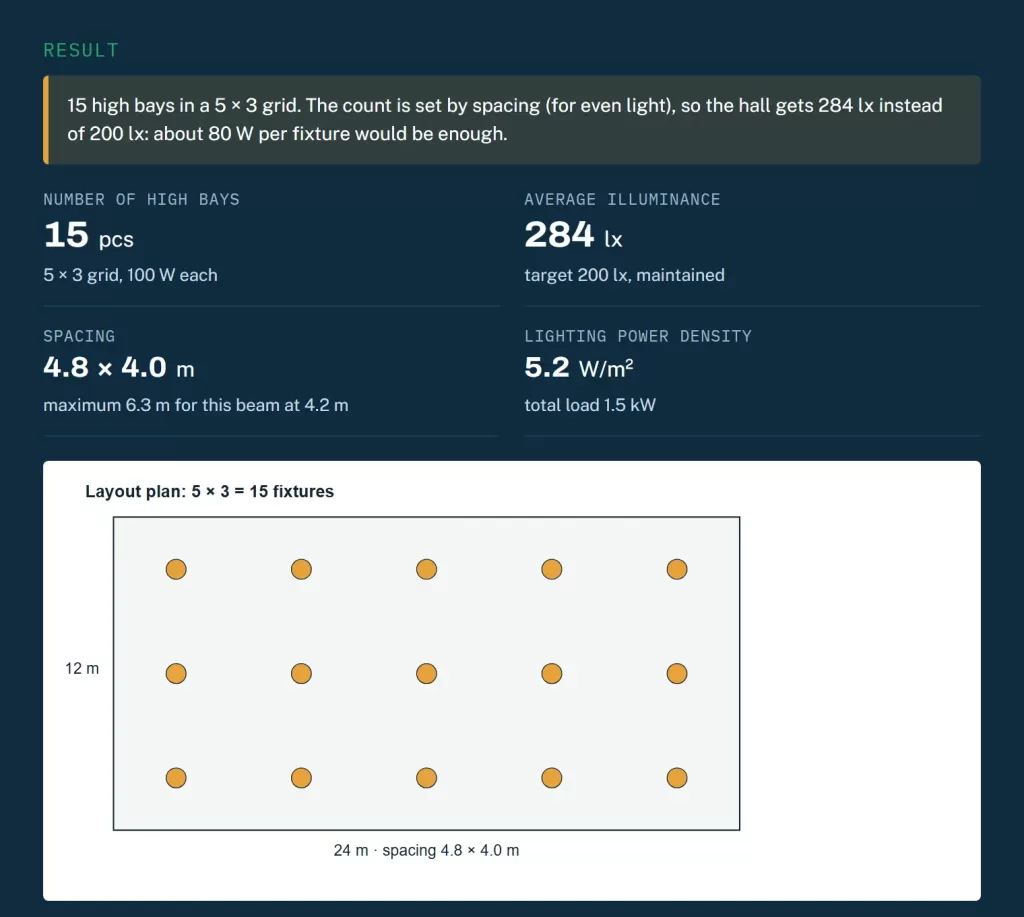
Because spacing set the count, the calculator suggests about 70 W per fixture would be enough. Running it again with 70 W fixtures gives a 6 × 3 grid of 18 fixtures at about 240 lx and 4.4 W/m²: more fixtures, evener light and about 15% less power.
Open this example in the calculator and change the wattage and beam to compare.
Layouts for common barn sizes
The same method for other common sizes, with wide-beam fixtures at 110 lm/W, a 0.8 m bench height and a 200 lx target (results from the high bay calculator, rounded):
| Barn | Mounting height | With 70 W fixtures | With 100 W fixtures |
|---|---|---|---|
| 30 × 40 ft (9.1 × 12.2 m) | 4.5 m | 9 (3 × 3), about 280 lx | 6 (3 × 2), about 265 lx |
| 40 × 60 ft (12.2 × 18.3 m) | 5 m | 16 (4 × 4), about 265 lx | 12 (4 × 3), about 285 lx |
| 40 × 80 ft (12.2 × 24.4 m) | 5 m | 18 (6 × 3), about 230 lx | 15 (5 × 3), about 275 lx |
| 60 × 100 ft (18.3 × 30.5 m) | 5.5 m | 28 (7 × 4), about 205 lx | 24 (6 × 4), about 250 lx |
In small barns the spacing rule, not the light level, sets the count, so 70 W fixtures give evener light at about the same total power. In larger barns the light level starts to matter and the 100 W layout gives more margin.
Foot-candles and lumens per square foot
US buyers often think in foot-candles (fc). One foot-candle is 10.76 lux, so:
- 100 lx ≈ 9 fc, 200 lx ≈ 19 fc, 300 lx ≈ 28 fc, 500 lx ≈ 46 fc
A quick cross-check is lumens per square foot of floor. The 40 × 80 ft example with 15 × 100 W fixtures at 110 lm/W delivers about 165,000 lm over 3,100 sq ft, or about 53 lm/ft²; the 70 W layout gives about 45 lm/ft². For general work at about 20 fc in a barn with average surfaces, 40–55 lm/ft² is a sensible range; workshops at 30 fc need roughly half as much again.
Cold, damp and unheated barns
Unlike metal halide, LEDs start instantly at full output in the cold and actually run more efficiently at low temperatures. Check two things for an unheated barn in a cold climate:
- Driver temperature rating: look for operation down to about −30 °C or lower if winters are severe.
- Condensation: a barn that warms up quickly on winter mornings can form condensation inside poorly sealed fixtures. IP65 fixtures with breather valves handle this better than open ones.
Running cost compared with metal halide
Many older barns have a few 400 W metal halide fixtures. Replacing eight of them (about 448 W each with the ballast) with the 18 × 70 W LED layout above, at 4 hours a day:
- Metal halide: about 5,230 kWh a year
- LED: about 1,840 kWh a year
- Saving about 3,400 kWh, roughly US$500 a year at US$0.15/kWh, with more and evener light, no warm-up time and no relamping
Try your own fixtures and hours in the LED retrofit savings calculator.
Which fixture?
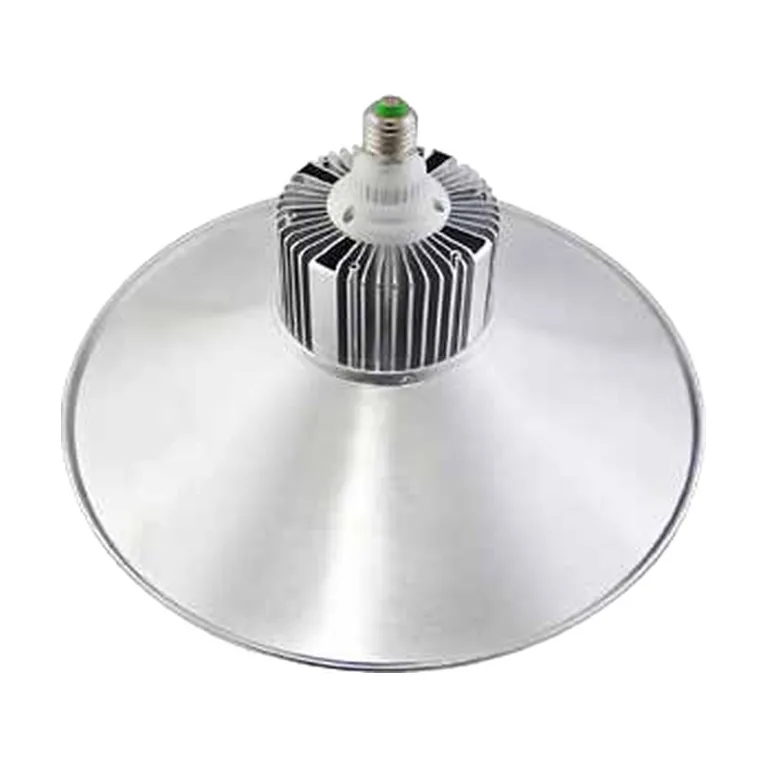
- Dry, enclosed workshop: a light aluminium high bay with an IP44 rating is enough, for example our economy high bay (30–100 W) or fin high bay (60–250 W).
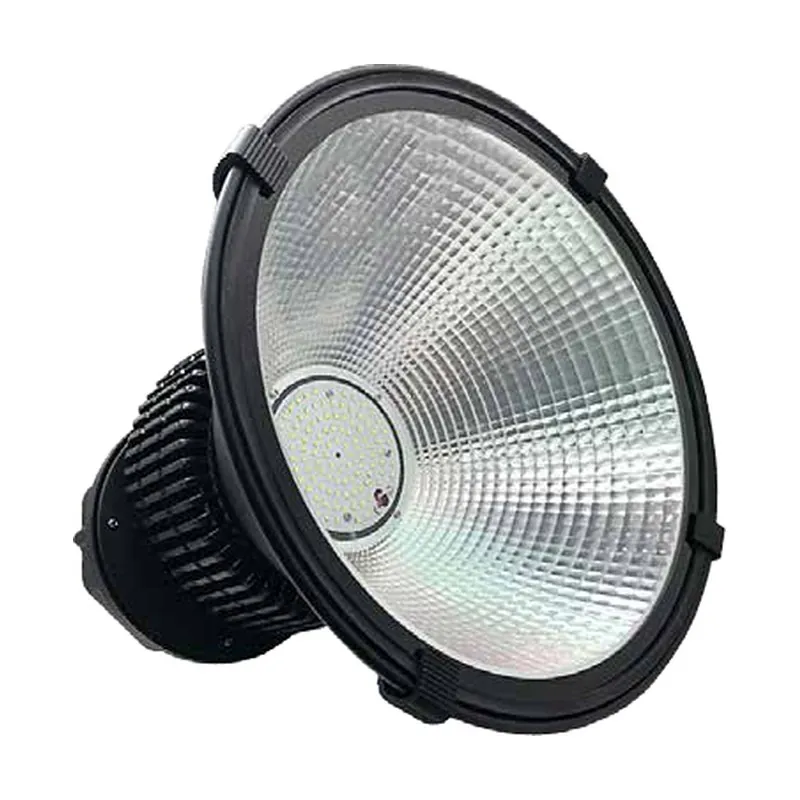
- Open-sided, dusty or damp barn: a sealed IP65 fixture with tempered glass, such as our fin heat-sink high bay or UFO high bay.
- Livestock barns: ammonia corrodes aluminium and copper; choose sealed fixtures with powder-coated housings and stainless fittings, and avoid mounting directly over manure areas.
Wiring and controls
- Circuits by zone (parking, work area, bench) so you light only what you use
- Daylight sensors near open doors and roof lights
- Motion sensors in storage areas that are visited briefly
- Surge protection if the barn is fed by a long overhead line
Common mistakes
- Too few, too bright. Four 300 W fixtures in a 12 × 24 m barn give glare and dark corners; 15–18 smaller fixtures give even light with the same or less power.
- No allowance for the bench. Measure mounting height above the work surface, not the floor.
- Ignoring dust and moisture. Open fixtures fill with dust and insects; specify IP65 where needed.
- No task light. For welding or fine work, add a local light at the bench rather than raising the whole barn to 500 lx.
For larger buildings, see how many LED high bay lights do I need and UFO vs linear high bays. Send us your barn dimensions and eaves height, and we will propose a layout.
Sources
Frequently asked questions
How many LED lights do I need for a 40 × 60 ft pole barn?
A 40 × 60 ft (about 12 × 18 m) barn with fixtures at about 5 m typically needs 9–12 wide-beam high bays of 70–100 W for 200 lx. The exact number comes from the spacing: keep fixtures no more than about 1.5 × the mounting height apart for wide beams.
What wattage LED high bay for a pole barn?
Usually 70–150 W per fixture at eaves heights of 4–6 m. Higher wattages force wider spacing than the beam can cover evenly, so more, smaller fixtures give better light.
Do pole barn lights need to be waterproof?
In open-sided, dusty or damp barns, choose IP65 fixtures. In fully enclosed, dry workshops IP44 is enough. Washdown areas and livestock barns need sealed fixtures with corrosion-resistant housings.